

.jpeg)
Do sole proprietors need a business bank account?
Not always legally but you’ll want one sooner than you think. You can technically run your business through a personal account. Many founders do in the early days. But things start breaking when:
- transactions increase
- expenses get mixed
- tax filing becomes unclear
- you need to show financial records
At that point, a sole proprietorship business bank account is no longer optional. It’s basic operational hygiene.
Once transactions start picking up, you need a clean way to separate business inflows and outflows, track expenses without guesswork, and keep records that actually hold up during tax filing or reviews. It also makes it easier to manage payments, spot inconsistencies, and avoid mixing personal and business activity.
Hence, sole proprietorship bank account requirements are one of the first things you’ll run into.
Sole proprietorship bank account requirements
All sole proprietorship business bank account requirements come down to three things:
- Are you a real, verifiable person?
- Does this business activity make sense and match what you’ve declared?
- Can the account be tied back to you for tax and compliance purposes?
Here’s the breakdown of the standardized formalities to open a sole proprietor business bank account.
Identity verification
You’ll need to prove you are the person behind the business. That usually means a government-issued ID like a passport or driver’s license. Banks are required to verify identity before opening any account, regardless of business type.
Tax identification (SSN vs EIN)
This is where sole proprietors are different. You can usually open a business checking account for sole proprietor setups using:
- SSN (most common)
- EIN (optional)
Because a sole proprietorship isn’t a separate legal entity, banks often accept your SSN as the primary tax ID. An EIN becomes useful if you:
- Hire employees
- Want to avoid sharing your SSN
- Plan to scale or separate finances later
But initially, SSN is enough to meet most sole proprietorship bank account requirements.
Business details (what you actually do)
Banks assess activity while opening a business account, be it a LLC, partnership or a sole proprietorship. You’ll typically need to provide:
- Business name (can be your own name)
- Business address (home or office)
- Type of business / industry
- Official start date or when operations began
This is how your sole proprietor business bank account requirements get tied to real-world activity, not just an application form.
DBA or trade name (if applicable)
This only applies if you operate under a different name.
If your business name is not the same as your personal name, as in most of the cases, you’ll usually need:
- DBA / trade name registration
Banks use this to confirm that the business name you’re using is legally linked to you. If you’re operating under your own name, you can skip this entirely.
Initial deposit
Some banks require a small opening deposit to activate the account. This can range from USD $5 to USD $100 depending on the bank.
Sole proprietorship bank account requirements: A checklist
Before you reach out to the bank to open a sole proprietorship account, make sure you have the following documents to avoid last-minute chaos.
- Government-issued ID (passport, driver’s license, etc.)
- Social Security Number (SSN) or EIN
- Business name (your name or registered name)
- Business address
- Business activity / industry details
- DBA or trade name registration (only if you’re not using your personal name)
- Initial deposit (varies by bank)
How to open a sole proprietorship bank account: Here’s a step-by-step guide
Opening a sole proprietorship bank account is straightforward. Here’s how it usually works in practice:
1. Choose the right account type
Start by deciding what kind of setup you actually need.
A basic business checking account for sole proprietor use cases is enough for most founders. But if you’re dealing with multiple currencies, online payments, or remote operations, a digital bank account for business or virtual business checking account might make more sense.
This decision affects fees, integrations, and how easily you can run day-to-day finances later.
2. Submit your identity and business details
This is where you provide the core information banks use to create your account. That includes:
- Your personal identity details
- SSN or EIN
- Business name and address
- Nature of your business
3. Complete verification checks
Once submitted, the bank verifies your identity and business activity. This can be instant for many online providers, especially if you’re trying to open a free business checking account online. In other cases, it may take a few days if manual review is involved.
If something doesn’t match, be it name, address, or business details, this is where delays usually happen.
4. Fund the account (if required)
Some banks require an initial deposit to activate your sole proprietorship business bank account. This is usually a small amount, but it depends on the provider. Digital-first banks sometimes skip this step entirely, while traditional banks may require it upfront.
5. Set up how you’ll actually use the account
Once your sole proprietor business bank account is active:
- Connect your payment tools
- Set up expense tracking
- Separate personal and business transactions
- Configure transfers, payouts, or invoicing flows
Choosing the right business checking account for sole proprietors
Say you’re running a solo consulting business. Client payments come into your account. You pay for tools, contractors, and subscriptions from the same place. At the end of the month, you need to know what you actually earned, what you spent, and what you owe.
If that’s all mixed into a personal account, you’re manually sorting transactions, second-guessing numbers, and losing visibility.
With a business checking account for sole proprietor use, that separation is built in. Your inflows, outflows, and balances reflect the business, not everything else happening in your life.
Here, the question shifts from “Do sole proprietors need a business bank account?” to “What should that account actually help me do?”
Types of sole proprietorship bank accounts
Not all accounts are built the same. What works depends on how you actually run your business.
[Table:1]
Here’s what to look for in a business bank account for sole proprietor:
- Clean separation of transactions: Your sole proprietorship business bank account should make it obvious what’s business and what’s not. If you still need spreadsheets to figure that out, something is off.
- Low or predictable fees: If you’re trying to open a free business checking account online, check what “free” actually covers, such as, monthly fees, transaction limits, transfers, and withdrawals.
- Strong digital access: A digital bank account for business or virtual business checking account should let you move money, track activity, and manage operations without relying on branch visits.
- Payment compatibility: Make sure it works smoothly with how you get paid — transfers, payment processors, or client invoices.
- Basic expense visibility: You don’t need full accounting software here. But you should be able to quickly see where money is going without digging.
- Scalability: What works at 5 transactions a month should still work at 200. Many founders outgrow their first account faster than expected.
Founders’ insight: If most of your money already moves online, sticking with a branch-dependent setup usually adds friction you don’t need. A virtual business checking account tends to work better once transactions increase, payments come from multiple sources, or you’re managing things remotely.
Best free online business checking accounts for sole proprietors
The right business checking account for sole proprietor use depends on how you operate across payments, expenses, and how fast things are moving.
Here are five commonly used options founders consider:
[Table:2]
Aspire
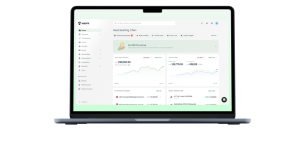
Aspire1 goes beyond the conventional advantages of a digital bank account for business. It’s built for founders who want to manage money and operations in one place. You get multi-currency accounts, expense controls, corporate cards, and global payments in a single setup.
It works well if you’re dealing with cross-border payments, team spend, or growing transaction volume. Instead of stitching tools together, you can track spend, control payouts, and move money globally from one dashboard. Moreover, it supports integrations with your accounting tools like Quickbooks and Zoho, keeping your finance stack structured.
Novo
Novo as a business checking account for sole proprietors use keeps things straightforward. No monthly fees, no minimum balance, and clean integrations with tools like Stripe and Shopify. It’s built for freelancers and small businesses that want simple cash flow without complexity.
Bluevine
Bluevine offers a digital bank account for business with interest on balances and no monthly fees. It also supports multiple sub-accounts and unlimited transactions. It’s more relevant if your business holds cash rather than moving it constantly.
Relay
Relay focuses on structuring money across multiple accounts. You can create separate accounts for taxes, expenses, or profit and automate transfers between them. It also offers multiple debit cards with spending limits, which helps if you’re managing different expense categories.
Mercury
Mercury is a virtual business checking account designed for tech startups. It offers no monthly fees, strong integrations, and developer-friendly tools. But it’s worth noting: it typically supports corporations and LLCs, not sole proprietors, which makes it less relevant for this setup.
Common mistakes to avoid after opening a sole proprietorship bank account
Most issues don’t come from meeting the sole proprietorship bank account requirements. They come from how it’s set up and used after.
Here are the ones that show up most often:
Opening the account, but not separating usage: Some founders open a sole proprietor business bank account and still route certain payments or expenses through personal accounts. That defeats the purpose. The separation only works if everything runs through it.
Ignoring how money actually moves: If your business checking account for sole proprietor use doesn’t match how you get paid or how you spend, friction builds fast. Delays, failed transfers, or manual workarounds start creeping in.
Not planning for scale early: What works at 10 transactions a month breaks at 200. Many founders switch accounts later because the first setup didn’t support growth.
Overlooking digital capabilities: A digital bank account for business or virtual business checking account should reduce manual work. If you’re still relying on spreadsheets to track spend or reconcile transactions, the setup is not doing its job.
Conclusion
Most founders don’t realize this early on, but the account you choose quietly shapes how the business grows.
Your sole proprietorship bank account requirements may be simple. But the way money flows through that account affects how easily you can track revenue, plan expenses, and make decisions as things scale.
A good business checking account for sole proprietor use gives you a clear financial baseline. You know what came in, what went out, and what’s actually available to reinvest in the business.
That clarity compounds over time resulting in smarter decisions and finance overheads.


.jpeg)