



What is an E-Wallet? How Hong Kong Actually Regulates Digital Payments
An e-wallet is a digital payment tool stored on your phone that lets you pay, transfer money, and top up funds without carrying cash or a physical card. That part everyone already knows. What matters more is how Hong Kong's regulator classifies the app sitting on your home screen, because that classification determines whether your money is protected, and whether the platform even needs a licence to operate.
Under the Payment Systems and Stored Value Facilities Ordinance (Cap. 584), the HKMA licenses and supervises any platform that qualifies as a Stored Value Facility. An SVF is a tool where you can pre-load and hold monetary value, then spend it or send it to someone else. An e-wallet is simply the non-physical, app-based version of this: the same regulatory category also covers physical prepaid cards.
Digital payment adoption in Hong Kong has already crossed a tipping point. FPS alone had accumulated roughly 14.95 million registered users by July 2024, a figure that covers close to the entire working-age population of the city. Separate industry research puts Hong Kong e-wallet usage at nearly 88% of residents paying in-store with a mobile wallet at least once in the past year. Digital payment is no longer the alternative option. For most people under 40, it is the default.
Stored Value Facilities (SVF): Licensed and Fund-Protected
An SVF is any e-wallet or prepaid card where the operator holds a real, spendable balance of your money. Because these platforms are custodians of consumer funds, not just payment interfaces, the HKMA requires them to hold a licence before they can legally launch. Licensed operators must demonstrate financial soundness, maintain proper risk management, and safeguard customer funds under ongoing regulatory supervision. That licensing requirement is the single biggest reason SVF wallets feel trustworthy enough for millions of people to keep real cash balances sitting inside them.
Hong Kong's five major licensed SVF wallets each dominate a slightly different niche:
- Octopus: Run by Octopus Cards Limited, this is Hong Kong's oldest and most entrenched stored value tool. It works as both a physical card and a mobile app (compatible with Apple Wallet and Google Wallet), and it remains the default standard for public transport, retail, and food and beverage payments across the city.
- AlipayHK: Operated by Alipay Payment Services (HK) Limited, a joint venture between Ant Group and CK Hutchison, this is the Hong Kong-localised version of Alipay. It covers local retail, personal transfers, and cross-border spending into the Greater Bay Area, with a local active user base above 4 million and steadily rising merchant acceptance.
- WeChat Pay HK: Operated by WeChat Pay Hong Kong Limited, Tencent's local arm of its mainland super-app. It focuses on local consumption while interoperating with mainland WeChat Pay, and by late 2023 it had extended coverage to all mainland cities, putting millions of merchants within reach of HKD-denominated payment.
- PayMe (HSBC): Run by HSBC, PayMe is built around instant peer-to-peer transfers rather than merchant checkout. With over 3 million users, it is the default way young Hong Kongers split bills, and it also supports merchant QR collection through a separate business product.
- Tap & Go: Operated by HKT Payment Limited, this wallet layers FPS transfer support with global Mastercard acceptance, making it one of the few local wallets that doubles as an international spending tool.
Non-SVF Wallets: Tokenised, No Stored Balance
The second category works entirely differently. Non-SVF wallets never hold a balance of your money at all. Instead, they act as a secure pass-through: every time you pay, the wallet authorises a transaction directly against your linked bank card or credit card, using tokenisation to swap your real card number for a device-specific, single-use code. Nothing is stored, nothing sits idle waiting to be spent, and no separate SVF licence is required because the wallet is never actually holding your funds.
The three tools Hong Kong users interact with most under this model are:
- Apple Pay: Links a credit or debit card to an iPhone, Apple Watch, or other Apple device, then authorises payment through NFC. From late 2025, Apple extended this further with a merchant-side "Tap to Pay" feature, letting an iPhone XS or newer act as a standalone payment terminal without any additional hardware.
- Google Pay (Google Wallet): The Android equivalent, using the same NFC and tokenisation approach, compatible with cards issued by Hong Kong's major banks.
- Samsung Pay: A Samsung-specific NFC payment tool for Galaxy device owners who have already linked a bank card.
These non-SVF tools are gaining ground quickly because merchant acceptance only requires a contactless terminal, checkout is fast, and there is no stored-value risk sitting inside the app.
Hong Kong's Main E-Wallets Compared: Fees, Coverage, and Top-Up Costs
Once you understand the regulatory split, the practical question becomes: what does each wallet actually cost to use, and where does it work? Fee structures vary meaningfully by platform, and the numbers below reflect officially published rates, which can shift by merchant type and partner agreement.
[Table:1]
E-Wallet vs Credit Card: Which Wins in 4 Everyday Scenarios
E-wallets and credit cards are Hong Kong's two dominant payment tools, and neither one wins outright. The better question is which scenario you're in, because fees, protection, rewards, and convenience each point in a different direction depending on what you're buying and where.
Fees: Where Each One Actually Costs You
[Table:2]
E-wallets clearly win on personal transfers and everyday small spending. A credit card's real costs come from foreign transaction fees and overdraft interest, both of which mainly hit users who spend in foreign currency or occasionally dip into their credit limit.
Purchase Protection: Why Cards Still Win for Big-Ticket Spend
For consumer protection, credit cards are the clear winner. Cards issued through international schemes like Visa and Mastercard come with a formal chargeback mechanism. If a merchant fails to deliver, the product never arrives, the service is materially different from what was promised, or the business simply shuts down, the cardholder can file a dispute with the issuing bank. Qualifying claims have a genuinely strong chance of a refund, even when the merchant refuses to cooperate.
E-wallets offer far less structured recourse. AlipayHK and WeChat Pay HK maintain customer service channels, but the scope and consistency of protection rarely matches what a card issuer offers. For higher-value online purchases or advance payments for services, a credit card is the safer default.
Beyond disputes, credit cards also hold a clear lead on rewards and cashback, because points and miles accumulate automatically on every swipe, compounding into predictable long-term value redeemable for flights, vouchers, or cash. E-wallet promotions tend to be one-off or seasonal, tied to specific merchants or festive campaigns. Some can beat a card's standard rebate rate for a limited window, but they don't compound the way a card's ongoing rewards program does. A common Hong Kong workaround is linking a credit card directly to AlipayHK or WeChat Pay HK, stacking the card's base rewards on top of the wallet's short-term promotions.
Where e-wallets take the lead decisively is everyday convenience. Scanning a QR code takes seconds, with no card to dig out, no PIN, no signature. That matters most for small transactions under roughly HK$50, and it matters even more at Hong Kong's many wet markets, snack stalls that either don't accept cards at all, or only above a minimum spend. AlipayHK, WeChat Pay HK, and PayMe are near-universally accepted at these smaller businesses, while cards frequently aren't.
[Table:3]
Which E-Wallet Should You Actually Use?
There's no single "best" e-wallet in Hong Kong. The right choice depends entirely on what you're doing day to day, so here's a use-case breakdown with the fastest path to getting set up.
Daily transit: the Octopus App. Octopus remains the standard for the MTR, buses, minibuses, ferries, and a portion of taxis. Beyond the physical card, the Octopus App turns your phone into a substitute, with NFC tap-in support and auto-reload so you never get stuck with an empty balance at the gate. To set it up: download the Octopus app from the App Store or Google Play, register with your phone number or email, link a credit card or bank account for top-ups, then tap in on any NFC-supported iPhone (iOS 13 or later) or Android device. This suits anyone commuting daily on public transport who would rather not carry a separate physical card.
Everyday retail and discounts: AlipayHK. Merchant acceptance keeps climbing across supermarkets, restaurants, retail chains, and online platforms, and the platform regularly runs time-limited promotions, from consumption vouchers to first-use discounts, that reward users who actively hunt for deals. AlipayHK also supports cross-border spending into the Greater Bay Area and more than 100 countries and regions. Best suited to people who shop frequently at chain retailers, chase coupon promotions, or travel north into the mainland regularly.
Splitting bills and P2P transfers: PayMe. Run by HSBC but usable regardless of which bank you hold, PayMe's core strength is instant, free personal transfers, making it Hong Kong's go-to tool for splitting a dinner bill, a trip, or shared household costs. Businesses that want to accept PayMe should never use the personal version. Set up PayMe for Business instead. Ideal for younger users who regularly settle shared expenses with friends and want transfers to land instantly.
Greater Bay Area and cross-border spending: AlipayHK or WeChat Pay HK. Planning a trip to Shenzhen, Guangzhou, or elsewhere in the Greater Bay Area? Both platforms interoperate directly with their mainland counterparts, letting you scan and pay at mainland merchants without exchanging currency manually. AlipayHK reaches over 100 countries and regions, while WeChat Pay HK plugs straight into Tencent's vast mainland ecosystem, useful across supermarkets, restaurants, and taxis. If you're weighing broader cross-border payment methods for regular travel or business, it's worth comparing options like cross-border FPS alongside these wallets.
Accepting E-Wallets as a Business: Why FPS Is Your Lowest-Cost Collection Channel
Everything above covers e-wallets from a consumer's chair. For Hong Kong SME owners, founders, and finance leads, the calculation looks completely different. Getting payment collection right isn't just about convenience anymore. It directly shapes your cost base, your cash flow speed, and how smooth the checkout experience feels to your customers.
Why FPS Beats E-Wallet and Card Fees for Local Collection
FPS (Faster Payment System) is the real-time payment rail the HKMA launched in 2018, operated by the Hong Kong Interbank Clearing Limited (HKICL). It lets both individuals and businesses send and receive money instantly using nothing more than a phone number, email address, or FPS ID.
Here's the number that matters most for a business owner: FPS itself charges merchants nothing. Any fee you encounter comes from your bank or your stored value provider layering their own service charge on top, and that pricing varies significantly by institution. Many banks give business customers a monthly allowance of fee-free FPS transactions before a small flat charge kicks in above that threshold. Compare that to typical credit card MDR, which runs roughly 1% to 3% per transaction, or e-wallet MDR sitting around 1.2% to 1.5% once introductory waivers expire, and FPS comes out as one of the cheapest local collection channels available in Hong Kong today.
FPS also solves a structural problem that e-wallets and cards don't: it works as a universal bridge across every bank in the city. A customer doesn't need to bank with the same institution as your business. As long as both sides have FPS enabled, the transfer lands, typically within seconds, without needing a shared bank relationship. For a deeper walkthrough of getting this running end to end, see our guide to setting up business FPS.
The Personal PayMe Risk Businesses Keep Making
One mistake shows up constantly among small Hong Kong businesses: collecting customer payments through a personal PayMe account instead of the proper business product. Personal PayMe is designed for peer-to-peer transfers between friends, and it comes with transaction limits and automated risk monitoring built for that use case. Route steady commercial income through it, and you're very likely to trip the platform's fraud controls, which can freeze the account or hold funds while the provider investigates.
There's a second cost that's easy to overlook: blending personal and business money inside the same wallet makes bookkeeping, tax filing, and financial reporting genuinely harder, and it directly violates PayMe's own terms of service for commercial use. If you're weighing whether to keep running transactions through a personal account, our breakdown of the risks of using a personal account for business covers exactly what tends to go wrong, and why. The fix is straightforward: open a proper business account, then apply for PayMe for Business through it.
Deciding which e-wallets and payment methods to support beyond FPS comes down to a few practical questions worth answering before you commit to any integration:
- Who is your customer? Local residents lean toward PayMe and FPS. Mainland visitors default to WeChat Pay and Alipay. International business clients tend to reach for Apple Pay or a credit card. Map your actual customer base first, so you're not stretching your integration budget to cover a payment method almost nobody in your market actually uses.
- What's the typical transaction size? Small retail and F&B transactions suit e-wallets well, since they're instant and carry low fees. Larger business-to-business transactions are usually better served by FPS or a full payment service provider setup, or by comparing broader payment methods in Hong Kong built for higher-value transfers.
- What does your industry actually need? Retail, food, and beverage businesses benefit most from instant QR or tap payments at the counter. Ecommerce and service businesses need a multi-wallet payment gateway integrated directly into checkout to keep the funnel smooth, whether through Stripe or PayPal. Tourism and hospitality businesses need to support both WeChat Pay and AlipayHK to capture mainland visitor spend.
- How much integration cost and effort can you absorb? Physical stores can adopt Hong Kong's common QR code standard, letting a single code accept multiple e-wallets and bank apps at once. Mobile and service-based businesses should look at POS terminal options and mobile checkout tools that flex to match how the business actually operates day to day.
Getting the collection layer right also means thinking beyond the point of sale. Reliable online payment acceptance and proper online payment security protect both your revenue and your customer's trust, while clean proof of payment records and organised invoice payment workflows keep your books reconciled without manual chasing at month end. And if a meaningful share of your revenue comes from overseas clients rather than local wallets, it's worth reviewing the full range of types of B2B payment methods and top international trade payment methods so your collection strategy covers both local and cross-border revenue, not just one side of the business.
Beyond Banking: Scaling Your HK Business with Aspire's All-in-One Finance OS
Aspire provides a one-stop solution for Hong Kong enterprises, perfectly integrating global transfers, expense management, and accounting automation into a single platform. With just one Aspire business account, you can fully control your corporate finances:
- Global Payment: Fully digital account opening with approval as fast as the same day. Supports 130+ countries and 40+ currencies, with FX spreads as low as 0.18% (costs are up to 3x lower than banks).
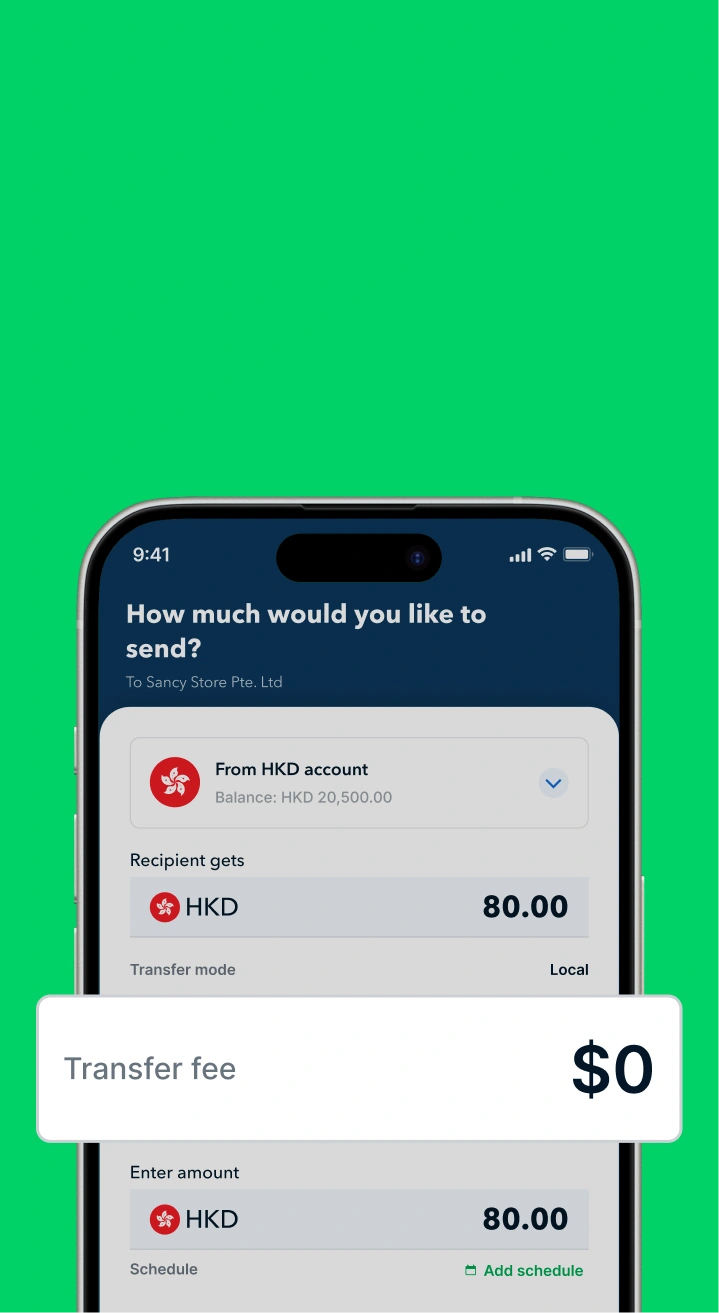
- Transfer Network: In addition to built-in FPS (Free) and CHATS to ensure local payments and payroll arrive on time, Aspire features a powerful local transfer network, allowing you to directly receive and send money overseas like a local. Compared to traditional SWIFT wire transfers, local transfers eliminate layers of intermediary bank fees and significantly shorten arrival times, helping you save on transfer expenses at the source.
- Spending Control: From Invoicing to paying Bills, the process is fully automated. You can instantly issue controllable corporate cards and pair them with "snap-and-claim" features to automatically categorize employee expenses. All transaction data syncs seamlessly with Xero, QuickBooks, and NetSuite, solving all administrative pain points from payroll to reconciliation on one platform.
- Operational Rewards: Turn your spending into returns! Earn 1.2% unlimited cashback on major business expenses, e.g. marketing and SaaS subscriptions. Your account also comes with over USD 500,000 in business rewards, covering tools like Google Workspace and Slack, rebating your operating costs from the start.
Open an account for free now to experience a smarter, more flexible business financial solution and accelerate your business growth!
FAQ
Are e-wallets safe and regulated in Hong Kong?
Yes, licensed e-wallets in Hong Kong are regulated by the HKMA under the Payment Systems and Stored Value Facilities Ordinance, and operators must implement security measures to protect user funds and personal data. Using a licensed e-wallet in Hong Kong is genuinely safe under this framework.
That said, users still need to stay alert on the everyday basics: watch for phishing messages, avoid logging in over public Wi-Fi, set a strong password or enable biometric authentication, and check your transaction history regularly. If you spot a suspicious transaction, contact your e-wallet's customer service immediately.
Can I use Mainland Alipay or WeChat Pay in Hong Kong?
Yes, but with conditions. You can use mainland Alipay or WeChat Pay at Hong Kong merchants that specifically support Alipay+ or the mainland version of WeChat Pay. However, many of Hong Kong's smaller neighbourhood businesses don't support these mainland versions, and acceptance falls well short of AlipayHK or WeChat Pay HK. For everyday spending in Hong Kong, sticking with the local wallet versions or FPS gives you far more reliable coverage.
Can my business collect payments through a personal PayMe account?
No, and doing so carries real risk. Personal PayMe is built for peer-to-peer transfers between friends and comes with transaction limits and automated risk monitoring. Using it for commercial collection tends to trigger the platform's fraud controls, which can freeze the account or hold funds, and it also breaches PayMe's own terms of service while muddying personal and business finances together. Weigh up the risks first, then open a proper business checking account and apply for PayMe for Business through it instead.
Do e-wallets charge foreign transaction fees?
Most local Hong Kong e-wallets, including AlipayHK and WeChat Pay HK, don't charge a separate foreign transaction fee on cross-border spending into supported regions like the mainland. This is a genuine advantage over many credit cards, some of which charge up to 1.95% on foreign currency transactions. Always check the specific wallet's current fee schedule before travelling, since terms can change.



.webp)