



Step 1: Know What You're Building
Most founders ask the wrong first question. They ask: "How do I register a company?" The right question is: "What business am I building and what gives me a genuine competitive advantage in it?"
Getting that answer clear before you touch any paperwork will save you months of wasted effort.
The Main Business Types in Hong Kong
Hong Kong's startup ecosystem is diverse. The major business categories each carry different startup costs, compliance profiles, and cash flow rhythms:
- Product-based businesses: You manufacture, source, or curate physical goods and sell them through e-commerce or retail channels. Think cross-border e-commerce, local consumer brands, or import/export trading. These businesses typically require more upfront capital for inventory.
- Service-based businesses: You sell time, expertise, or professional skill. Consultancy, design, education, legal, and accounting firms all fall here. Lower startup costs, but revenue is tied to your own capacity.
- Technology / SaaS businesses: You build software or platforms and charge on a subscription or usage basis. High development costs upfront, but the scaling potential is unmatched.
- Agency or intermediary businesses: You connect buyers and sellers and earn a commission or referral fee. Insurance agencies, property agents, and trade brokers operate this way.
- Content or media businesses: You build an audience and monetize through advertising, sponsorships, or paid subscriptions.
Each model has a completely different capital requirement and cash flow pattern. A product business might burn significant cash before its first sale. A service business can be cash-flow positive in its first month. Understanding this upfront shapes every decision that follows from how much runway you need to what kind of bank account makes sense.
3 Honest Questions Before You Register Anything
Before you spend a cent on registration, company secretaries, or branding, answer these honestly:
- What is your real competitive advantage?
Is it technical expertise, a proprietary supplier relationship, a cost structure that undercuts existing providers, or deep knowledge of an underserved market? "I'll provide better service" is not a competitive advantage, every competitor says that.
- Do your target customers already want this or do you need to educate them first?
Selling into existing demand is fundamentally different from creating new demand. The latter takes longer and costs more.
- Can this business generate enough revenue to cover its basic costs within 12 months?
If the answer is no, you need to either revisit the model or have a clear plan for how you'll fund the gap.
If you're still working through the "what to build" question, it's worth spending time on what business to start in Hong Kong before moving to any registration steps. Rushing into a structure before you have clarity on the business itself is one of the most common and costly mistakes first-time founders make.
Step 2: Choose the Right Legal Structure
Once you know what you're building, you need to decide how to structure it legally. In Hong Kong, the two most common choices for early-stage founders are a Private Limited Company and a Sole Proprietorship. The differences are significant.
Private Limited Company vs. Sole Proprietorship
[Table:1]
The private limited company is the structure of choice for most serious founders, and for good reason. Limited liability means that if the business incurs debts or faces legal action, your personal savings, property, and other assets are not on the line as long as you haven't acted fraudulently or recklessly as a director. That protection matters enormously once you're signing supplier contracts, taking client deposits, or hiring employees.
The tax difference between the two structures is small. A limited company pays 8.25% on its first HK$2 million in profits, versus 7.5% for a sole proprietor. Beyond HK$2 million, both face a higher rate (16.5% for companies, 15% for individuals). For most early-stage businesses, this differential is marginal and the liability protection that comes with incorporation is worth far more.
The sole proprietorship makes sense in specific situations: if you're testing a low-risk service business with minimal contractual exposure, want to keep compliance costs near zero in year one, or aren't yet sure whether the business will gain traction. You can always convert later, but converting a sole prop into a limited company requires re-registering everything, including your bank account.
For a full breakdown of all entity types available in Hong Kong including partnerships, branch offices, and representative offices see this comparison of Hong Kong business entities.
Step 3: Get Your Business Registration Certificate (BR)
Here's something that trips up a surprising number of first-time founders: registering a company and registering a business are two separate things.
When you incorporate a private limited company with the Companies Registry, that gives you a Certificate of Incorporation (CI). What it doesn't automatically give you is a Business Registration Certificate (BR). You need to apply for that separately with the Inland Revenue Department (IRD). Both steps are required before you can legally operate.
Under Hong Kong's Business Registration Ordinance (Cap. 310), any person or entity conducting business in Hong Kong must obtain a BR within one month of commencing operations. Operating without one is a criminal offence.
What the BR Application Involves
Key details (2026):
[Table:2]
The good news: if you're incorporating a new company, Hong Kong's Companies Registry offers a one-stop service. Submit your company incorporation application, and the Registry automatically forwards the relevant information to the IRD. You receive both the Certificate of Incorporation and the Business Registration Certificate in a single process.
Once you have your BR, you can legally sign contracts, open a business bank account, apply for business loans, and tender for government or enterprise contracts. The BR must be renewed every one or three years, missing the renewal deadline is a criminal offence carrying fines of up to HK$5,000 and potential imprisonment. Set a calendar reminder on the day you receive it.
For Hong Kong company formation costs including government fees, company secretary costs, and registered address requirements, the total year-one investment typically ranges from HK$8,000 to HK$12,000 for a properly set-up limited company. Make sure any quote you receive includes the mandatory company secretary and registered office address, as some providers advertise low "registration fees" that exclude these statutory requirements.
Every Hong Kong limited company must also maintain a registered office address, this must be a physical Hong Kong address (not a P.O. box), though a virtual office service qualifies. And it must appoint a company secretary, who must be a natural person residing in Hong Kong or a Hong Kong-incorporated corporate body.
Step 4: Build Your Market Entry
Getting your BR in hand is a milestone, but it doesn't mean you have a business yet. It means you have a legal container for one. The real work starts now: turning a registered company into a customer-generating, revenue-producing operation.
3 things need to get right, in order.
Define Your Positioning (Not Your Mission Statement)
Positioning is not about your vision or values. It's about answering a specific question in the mind of your target customer: "Why should I choose you instead of the alternatives?"
If your answer is something like "we're more customer-focused" or "we really care about quality," that's not positioning that's noise. Every competitor says the same thing.
Good positioning is specific and falsifiable. Examples that work: "We're the only accounting firm in Hong Kong that specialises exclusively in e-commerce brands and integrates with Shopify from day one." Or: "Our pricing is 30% below comparable providers because we operate a fully remote model with zero office overhead." A clear positioning statement tells your sales team what to say, tells your marketing team what to emphasise, and tells you which clients to decline.
Without clear positioning, every dollar you spend on marketing is effectively market research. With it, every campaign has a defined target and a measurable return.
Price It Right From Day One
The most common pricing mistake early-stage founders make is pricing too low. The instinct makes emotional sense: "If I charge less, more people will buy." In practice, this creates two problems simultaneously.
- Your margins are too thin to survive.
- Low prices often signal low quality in markets where the buyer has no other reference point.
Start with your cost structure. Calculate what it costs you to deliver one unit of service or product including your own time, priced honestly at market rate. Add a margin that actually sustains the business. Then compare your number to what the market charges and ask: if you're priced higher, what specifically justifies the premium? If you're priced lower, is that sustainable and does it attract the type of customer you actually want?
For a deeper look at go-to-market frameworks and how to build a go-to-market strategy, there are proven models that can structure how you approach pricing, channels, and customer acquisition together.
Where Your First Customers Will Come From
For most early-stage businesses, the first customers don't come from advertising. They come from the founder's personal and professional network. This is almost universal and it's not a weakness, it's a feature.
Think carefully about who in your existing network could be a potential customer, a warm referral, or a connector to the right decision-maker. Before you invest in any marketing channel, exhaust this source first.
After the founder network, the right next channel depends on your business type:
- B2B businesses: LinkedIn, targeted cold email, and industry events or meetups are usually the most cost-efficient early channels in Hong Kong.
- B2C businesses: Instagram and Xiaohongshu (小紅書) have the strongest organic traction for consumer products and lifestyle brands in the HK market.
- E-commerce businesses: Platform-specific strategies, setting up on Shopify, Amazon Seller Central, or Taobao, each have their own playbooks.
The goal for your first 30 to 90 days is not scale. It's 5 to 10 customers who give you genuine, honest feedback. That feedback is more valuable than any market research report.
Step 5: Do You Need to Raise Money? How to Pitch Investors
Not every business needs external funding. Service businesses can often become cash-flow positive from their first invoice. Product and technology businesses are different, they typically require capital to build the product, stock inventory, or acquire initial users before revenue arrives.
If your business falls in the second category, fundraising is not a question of if but when.
The Pitch Deck: Your First Investor Touchpoint
Every investor conversation starts with a Pitch Deck, a concise presentation of 10 to 15 slides that communicates why your business deserves capital. Investors see dozens of decks a week. The ones that get a second meeting are the ones that answer two questions with complete clarity: "How real is this problem?" and "Why is this team the right one to solve it?"
A strong Pitch Deck covers:
[Table:3]
The "Ask" slide is one of the most commonly botched. Investors don't want to hear "we're raising HK$2 million." They want to hear: "We're raising HK$2 million to hire two senior engineers and reach 500 paying customers within 18 months, which positions us for a Series A." The specificity demonstrates that you've actually thought about what the money does, not just that you want it.
Funding Sources Available to Hong Kong Founders
Hong Kong's startup funding ecosystem has matured significantly. The main channels are:
- Angel investors: Best suited for pre-seed and seed rounds, typically ranging from HK$500,000 to HK$5 million. Angel investors are usually high-net-worth individuals with operating or investment experience. They back founders as much as ideas, so the personal relationship matters.
- Incubators and accelerators: Programmes like Cyberport Incubation Programme and HKSTP Incubation Programme offer more than just funding, they provide office space, mentorship, regulatory guidance, and access to networks. See Hong Kong startup incubators for a current overview of what's available.
- Government grants: The Hong Kong government operates several funding schemes specifically designed for SMEs and startups. The BUD Specific Fund (maximum HK$7 million) supports market expansion. The Innovation and Technology Fund (ITF) backs technology development projects. Eligibility criteria and application requirements vary significantly check with the relevant administering body before investing time in applications.
- Venture capital: VC funding is typically relevant from Series A onwards, when a business has demonstrable traction, a scalable model, and a clear path to significant revenue. For earlier-stage founders, understanding how to secure VC funding is valuable as future preparation even if it's not the immediate priority.
- SME funding in Hong Kong: Various bank loan schemes and government-backed lending programmes are available for established SMEs. These aren't suitable for pre-revenue startups, but they become relevant as the business matures.
For a broader look at all Hong Kong startup funding options including eligibility criteria and how to approach each type of investor, there are dedicated resources worth reviewing before you start your fundraising process.
Step 6: Open a Business Bank Account
Your company is registered. Your BR is in hand. The next critical practical step: getting a business bank account up and running.
This is where many Hong Kong founders, especially those launching remotely or without an existing banking relationship hit their first serious wall.
The Reality of Traditional Bank Onboarding in Hong Kong
Hong Kong's major traditional banks: HSBC, Hang Seng, Standard Chartered, Bank of China are globally respected institutions with rigorous compliance standards. Under HKMA guidelines, all banks are required to conduct thorough Customer Due Diligence (CDD) on new business account applicants. In practice, this means:
- Documentation requirements: Beyond the standard company documents (CI, BR, Articles of Association), you'll typically need a business plan, proof of business activity (contracts, invoices, supplier agreements), and identification documents for all directors and Ultimate Beneficial Owners (UBOs).
- Timeline: Best case, two weeks. More commonly, four to eight weeks. For businesses with complex ownership structures, international directors, or unusual business models, the process can stretch to three months or result in a declined application.
- Business substance requirements: Banks want to see evidence that your company does something real. A freshly incorporated shell with no contracts, no clients, and no transaction history is a high-risk application from the bank's perspective.
- In-person requirements: Many banks still require at least one director to appear in person at a branch. For internationally-based founders, this adds significant friction.
For a detailed guide on how to open a business bank account in Hong Kong including what documents each major bank requires and how to prepare a strong application see the full walkthrough. If you want to compare specific institutions, the best banks in Hong Kong for business accounts guide covers the main options.
There's also a practical case for opening a business bank account online. Some providers make this possible from anywhere in the world.
Why More Hong Kong Founders Are Choosing Digital Business Accounts
The frictions of traditional banking have accelerated a structural shift toward digital banking in Hong Kong. Digital-first business accounts offer approval timelines measured in hours rather than months and the fee structures are often dramatically different.
Here's a direct comparison that illustrates why the cost difference is real:
[Table:4]
To put the FPS fee difference in concrete terms: if your business receives 20 inbound FPS transfers per month averaging HK$10,000 each, and your bank charges 0.3% per receipt, that's HK$7,200 per year in fees on transfers alone. For a startup watching every dollar of runway, that's not a small number.
For a structured comparison of account types and providers, see top SME banking options in Hong Kong. If you want to understand whether you should maintain multiple accounts one at a traditional bank and one digital, the how to choose a business account guide covers the tradeoffs.
One principle that applies regardless of which account you choose: never mix personal and business finances. The risks of using a personal account for business including audit complications, tax exposure, and optics with investors far outweigh any short-term convenience.
The documents required to open a business bank account in Hong Kong vary by institution, but you'll typically need your CI, BR, Articles of Association, director ID, and some form of evidence of business purpose.
Step 7: Post-Incorporation Compliance
Many founders put so much energy into launching the business that they don't think about what comes after incorporation. Then, 12 months in, they get hit with late filing notices, audit surprises, and compliance penalties that were entirely avoidable.
Here are the four obligations that every Hong Kong limited company must manage on an ongoing basis.
Annual Return (NAR1) Filing
Every Hong Kong limited company must file an Annual Return (Form NAR1) with the Companies Registry within 42 days of its company anniversary date. The filing captures a snapshot of the company's registered details: directors, shareholders, share capital, and registered address.
The penalties for late filing are tiered:
[Table:5]
This is a simple annual filing that costs almost nothing when done on time and becomes surprisingly expensive when forgotten. Most founders delegate it to their company secretary. For a detailed walkthrough of how to complete and file the NAR1, see the dedicated guide.
Annual Audit and Profits Tax Return
Every Hong Kong limited company regardless of whether it has revenue must have its financial statements audited annually by a Certified Public Accountant (CPA) registered in Hong Kong. The audited accounts are then used to prepare the company's Profits Tax Return, filed with the IRD.
Hong Kong's corporate tax rate uses a two-tier system: 8.25% on the first HK$2 million of assessable profits, and 16.5% on everything above that. There are no additional dividend taxes, no capital gains tax, and no VAT or GST, making Hong Kong's tax regime genuinely one of the world's most competitive.
The practical risk here: audit fees rise sharply when your bookkeeping is a mess. Companies that track expenses in real time and maintain clean records typically pay 40% to 60% less for their annual audit than companies that hand their accountant a pile of receipts in month 11. Tools like Xero or QuickBooks Online, both of which sync natively with Aspire make this substantially easier. A proper bookkeeping and accounting discipline from day one pays for itself many times over.
Renewing Your Business Registration Certificate
Your BR must be renewed every one or three years. The IRD will send a written renewal notice before the expiry date but not receiving the notice doesn't remove your legal obligation to renew. Failure to renew is a criminal offence carrying fines of up to HK$5,000 and up to one year's imprisonment.
The current fee for a one-year renewal is HK$2,350 (effective April 2026). Three-year renewals cost HK$6,020. Set a recurring calendar reminder well before expiry or ask your company secretary to manage it.
Mandatory Provident Fund (MPF): Employer Obligations
The moment you hire your first employee, including part-time workers earning more than HK$7,100 per month, MPF obligations kick in.
Key rules:
- You must enrol the employee in an MPF scheme within 60 days of their start date.
- Both employer and employee each contribute 5% of relevant income, capped at HK$1,500 per month each (the cap applies at a monthly income of HK$30,000).
- Employees earning less than HK$7,100 per month are exempt from their own contributions, but the employer's contribution is still required.
- Late or missing contributions trigger penalties and potential prosecution.
For a comprehensive guide to managing payroll in Hong Kong including MPF, salaries tax obligations, and how to structure payroll efficiently, there's a detailed resource worth reading before you make your first hire.
Step 8: Licences and Trademark Registration
Two things that many founders address too late and sometimes never. Getting these right early prevents expensive scrambles later.
Does Your Business Need a Licence?
A Business Registration Certificate confirms that your business is registered with the IRD for tax purposes. It does not authorise you to operate in a regulated industry. Many business activities in Hong Kong require a specific licence from the relevant government authority and operating without one can result in fines, forced closures, or criminal charges.
The most common regulated industries and their licensing requirements:
[Table:6]
Important note on timing: food business licences, for example, typically take 4 to 8 weeks from application to approval and require on-site inspections for environmental hygiene and fire safety. If you sign a commercial lease before confirming your licence is obtainable for that premises, you may find yourself locked into a rental agreement for a space you cannot legally operate from. Always confirm licensing feasibility before signing any property commitments.
The Hong Kong Government's GovHK business portal lists all licensed activities and their respective regulatory bodies, it's the most reliable first-step resource for checking whether your specific business activities require a licence.
Trademark Registration: Don't Wait Until You've Built a Brand
Trademarks protect your brand name, logo, and the distinctive identifiers of your business. Hong Kong operates on a first-to-file principle, meaning that regardless of who created or used the name first, the person who successfully registers the trademark first owns the legal protection.
This creates a very real risk: you could build a recognisable brand over two or three years, and then discover that someone else has registered your brand name as a trademark. At that point, your options are limited: rebrand, pay to buy the trademark, or enter costly legal proceedings, none of which are good outcomes.
Trademark registration basics in Hong Kong (2026):
[Table:7]
Two things to do before you file:
- Run a trademark search. Use the IPD's eTrademarks portal to check whether your brand name, or anything confusingly similar, is already registered in the class relevant to your business. If it is, your application may be rejected and the filing fee is not refunded.
- Identify the right class(es). Hong Kong trademarks are categorised under the Nice Classification system, 45 classes covering different types of goods and services. You must apply and pay separately for each class that applies to your business. Choosing the wrong class means your brand is unprotected in the category that actually matters.
One critical clarification: your company name and your trademark are legally separate. Registering "ABC Holdings Limited" with the Companies Registry prevents another company from incorporating under the exact same name, but it does not prevent a different business from trading under "ABC," using your logo, or registering "ABC" as a trademark in their industry. Brand protection requires a trademark; company incorporation alone is not sufficient.
How Aspire Supports Your Financial Compliance
Aspire is a fully integrated financial operating platform designed specifically for modern Hong Kong businesses:
- Global reach, local simplicity. With Aspire multi-currency account, your business can send and receive payments across 130+ countries in 40+ currencies — with FX spreads from just 0.18%, up to 3x cheaper than a traditional bank wire. Where possible, Aspire routes transfers through local payment rails rather than multi-hop SWIFT chains, which means fewer intermediary fees, faster settlement, and less risk of funds being held at a correspondent bank for compliance review. This is particularly valuable when sending to markets like the UK, the US, or Southeast Asia, where local payment networks can significantly reduce costs and settlement times versus SWIFT.
- SWIFT transfers with instant confirmation. When SWIFT is the right rail for your payment, Aspire processes it with full SWIFT GPI tracking enabled. Once your transfer completes, you can download your payment confirmation instantly from the app — no calls to the bank, no admin fees, no waiting for an MT103 copy to be emailed over.
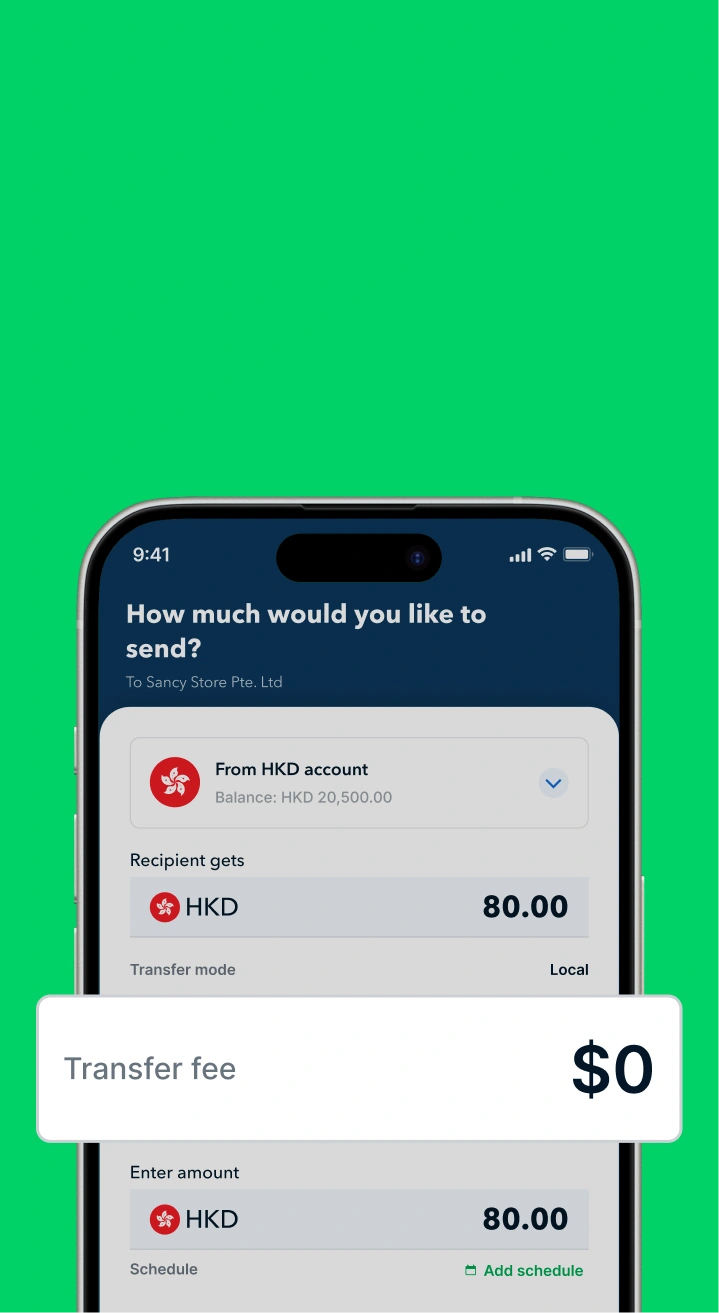
- Full financial control in one platform. Issue corporate cards with configurable spending limits, automate invoice and bill management, and sync every transaction with Xero or QuickBooks in real time. For Hong Kong SMEs managing payroll, free FPS and CHATS are both natively supported — ensuring domestic payments clear on time, every time.
- 1.2% unlimited cashback. Every eligible transaction on your Aspire corporate card earns 1.2% cashback. Combined with over USD 500,000 in partner rewards included with your account, Aspire turns your operating costs into working capital from day one.
Open your account free. Approved in as little as one business day. No branch visits, no stacks of paper forms, no waiting weeks for a relationship manager to call you back.
Frequently Asked Questions
Can a foreigner start a business in Hong Kong?
Yes. There are almost no restrictions on doing so. Hong Kong allows 100% foreign ownership of private limited companies. You don't need to be a Hong Kong resident, hold a Hong Kong visa, or have a local business partner to incorporate. The only statutory requirements are that the company has a Hong Kong physical address as its registered office and that the company secretary is either a Hong Kong resident individual or a Hong Kong-incorporated corporate body. Most of the incorporation process can be completed entirely remotely, including identity verification via video KYC.
Do I need a Hong Kong address to register my company?
Yes, a physical Hong Kong address is required as the registered office. A P.O. box does not qualify. However, a virtual office address provided by a licensed company secretary or virtual office service is acceptable and widely used. If you're based overseas, your company secretary provider will typically include a registered address in their service package.
Do I need to physically visit Hong Kong to open a business bank account?
It depends on the institution. Traditional banks in Hong Kong often require at least one director to appear in person either at a branch or via video interview. Digital business account providers like Aspire conduct their account verification entirely remotely, which is particularly relevant for founders who incorporate from overseas and want to start operating immediately.
How long does it take to set up a company in Hong Kong?
The company incorporation process through the Companies Registry's e-Registry system typically takes one to three business days for electronic applications. If you apply alongside a Business Registration Certificate (the one-stop process), you receive both documents in the same timeframe. The total timeline from "starting the process" to "fully operational" depends primarily on how quickly you can open a business bank account which, at a traditional bank, can add weeks or months.
Is a separate business bank account legally required?
There is no statutory law in Hong Kong that mandates a separate business bank account. In practice, however, it is strongly advisable for three reasons.
- Mixing personal and business finances produces accounting records that are nearly impossible to audit cleanly and audits are mandatory for limited companies.
- IRD views mixed accounts as a red flag during tax assessments.
- Institutional clients, investors, and larger suppliers routinely require payment to a company account, not a personal one. Starting with a clean separation from day one is the right foundation.

.jpeg)




.webp)