


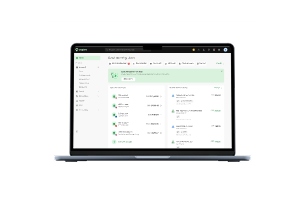
Best corporate cards in Australia at a glance
[Table:1]
What is a corporate credit card
A corporate credit card is issued to a business for company spending, to be used by business owners and employees, with transactions consolidated under one account for reporting and reconciliation.
Operationally, a small business needs to make a couple of decisions around this. Who receives the cards matters: most providers let you issue cards to multiple employees, each with its own limit.
With personal liability, the business owner is on the hook for the balance regardless of who made the purchase. With business liability, the company itself carries the obligation, which matters if the business has multiple directors or external investors who don't want personal exposure tied to day-to-day card spend.
Corporate cards vs business credit cards
A corporate card can be a credit product, a debit product, or a charge card, depending on who issues it. A business credit card specifically refers to a revolving credit facility.
[Table:2]
For example, Aspire's corporate card and Airwallex's Borderless Card are both "corporate cards" in the everyday sense, but neither is a business credit card.
Best corporate and business cards in Australia for small businesses
1. Aspire Corporate Card
Aspire is a strong fit for businesses that care about controlling team spend and managing international expenses. Its debit-based corporate cards connect card spending with multi-currency accounts, and expense controls.
Aspire's corporate cards are debit cards, drawing from the business's account balance rather than extending revolving credit.
Where it works well
For a business paying for SaaS subscriptions, ad spend, or supplier invoices in multiple currencies, the combination of a multi-currency account and FX cashback turns a recurring cost centre into a small but real saving.
For team spend management, per-card limits, merchant category blocks, and automatic receipt reminders reduce the manual work that usually falls on whoever reconciles the books at month-end.
Watch out for
Because the standard card is debit-based, it doesn't provide the same financing flexibility as a revolving credit card. A business that specifically wants to finance purchases over time on the card itself should weigh that against a traditional bank credit card.
Best fit
Businesses with distributed teams making regular purchases across multiple currencies, and founders who want to spend visibility and control more than they want credit card points.
2. Airwallex Borderless Card
Airwallex is built for businesses that regularly spend, collect, or hold money across multiple currencies. Rather than functioning as a traditional revolving credit card, the Borderless Card draws from the business’s available currency balances and connects card spending with Airwallex’s finance infrastructure.
The Borderless Card is a multi-currency Visa debit card, free to create, with no annual card fee on the entry-level Explore plan (waivable AUD $29 monthly fee if minimum deposit or balance thresholds are met).
Where it works well
Businesses paying overseas vendors regularly, or running ad spend and SaaS subscriptions across several currencies, get a genuine FX advantage by holding balances in the currencies they spend in. The platform's API and accounting integrations (Xero, QuickBooks, NetSuite) suit businesses with more complex reconciliation needs than a basic spend tool can handle.
Watch out for
Airwallex is built for businesses that want deep platform capability, and the onboarding and feature set reflect that. A small business that just wants a simple card with limits may find the broader platform more than it needs.
Best fit
Ecommerce and SaaS businesses with material international supplier or marketing spend, and businesses planning to use Airwallex's broader payments infrastructure alongside the card.
3. CommBank Business Awards
CommBank Business Awards is an old-school business credit card for Australian businesses that want to earn points on everyday domestic spending. Its value depends heavily on paying the balance in full. However, the purchase rate and foreign transaction fee can quickly outweigh the rewards earned.
The Business Awards card carries an AUD $100 annual fee plus AUD $75 per additional cardholder, a 20.74% p.a. purchase rate, and up to 55 days interest-free. It earns 1 Awards point per dollar on the first AUD $2,000 of monthly spend, dropping to 0.5 points per dollar after that, with a 3% foreign transaction fee.
Where it works well
For a business with predictable, moderate monthly spend that clears its statement balance in full, the points accumulate steadily and CommBank's redemption network (including Qantas Point transfers) is broad.
Watch out for
A 20.74% p.a. The purchase rate is expensive, and the 3% FX fee erodes the value of points earned. As a result, businesses can also check out their corporate cards which come with lower p.a charges and other perks.
Best fit
Domestically focused small businesses that pay their card off in full each month and want simple rewards earned on everyday purchases.
4. NAB Low Rate Business Card
The NAB Low Rate Business Card prioritises lower borrowing costs over rewards and premium perks. It suits established businesses that occasionally need to carry a balance and want a more affordable revolving credit option than a high-rate rewards card.
The card has a 0% annual fee in year one, reverting to AUD $60 thereafter, with sources citing a purchase rate of 13.99% p.a.
Where it works well
Businesses managing irregular cash flow that sometimes need to carry a small balance benefit from the lower ongoing rate compared with rewards cards charging 18% to 21% p.a.
Watch out for
New-to-bank applicants need a minimum annual turnover of AUD $75,000 and 12 months of reconciled financial data to qualify, which rules this out for very early-stage businesses. There's no rewards program.
Best fit
Established small businesses with at least a year of trading history that want low-cost access to revolving credit rather than rewards.
5. ANZ Business Low Rate
ANZ Business Low Rate is designed for businesses that expect to use their card as a short-term credit facility rather than a rewards tool. Its relatively low purchase rate may reduce borrowing costs, but the lack of interest-free days changes how businesses need to manage repayments.
The card charges 12.99% p.a. on purchases, an AUD $0 annual fee in the first year rising to AUD $100 afterward, and a cash advance rate of 14.49% p.a. Unlike several competitors, it doesn't offer interest-free days on purchases, so it's structured for businesses expecting to carry a balance.
Where it works well
A business that knows it will carry some balance month to month benefits from accruing interest at the lowest available big-bank rate, rather than paying a higher rate just to access interest-free days it won't fully use.
Watch out for
Without an interest-free period, even businesses that intend to pay in full need to track their statement date carefully, since interest can apply from the date of purchase depending on account activity.
Best fit
Businesses with annual turnover under AUD $75 million that expect to carry a balance and prioritise minimising the interest rate over earning points or accessing interest-free days.
6. Westpac BusinessChoice Everyday
Westpac BusinessChoice Everyday combines a traditional business credit facility with controls for companies issuing cards to several employees. Its individual card limits and large supplementary-card capacity make it more relevant to growing teams than to sole traders seeking rewards or premium travel benefits.
The card has a 14.25% p.a. purchase rate, AUD $75 annual fee per card (waived the following year if that card spends AUD $15,000 or more), up to 55 days interest-free, and a foreign transaction fee of 3% range depending on the source consulted. Up to 99 cards can be issued under one facility, each with an individually set limit.
Where it works well
For a business issuing cards to a moderate-sized team, individual credit limits per card, combined with the spend-based fee waiver, create a reasonably predictable cost structure as the team grows.
Watch out for
The per-card annual fee adds up quickly for larger teams unless each card clears the AUD $15,000 annual spend threshold for the waiver.
Best fit
Small to mid-sized businesses issuing cards to multiple employees who want individually controllable limits under one Westpac facility.
7. American Express Business Charge Card
American Express Business Charge Cards are aimed at established businesses that value cash-flow flexibility, travel benefits, and premium service. Because charge cards generally require full repayment, they suit businesses with predictable cash flow rather than those looking to carry debt over several months.
Annual fees vary sharply by tier, from AUD $249 to AUD $1,750 depending on the specific charge card product, with cash-flow days ranging from 51 to 55 days. The currency conversion fee across Amex's charge card range is 3.5%, among the highest in this comparison.
Where it works well
Businesses that value Amex's service network, travel benefits, and longer cash-flow windows, and that pay their balance in full each period as the charge card structure requires, get strong value from the higher-tier products.
Watch out for
The annual fees on premium tiers are materially higher than every other product in this comparison, and the 3.5% FX fee makes Amex an expensive choice for businesses with regular international spend. Amex acceptance is also narrower than Visa or Mastercard with some smaller merchants and overseas vendors.
Best fit
Established businesses with strong, predictable cash flow that value premium service and travel benefits over low fees, and that don't carry significant international transaction volume.
8. St.George BusinessVantage
St.George BusinessVantage is a straightforward business credit card for companies that prioritise a low purchase rate and modest annual fee over points. It offers a simple revolving credit facility without adding the cost or complexity of a rewards programme.
New cards carry a 9.99% p.a. variable purchase rate, an AUD $55 annual fee per card, up to 55 days interest-free, and a 3% foreign transaction fee. Up to 99 additional cards can be issued, each with an individually set limit, but the card offers no rewards program of any kind.
Where it works well
A business that wants straightforward, low-cost access to a business credit facility, without paying for a rewards program it has no intention of using, gets real value from the combination of low rate and low fee.
Watch out for
The complete absence of a rewards program means there's no offsetting value if the business does spend enough to make points worthwhile elsewhere.
Best fit
Cost-conscious small businesses that want a no-frills revolving credit facility and don't place any value on rewards points.
How to compare corporate credit cards
Comparing business credit cards properly means working through several decisions in sequence, not skimming a features table.
1. Start with the repayment model
There are four distinct repayment structures in this market. This includes revolving credit, where you carry a balance and pay interest on the unpaid portion; full monthly repayment, as required on charge cards like Amex's business products; debit or prepaid spending, where you're spending money already in the account; and provider-specific terms.
Decision point: choose revolving credit only when short-term financing is genuinely needed and you understand the interest cost of carrying a balance at the card's specific rate.
2. Compare annual fees against actual benefits
A high annual fee is only justified when the rewards, travel benefits, or operational savings genuinely exceed it. Here's a hypothetical calculation: if a card charges an AUD $400 annual fee and earns 1 point per dollar on AUD $80,000 of annual spend, that's 80,000 points.
If those points are conservatively valued at 0.5 cents each, that's AUD $400 in value, exactly offsetting the fee with no net gain. Run this calculation with your own actual spend and the specific point valuation you'd realistically redeem at.
3. Calculate the real cost of foreign spending
Foreign transaction fees, exchange-rate margins, and overseas merchant charges compound quickly for businesses with international suppliers or subscriptions. As a mathematical example: a business spending AUD $50,000 per year with overseas suppliers faces AUD $1,500 in fees at a 3% foreign transaction rate, before considering any exchange-rate margin layered on top by the card network.
This is an illustrative calculation, not a statement about any specific provider's current fee, and actual costs vary depending on the card and currency involved.
4. Check employee-card controls
Once more than one person is spending company money, controls stop being optional. Look for per-card spending limits, merchant category restrictions, the ability to issue temporary or single-use virtual cards, instant card freezing, and real-time spend alerts.
This is where the gap between bank-issued credit cards and fintech-issued debit cards is widest. Most bank business credit cards offer basic per-cardholder limits and monthly statements. Fintech platforms like Aspire and Airwallex typically offer real-time visibility and more granular controls as standard.
5. Compare accounting and reconciliation workflows
There's a practical difference between downloading a monthly PDF statement and manually entering transactions, versus an automatic feed into Xero or QuickBooks that categorises spend and matches receipts as transactions occur.
For a business with a finance team or an external bookkeeper, the time saved at month-end close compounds every reporting cycle. This is worth weighing against rewards value, since the operational time saved often outweighs the points earned on a moderate-spend card.
Alternatives to traditional corporate cards
1. Business debit cards
Cards that draw directly from an existing business account balance, with no credit extended. Suit businesses that want to avoid interest risk entirely and have sufficient cash flow to fund spending directly.
2. Charge cards
Cards like Amex's business products, requiring full repayment each period rather than allowing a carried balance. Suit businesses with strong, predictable cash flow that want cash-flow days within the cycle without taking on revolving debt.
3. Business lines of credit
A more direct financing tool than a card, typically with a lower interest rate for larger or planned capital needs. Suits businesses needing working capital rather than day-to-day transaction tools.
4. Expense reimbursement
For very small teams or businesses not ready to issue cards, employees pay out of pocket and submit for reimbursement. Simple to set up but creates more manual administrative work and delays expense visibility.
Business credit cards with no annual fee
Business credit cards are a worthy alternative to corporate cards, especially if you are looking for something with no ongoing annual fee. Though other conditions might vary, here’s the gist of the best business credit cards for you:
[Table:3]
How to apply for a corporate or business credit card in Australia
Exact requirements vary by provider, but most Australian business card applications request:
- A registered ABN or ACN for the business
- Confirmation of business registration and structure (sole trader, partnership, company, trust)
- Trading history, often 6 to 12 months of reconciled financial data for bank-issued credit products
- Annual revenue or turnover figures, with several bank cards setting minimum turnover thresholds around AUD $75,000
- Recent business bank statements
- Director identification details for each director or authorised signatory
- Consent for credit checks on the business and, in many cases, on individual directors or guarantors
Exact eligibility varies meaningfully by provider and product, and this list is general guidance rather than a guarantee of approval for any specific card.
One key thing to note here is that corporate cards by business financial platforms like Aspire or Airwallex often don’t need you to show up physically at the bank. This is great for small business owners who are looking for something quick yet valuable.
Choose the card that matches how your business spends
The best corporate card is the one that solves your actual operating problem. A traditional business credit card may suit you when short-term financing or rewards matter most. A low-rate card may work better when you expect to carry a balance. Aspire offers a more practical alternative to a conventional rewards card.
Aspire’s standard corporate cards draw from your business account balance, so they don’t create revolving card debt. You can issue cards for specific employees or expenses, set spending limits, restrict merchant categories, and track transactions as they happen.
Frequently asked questions
What is the best business credit card in Australia?
There's no single best card; the right one depends on whether you need revolving credit, employee spend controls, low international costs, or rewards. A business that pays in full each month and wants Qantas Points has different needs from one issuing cards to a distributed team with overseas suppliers.
What is the difference between a corporate card and a business credit card?
A corporate card describes how a card is used across a business, typically issued to multiple employees under one account. A business credit card specifically refers to a revolving credit facility. Not every corporate card is a credit card; some are debit-based or charge-based instead.
Can a small business get a corporate credit card?
Yes, though eligibility varies by provider. Bank-issued business credit cards typically require an ABN or ACN, a minimum trading history, and sometimes a minimum annual turnover. Debit-based corporate cards from fintech providers often have lighter eligibility requirements since no credit is being extended.
Can I get a business credit card with no annual fee?
Yes, several Australian providers offer fee waivers, either permanently with a minimum annual spend (like Westpac's BusinessChoice Everyday) or temporarily for the first year (like NAB's Low Rate and ANZ's Business Low Rate cards). Confirm whether the waiver is conditional and check the ongoing interest rate and FX fee before assuming it's the cheapest option overall.
Does a business credit card affect my personal credit?
It depends on the liability structure. If you've provided a personal guarantee, the account may be reported in a way that affects your personal credit profile, particularly if repayments are missed. Cards issued under pure business liability are less likely to directly affect personal credit, but this varies by provider. Confirm the specific structure with the issuer before applying.






































.jpeg)





.jpeg)


.jpeg)