


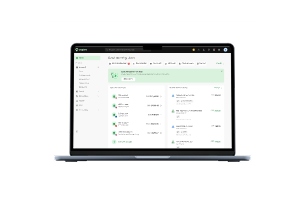
What is employee expense management
Employee expense management is the process by which companies track, approve, pay, and record employee spending for work purposes. It takes care of everything from establishing spending policies and issuing corporate cards to recording receipts, approving claims and syncing expenses with accounting software.
A well-established employee expense management strategy gives finance teams real-time visibility into employee expenses, helps businesses capture and retain valid tax invoices needed to claim eligible GST credits, and supports compliance with Australian Taxation Office (ATO) standards.
[Table:1]
Why manual employee expense management fails first
Many Australian SMEs start managing employee expenses with spreadsheets and email, where inefficiencies quietly compound until quarter-end.
Lost hours
Airwallex's 2024 Spend Management Report found that 63% of Australian finance leaders still manage expenses manually, highlighting how disconnected systems and manual processes continue to create unnecessary administrative work.
Cash flow you can't see
When staff pay out of pocket, and claim weeks later, your bank balance lies to you: a director checking the account on the 20th has no idea AUD $8,000 in approved-but-unpaid reimbursements is due on the 28th.
GST and FBT errors
The same OFX survey found 38% cite manual data-entry errors as their top inefficiency. An AUD $247.50 invoice keyed as AUD $274.50 distorts your BAS and your FBT return, too, if the expense touches Fringe Benefits Tax.
Each traces to one cause: a human keying data or chasing paper. Removing that step, not a stricter memo, is what the rest of this guide does for employee expenses Australia-wide.
Step 1: Build your expense policy
A written policy stops every claim from becoming a negotiation. A policy built for employee expenses in Australian businesses needs four parts.
Categories: Group employee expenses into travel and accommodation, client entertainment (this has FBT implications, so keep it separate), software and subscriptions, and office or remote-work expenses. Here, precision makes mapping the chart of accounts easier because expenses start flowing into your accounting system.
Role-based limits: A sales rep allowing client entertainment might be capped at roughly AUD $500 per month; an ops lead signing off on software may need a larger restriction, as a single annual SaaS subscription can exceed that in one transaction. Make sure spending limits for employee expenses are documented in writing, not simply the intent, so employees and approvers are on the same page.
The ATO threshold: A valid tax invoice is required to claim a GST credit on any purchase over AUD $82.50 (including GST), which is AUD $75 plus 10% GST. Below that, a receipt showing the GST-inclusive price is enough. Most teams still require a receipt for every transaction internally, because a missing AUD $12 receipt is still a gap in the audit trail. Worth flagging to staff directly: for purchases of AUD $1,000 or more, the tax invoice must also show the buyer's identity or ABN.
Exclusions: List non-reimbursable employee expenses in Australia: parking and traffic fines, personal grooming or clothing, and unauthorised alcohol. Put it in writing.
Step 2: Replace reimbursements with corporate cards for employee expenses in Australia
Reimbursement-first workflows often require employees to cover business expenses out of pocket until they're reimbursed, sometimes for an entire payroll cycle. That creates unnecessary friction for employees while delaying finance teams' visibility into company spending. As businesses grow, many replace reimbursement-first workflows with corporate cards to simplify expense management and reduce administrative work.
Both reimbursement and corporate card models can work, but they manage employee expenses very differently for employees and finance teams.
[Table:2]
Physical cards are still handy for frequent travellers, but virtual cards offer more control over regular vendor payments and online subscriptions. Create a separate virtual card for each recurring vendor you use (Google Ads, AWS, etc.). If a card is compromised, you can cancel it and still get paid by other vendors.
Merchant category code (MCC) restrictions provide another layer of control by preventing cards from being used outside approved spending categories, such as limiting a courier's card to fuel and transport merchants.
Step 3: Automate receipt capture
Chasing missing invoices at quarter-end is a process design problem, not an employee discipline problem. The fix is capturing receipts for employee expenses at the point of purchase.
The platform pushes a notice within seconds of the card being tapped, and the employee takes a snapshot of the receipt and submits it. Behind that, OCR extracts the merchant, date, and total, matches the receipt to the transaction, and may identify GST information depending on the platform and receipt quality. More complex cases, such as mixed-supply invoices or non-GST items, may still require manual review. This is where management of employees' expenses in Australia shifts from chasing paperwork to reviewing exceptions.
Step 4: Connect to Xero or MYOB
An expense platform that doesn't integrate with your accounting software simply shifts the manual work of managing employee expenses further downstream. A direct integration sends the transaction details directly into Xero or MYOB automatically, usually hourly as opposed to a monthly bank-feed export. For a company conducting 200+ transactions a month, that difference can make a two-day month-end close into an afternoon.
Set the chart-of-accounts mapping once. Tag a transaction under "software", and it lands in the corresponding ledger code with the GST credit already calculated, with fewer manual journal entries or bookkeeper judgment calls for every transaction.
Step 5: Set tiered approval paths for employee expenses in Australia
An AUD $20 rideshare and an AUD $4,000 conference sponsorship shouldn't follow the same approval workflow. Set a firm number, not a "use your judgement" instruction: anything under, say, AUD $50 with a valid receipt clears automatically. Beyond this, route to a tiered path: direct manager first, then a CFO or finance director once spend reaches a set milestone, such as AUD $2,000.
If an employee's expense is against policy, the system should flag and hold the claim rather than reject it with a written justification before it is placed in the manager’s queue. This keeps day-to-day expense approvals rolling without introducing additional bottlenecks.
Step 6: Run the audit-readiness check
Run this before calling your system compliant, not just operational:
- Every transaction over AUD $82.50 for employee expenses in Australia has a valid tax invoice, showing the supplier's ABN and the GST amount, not just a card statement line
- FBT-relevant categories are isolated, so client entertainment, meals, and gifts are ready for your FBT return without a manual sort
- Records are retained for 5 years from the date you lodge the related return rather than the transaction date, although ATO record-keeping requirements can vary depending on the record type and circumstances.
- Category labels map one-to-one with your accounting software's ledger codes
Miss the FBT isolation point, and your accountant re-sorts a year of employee expenses Australia-wide by hand every March.
How can Aspire help
When card issuing, receipt capture, and accounting sync sit in separate tools, finance teams often have more reconciliation work.
Aspire combines card issuance, expense capture, and accounting sync into a unified procedure. Instead of using different tools, businesses can track employee expenses, match receipts, and sync transactions to their ledger from one platform.
Aspire's expense management solution combines corporate cards, expense claims, accounting automation, and spend controls in one platform. Businesses can manage company spending, automate receipt collection, sync expenses with accounting platforms like Xero, and gain real-time visibility into expenses without relying on multiple disconnected tools.
Fees, FX rates, and cashback terms vary by market and eligibility. Confirm current Australian pricing with Aspire before using them in any insurance document.
Employee expense management readiness checklist
- Write up a firm expense policy, containing categories of allowable expenses and limits on how much can be spent.
- Use corporate or virtual cards where appropriate, rather than relying only on reimbursements.
- Turn on receipt capture and OCR to reduce manual data entry.
- Link your spend platform to Xero or MYOB and have transactions go through seamlessly.
- Configure approval workflows by spending limits and roles.
- Client entertainment and gifts should be separated out to ease reporting for FBT-related expenses.
- Verify that transactions over the ATO tax invoice threshold include valid supporting documentation.
- Keep records of expenses for the ATO record-keeping period required.
Conclusion
Effective management of employee expenses in Australia should do more than reimburse employees. It gives financial teams real-time visibility into corporate spend, minimises administrative effort and makes compliance easier as the organisation scales. If you’re replacing spreadsheets or making an existing process better, having consistent workflows today can make month-end reporting, GST tracking and audits much easier tomorrow.
FAQs
Do I need a tax invoice for every business expense in Australia?
For purchases exceeding AUD $82.50, including GST only. Below that, a receipt displaying the GST-inclusive price is sufficient, but most teams still need a receipt for every transaction internally since a missing payment, like an AUD $12 receipt, is still a gap in the audit trail.
How long do I need to keep expense records?
Five years from the date you lodge the relevant return, not the transaction date. Lodge late, and the retention period shifts later with it.
Is a corporate card statement enough to claim a GST credit?
Generally no. It isn't issued by the actual supplier, so it doesn't usually qualify as a valid tax invoice on its own. Narrow ATO exceptions exist for certain corporate card arrangements, but the safer default is to always capture the underlying receipt.
Can employers require receipts for every expense?
Yes. The ATO just needs a valid tax invoice to claim GST credits on purchases over the appropriate threshold, but a business might compel employees to produce receipts for every expense as part of their internal expense policy. This gives a more thorough audit trail, makes it easier to verify expenses, and helps finance teams reconcile transactions more correctly.
What should an employee expense policy include?
A strong expenditure policy outlines what expenses can be reimbursed, how much can be spent, what evidence is needed, who has to approve expenses, how quickly expenses are reimbursed, and what expenses the company will not reimburse. Defined policies eliminate disputes, increase compliance and enable finance teams to handle claims consistently.
What employee expenses can businesses claim in Australia?
The employee expenses claim depends on your company’s expense policy, but popular expense categories include business travel, housing, meals while travelling for work, office supplies, software subscriptions and professional development. Clear articulation of what costs are permissible, limitations of spend and documentation criteria should be established to provide consistency in approvals and compliance with ATO standards.








.jpeg)

































.jpeg)





.jpeg)


.jpeg)