


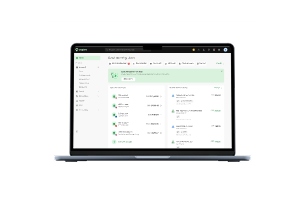
What is a virtual credit card
A virtual credit card is a set of digital card credentials: a 16-digit virtual card number, expiry date, and CVV. It is linked to an underlying account and can be used like a physical card for online payments.
Some providers also let you add virtual cards to Apple Pay or Google Wallet for in-store payments.
Best virtual credit cards in Australia
[Table:1]
Archa
Archa is an Australian fintech with its own Australian Credit Licence, meaning it underwrites credit directly rather than routing through a third-party lender. That matters because it makes approvals faster and more tailored to business financials rather than to founders' credit histories.
For this, no personal guarantee is required, and the application process is handled online without branch visits or paper forms.
It’s a genuine business credit card with 30-day repayment terms and no interest charges — structured more like a charge card than a revolving credit line.
Archa also offers single-use virtual cards and temporary cards with fixed budgets and expiry dates, making it useful for contractor payments or travel allowances where you want a hard spending cap that disappears when the job is done.
Standout features:
- 0.49% FX fees on international spend (a hard saving of approximately
- 3% compared to big-four bank cards
- Velocity Points earned on all spending
- Integrated travel cover underwritten by Mastercard and AIG Australia
- Automated policy auditing that flags 100% of transactions against spend policy
- Instant card issuance with spend controls configured before a single purchase is made.
Best for: Growing businesses that want the structure of a business credit card, not a prepaid or debit model, alongside proper spend controls, rewards, and 0% FX fees for international spending.
Limitation: Archa is best suited to businesses that can manage a monthly repayment cycle rather than those needing a high revolving credit limit. Credit limits scale with business size but start conservatively for newer businesses. Not the right fit if you need multi-currency accounts or deep international payment infrastructure.
Cape
Credit limits go up to AUD $500,000, the APR is 0%, FX fees are 0% on foreign currency transactions up to AUD $50,000, and virtual cards are issued instantly to any team member. Plans start at AUD $39.99 per month.
Standout features:
- Unlimited virtual cards with no transaction fees
- Real-time per-card spend limits and category restrictions
- 0% APR (pay monthly)
- Mastercard Principal Membership that gives Cape direct control over interchange and BIN infrastructure
Best for: Businesses past the early startup phase that need genuine credit access alongside spend controls.
Limitation: Cape is more useful when your business needs credit, not just virtual cards. If you only need simple debit-style spending, subscription cards, or team expense tracking without a credit facility, a prepaid or account-linked virtual card platform may be easier to manage.
American Express Business
American Express offers virtual card access through its business charge card products. No preset spending limit (the limit adjusts based on your payment history), Membership Rewards points on eligible purchases, and virtual card numbers available via the Virtual Account Numbers through the vPayment app for online transactions. Annual fees range from AUD $169 to AUD $1,750 depending on the card tier.
Standout features:
- Strong rewards programme
- Travel perks on premium tiers
- Virtual card number generation via app
- Good fraud monitoring
Best for: High-spending businesses where rewards redemption justifies the annual fee and the 3.5% FX charge is manageable because most spending is domestic.
Limitation: 3.5% foreign transaction fee makes it expensive for international spend. Merchant acceptance, while broad, is lower than Visa or Mastercard in some contexts. Not a spend management platform as controls are limited compared to fintech alternatives.
CommBank Virtual Card
The CommBank card works like a normal credit card, but instead of issuing a physical card, CommBank generates a single-purpose virtual card number for a specific situation. That matters for businesses paying suppliers, managing recurring payments, or replacing cheque and EFT supplier payments with card-based payments.
You can restrict the virtual card by transaction, date range, dollar value, or merchant, which makes it more controlled than handing over a shared company card.
Standout features:
- Single-purpose virtual card numbers
- Supplier payment use cases
- Controls by transaction, date range, dollar value, and merchant,
- Support for travel or procurement payments
Best for: Established businesses already using CommBank that want to add virtual card functionality to supplier, travel, or procurement payments without moving to a separate fintech platform.
Limitation: CommBank is better suited to businesses already inside its corporate card ecosystem. The virtual card page does not publicly list instant issuance timing, FX fees, or third-party accounting integrations, so it is less transparent for founders comparing providers from scratch.
NAB Virtual Corporate Card
NAB Virtual Corporate Card is a plastic-free digital corporate card built for employee, contractor, travel, and purchasing expenses.
The stronger point here is speed after setup. NAB says virtual cards can be issued for a specific business purpose in minutes, not days, and requested through FlexiPurchase. A cardholder submits a request, an approving manager receives a notification, and once approved, the cardholder can start using the virtual card for online, in-store, or in-app purchases.
Standout features:
- Virtual cards issued through FlexiPurchase, Apple Pay and Google Pay support
- Single or multiple work-related purchases
- Dollar value restrictions
- Expiry date controls
- Merchant type restrictions
- Integration with existing expense management systems
Best for: Businesses already using NAB corporate card products that want purpose-driven virtual cards for employees, contractors, business trips, trade shows, emergency purchases, or day-to-day expenses.
Limitation: NAB Virtual Corporate Cards can only be used with NAB’s corporate card product. If you only have a standard business credit card facility, this may not be available. The product is stronger for businesses already using NAB corporate card infrastructure than for founders wanting a standalone virtual credit card in Australia.
HSBC Virtual Card
HSBC Virtual Card is designed for businesses making large-value, high-volume, or repeat supplier payments. It is not positioned as a simple employee expense card. It is closer to a controlled supplier payment and financial management tool.
Through HSBC’s Virtual Cards Online Portal, businesses can generate unique account and card numbers for each transaction, pay suppliers immediately, and use reporting fields to make reconciliation easier.
Standout features:
- Unique account and card numbers per transaction
- Supplier payment use cases
- Up to 29 custom data fields
- Online reporting, personalised reporting, and reconciliation support
Best for: Businesses that process supplier payments at scale and want more control over invoice payments, procurement spend, and supplier reconciliation.
Limitation: HSBC Virtual Card is more suitable for established businesses with repeat supplier payment workflows than very small teams that only need quick virtual cards for SaaS subscriptions. FX fees and accounting software integrations are not clearly disclosed on the public virtual card page, so those need to be confirmed directly with HSBC.
Westpac Dynamic Virtual Card
Westpac Dynamic Virtual Card is built for corporate clients that want to create secure card number tokens for specific invoices, supplier payments, travel expenses, or employee funds.
The most useful distinction is that Westpac’s Dynamic Virtual Card is not just a digital copy of a normal card. It creates secure card number tokens against a real card number, so payments can be matched to a specific invoice, supplier payment, or employee expense. That makes it useful for businesses trying to reduce manual reconciliation and improve supplier payment control.
Standout features:
- Secure card number tokens
- Invoice-specific payments, supplier payment use cases
- Travel expense support, employee fund use cases
- Compatibility with mobile wallet payments through Apple Pay or Google Pay where configured
Best for: Corporate clients that need controlled virtual payments for invoices, suppliers, travel, or employee expenses, and want data feeds into expense management systems.
Limitation: Westpac Dynamic Virtual Card is more corporate than small-business-first. It is best suited to businesses already operating a commercial card programme or working with Westpac corporate banking. FX fees and setup timing are not clearly listed on the Dynamic Virtual Card product page.
ANZ Single Use Card / ANZ Virtual Card
With ANZ, institutional customers can generate virtual, single-use Visa credit cards to pay for travel, e-commerce, and supplier invoices.
The structure is useful when a business wants each payment to have its own card credentials instead of exposing a standing corporate card number across multiple merchants or suppliers.
Standout features:
- Single-use Visa credit cards
- Travel payment use cases
- E-commerce payments
- Supplier invoice settlement
- Account credit limits
- Virtual card spend caps
Best for: Institutional or larger business customers that need controlled one-off virtual card payments for travel, supplier invoices, and online business purchases.
Limitation: ANZ’s virtual card offer is not positioned as a simple self-serve product for solo founders or small businesses. It is more relevant to institutional customers with commercial card arrangements and internal finance controls already in place.
Virtual credit cards in Australia vs corporate cards vs traditional business credit cards
A virtual credit card is built for controlled digital payments in Australia. It gives you card credentials without a physical card, making it useful for subscriptions, supplier payments, online tools, and one-off vendor purchases.
A corporate card is built for team spending. It can be physical, virtual, or both, but the main value is employee-level control, approvals, spend limits, and expense visibility.
A traditional business credit card is built for general business purchases and credit access. It gives the business a credit facility, but the controls are usually less granular than purpose-built virtual card or corporate card platforms.
[Table:2]
Corporate cards and virtual cards: Alternatives to a virtual business credit card
If your business doesn't need a credit facility, just controlled virtual cards, spend visibility, and FX savings, a finance platform built around a corporate or debit card may serve you better than a traditional virtual credit card.
- Aspire: Issues unlimited virtual and physical corporate cards with real-time spend limits set per card and 1% uncapped cashback on all FX spend. Cards integrate with Xero and QuickBooks. It's a debit-style card linked to your Aspire business account, with credit access available to eligible businesses, not a revolving credit card.
- Wise Business: Offers one free physical card plus up to three active virtual cards per account (Mastercard network), with no subscription fee. You pay no FX fee if you hold a balance in the currency you're spending; otherwise, a conversion fee from 0.65% applies.
- Airwallex: The Explore plan gives up to 10 company cards and 2 free employee card users (additional cards from AUD $15/cardholder/month). It draws directly from a multi-currency wallet across currencies like AUD, USD, EUR, and GBP, which avoids unnecessary conversion. FX markup runs 0.5%–1.0% above interbank rate depending on plan tier. Xero, QuickBooks, and NetSuite integrations scale with plan level (Explore, Grow, Accelerate).
- Revolut Business: Runs a tiered subscription model, Basic ( AUD $15/month) up to Enterprise with virtual and physical cards included on every plan. FX is at interbank rate within a monthly allowance; a 0.6% fee applies beyond that (1% outside market hours).
- Volopay: Combines unlimited virtual Visa cards with subscription pricing starting around AUD $25/month in Australia. It's debit-based by default, with an optional credit facility.
Note: None of these are conventional virtual business credit cards. They're corporate card and spend-management platforms where the virtual card is one feature inside a broader finance stack (FX, approvals, reconciliation). If your priority is unlimited card issuance, real-time controls, and accounting sync rather than a revolving credit line, this is the category to compare instead.
How to choose the right virtual credit card for your business
Four qualifying questions to answer before you compare:
1. How many people need cards?
If it's just you, a bank's built-in virtual card may suffice. If you have a team, even two or three people, a platform with multi-card issuance pays for itself immediately in saved admin time.
2. Do you pay international vendors?
If yes, FX fees matter enormously. A 3.5% FX fee on AUD $5,000/month in international payments is AUD $1,800/year in dead spend. Filter for providers with competitive FX rates or multi-currency support upfront.
3. Do you need instant card issuance?
If you're onboarding a contractor today and need them paid this week, you need an instant-approval virtual credit card provider in Australia. Traditional bank applications can take days.
4. What does your expense reconciliation look like?
If you're still manually entering card receipts into a spreadsheet, an integrated virtual card platform isn't just a payments upgrade but a bookkeeping one.
Do you need a virtual credit card in Australia or a finance platform with virtual cards
A virtual credit card in Australia solves the card problem. It gives you a safer way to pay online, manage subscriptions, issue cards to team members, and reduce exposure from shared card details.
But if your business is growing, the card is usually not the only problem. You may also need to approve spends before it happens, track who owns each expense, collect receipts, manage FX costs, reconcile payments, and understand where cash is going across cards, bills, and transfers.
That is where the decision changes.
If you only need one or two cards for online payments, a standalone virtual credit card or bank-issued virtual card may be enough. But if you want virtual cards to sit inside a wider finance workflow, a platform like Aspire may be more practical.
FAQs
- What is a virtual credit card in Australia?
A virtual credit card in Australia is a set of digital card details: a card number, expiry date, and CVV. It can be used for online payments, supplier payments, subscriptions, and team expenses without issuing a physical card.
- What is the best virtual credit card for Australian businesses?
The best virtual credit card depends on what your business needs to control first. Aspire is useful for founders wanting virtual corporate cards, spend controls, and expense visibility, while Archa and Cape are stronger fits when business credit access is the priority.
- Can I get an instant approval virtual credit card in Australia?
Some providers offer instant virtual card issuance after your account or facility is approved. However, instant approval depends on the provider’s onboarding process, business checks, eligibility criteria, and whether the card is linked to a credit facility, corporate programme, or finance platform.
- What is a virtual card number?
A virtual card number is the digital card number used to make payments without a physical card. It usually comes with an expiry date and CVV, and can often be created for a specific vendor, employee, subscription, invoice, or one-off payment.
- What is the difference between a single-use and multi-use virtual card?
A single-use virtual card is created for one transaction or one specific payment. A multi-use virtual card can be used repeatedly for recurring expenses such as SaaS subscriptions, supplier payments, travel, or employee spend, depending on the provider’s controls.
- Are virtual credit cards safer than traditional business credit cards?
Virtual credit cards can be safer for online spending because they can be issued for specific vendors, capped with limits, paused, or cancelled quickly. Some providers also use tokenisation, so merchants do not directly receive the underlying account details.
- Should I choose a virtual credit card or a finance platform with virtual cards?
Choose a standalone virtual credit card if you only need a few controlled online payments. Choose a finance platform with virtual cards if you also need approvals, spend limits, receipt tracking, FX visibility, expense management, and reconciliation in one workflow.







































.jpeg)





.jpeg)


.jpeg)