


Quick answer: How does global payroll outsourcing work?
Global payroll outsourcing works by moving defined payroll tasks to a specialist provider. You share the employee and payroll inputs, the provider applies the relevant country-specific rules and calculations, your team checks and approves the payroll, and the provider handles the agreed payment and reporting tasks.
For example, if your team includes employees in Singapore, Australia, and Japan, you can work with a provider that coordinates payroll across all three markets rather than asking your finance team to manage each country separately.
What the provider handles depends on the service you choose. Some cover calculations and statutory reporting, while full-service arrangements can also include salary payments, payslips, tax filings and payroll records. If you’re still assessing how global payroll works, it’s worth understanding the different responsibilities before choosing a provider. Your contract should make those responsibilities clear before you sign.
What is global payroll outsourcing?
Once you have employees in more than one market, payroll involves more than calculating salaries. You also need to make sure the right records, statutory submissions, payslips and employer obligations are handled for each workforce.
Global payroll outsourcing means hiring an external provider to take responsibility for defined payroll activities across your international team. Depending on the arrangement, this can include:
- Payroll calculations: Working out gross pay, deductions, allowances, bonuses and other payroll components according to the applicable local rules
- Statutory administration: Preparing or submitting required payroll information to the relevant authorities. In Singapore, employers covered by the Employment Act must provide itemised payslips. For employment income reporting, employers may need to prepare Form IR8A, Appendix 8A and Appendix 8B, depending on the employee’s circumstances. Employers under the Auto-Inclusion Scheme (AIS) submit the relevant employment income information electronically to IRAS instead of providing hardcopy forms to employees.
- Payroll records: Maintaining payroll information and providing reports or records your finance team needs for accounting and internal review
- Payments and payslips: Depending on the service, the provider may prepare salary payments and issue payslips, while you retain approval over the final payroll run
The important point is that outsourcing doesn’t mean giving up control. You decide how much responsibility to hand over, while your team can retain approval, oversight and decisions around employee pay.
For example, a Singapore-based software company with employees in Singapore, Malaysia and Australia could outsource payroll administration for all three markets while keeping final payroll approval with its finance team. The provider handles the agreed country-specific work, while the company retains visibility over what gets paid and when.
When should you consider global payroll outsourcing?
You don’t need to outsource payroll just because you have an employee overseas. The decision usually becomes more compelling when the time and administrative work involved in managing payroll internally starts to outweigh the benefits of keeping it in-house. In Singapore, 41% of organisations cite reducing administrative time and workload for internal teams as a top payroll technology investment priority, reflecting the growing focus on making payroll processes more efficient.
1. You’re hiring across several countries
Managing one overseas payroll may be manageable. Adding several countries can make the process harder to coordinate, particularly when your finance or HR team has to keep track of different filing dates, employee requirements, and payroll calendars.
If international hiring is becoming a regular part of your growth plan, global payroll outsourcing can give your team a more consistent way to manage those markets without building a separate payroll operation for each one.
2. Payroll knowledge sits with one person
If only one person knows how your international payroll works, you have a continuity problem.
A resignation, extended absence, or internal move could leave your team scrambling to understand payroll procedures that were never properly documented. An outsourced arrangement can spread responsibility across a defined process and give your team clearer records and approval points.
3. Payroll is taking time away from higher-value work
Your finance team should be able to focus on cash flow, forecasting, reporting, and other decisions that directly support the business. Comparing payroll outsource vs in-house setup can help you assess whether the administrative workload still makes sense for your team.
If international payroll regularly involves chasing employee changes, checking calculations, preparing payment files, or resolving issues across markets, it’s worth calculating how much internal time that process consumes. Outsourcing can make sense when that workload no longer justifies keeping all the administration in-house.
4. You’re entering a market where you lack local payroll knowledge
Hiring your first employee in a new country means deciding whether to build the required payroll knowledge internally or work with a provider that already supports that market.
For a small overseas team, outsourcing can be more practical than creating an internal payroll function from scratch. You can also reassess the arrangement as your headcount and presence in that market grow.
A simple rule of thumb: If adding another country means adding another spreadsheet, payroll calendar, and compliance process for your team to manage, it may be time to consider outsourcing.
How does global payroll outsourcing work?
The exact workflow varies by provider and service model, but most arrangements follow a monthly cycle. Your team supplies the required inputs, reviews the results, and retains approval over the final payroll while the provider handles the agreed administrative work.
1. You submit employee and payroll data
You provide the information needed for the upcoming pay cycle. This can include new hires, resignations, salary changes, bonuses, commissions, leave, overtime, deductions, and other adjustments.
Set clear submission deadlines from the start. Late changes can create additional work or require adjustments after calculations have already been completed.
2. The provider checks the submitted information
Before calculations begin, the provider reviews the data for missing or inconsistent information. This can include employee records, salary changes, payment details, and other information required for the relevant market.
The aim is to identify issues early, before they affect salary payments or statutory submissions.
3. Country-specific payroll calculations are completed
This is where international payroll becomes more complex. The provider applies the applicable tax, contribution, deduction, and statutory rules for each employee’s location.
For example, for Singapore employees aged 55 and below with monthly wages above S$750, the 2026 CPF contribution rate is 37%, comprising 17% from the employer and 20% from the employee. Different rates apply based on age, citizenship status, and wage bands.
4. You review and approve the payroll
Your team should have a clear approval stage before payments are released.
Review the payroll summary, employee changes, total amount, deductions, and payment details. This gives you a final opportunity to question unusual changes or correct errors before funds move.
5. Salaries and statutory payments are processed
Once you approve the payroll, the provider can support salary payments and statutory submissions included in your service arrangement.
For Singapore employees covered by the Employment Act, salary must generally be paid at least once a month and within seven days after the end of the salary period.
When you have employees in several countries, the payment stage can also involve different currencies, banking systems, and local payment requirements.
6. You receive reports and payroll records
After the payroll run, your team should have the records needed for reconciliation, reporting, and ongoing payroll administration. Aspire’s HReasily integration can also help connect employee and payroll information with the wider payroll workflow, reducing the need to move data manually between systems.
Depending on your arrangement, these can include payroll summaries, payslips, payment reports, statutory records, and accounting files. Singapore employers must also keep records of itemised payslips issued to employees covered by the Employment Act.
This gives your finance team a clear record of what was processed and makes it easier to connect payroll with the rest of your financial reporting.
What does Singapore payroll add to the process?
Outsourcing payroll doesn’t remove your Singapore obligations. You still need to know which requirements apply to your employees and make sure your payroll arrangement assigns responsibility for each one.
For a business hiring in Singapore, four areas deserve particular attention.
1. CPF contributions
CPF calculations depend on factors such as an employee’s age, citizenship or permanent resident status, and wages. The rates can also change, so your payroll setup needs to reflect the rates that apply to the relevant period.
In 2026, CPF contribution rates increased for employees aged 55 to 65. From 1 January 2027, rates for employees aged above 55 to 65 will increase again.
That makes current payroll data and regularly updated calculations important when you’re deciding how much of the process to handle internally.
2. Itemised payslips
Employers covered by the Employment Act must provide itemised payslips to employees. If the payslip isn’t provided together with salary, it generally needs to be given within three working days of payment.
Your outsourcing agreement should therefore make clear who prepares the payslips, who distributes them, and how the records are retained.
3. IRAS employment income reporting
If your business falls under the Auto-Inclusion Scheme (AIS), you must submit employees’ employment income information electronically to IRAS.
For the 2026 reporting cycle, 123,000 employers were under AIS, covering more than 2 million employees. Employers had to submit their employees’ 2025 employment income information by 1 March 2026.
If you outsource payroll, check whether your provider submits the required information directly or prepares it for your team to file.
4. Foreign employees
Hiring foreign employees adds another layer to your Singapore payroll setup. The Employment of Foreign Manpower Act covers employers of foreign employees and includes responsibilities relating to work passes, medical insurance, foreign worker levies, cancellation and repatriation.
Your payroll setup should also account for the Skills Development Levy (SDL), which employers must pay for all employees, including Singapore citizens, Singapore permanent residents and foreign employees. The levy is calculated based on each employee’s monthly remuneration, subject to the applicable minimum and maximum amounts.
Payroll outsourcing can help with the administrative side, but it doesn’t replace your responsibility to meet applicable employment, levy and work pass requirements.
Before you outsource, clarify who owns what
Before signing with a provider, map each Singapore payroll requirement to a specific owner. You should know what the provider handles, what your team approves, and what remains your responsibility.
Global payroll outsourcing vs EOR: What’s the difference?
Global payroll outsourcing and an Employer of Record (EOR) can both support international hiring, but they solve different problems. The choice largely comes down to whether your business already employs the worker through its own entity in that country.
1. Use payroll outsourcing when your business employs the worker
If your Singapore company has a legal entity in another country and employs people through that entity, international payroll outsourcing can handle the administrative side without changing the employment relationship.
You remain the employer, while the provider can manage agreed payroll tasks such as calculations, statutory reporting, payslips, and payment administration.
This can work well when you already have the legal structure in place but don’t want your finance or HR team managing every local payroll requirement themselves.
2. Consider an EOR when you don’t have a local employing entity
An EOR takes a different approach. The EOR becomes the legal employer of the worker while the worker performs their day-to-day role for your business. Singapore’s Ministry of Manpower confirms that a worker employed by an EOR can be considered an employee of the EOR when there is a contract of service between them.
This can be useful when you want to hire in a country where your business doesn’t have its own employing entity. EOR in Singapore can also be relevant when you’re evaluating how an Employer of Record arrangement fits into your wider hiring and compliance setup.
For example, if your Singapore company wants to hire its first employee in a new market, an EOR may allow you to establish the employment arrangement without immediately setting up your own local entity.
3. The decision comes down to your employment structure
Think of it this way:
Payroll outsourcing: your business employs the worker → the provider manages agreed payroll responsibilities.
EOR: the EOR employs the worker → your business manages the employee’s day-to-day work while the EOR handles the employer responsibilities assigned to it.
An EOR therefore isn’t simply a more comprehensive payroll service. It changes the legal employment arrangement itself.
What should you outsource and what should you keep in-house?
Outsourcing doesn’t mean handing over every payroll decision. You’re still responsible for deciding how your people are hired, paid, and managed. The provider takes care of the operational work you’ve agreed to delegate.
1. Outsource payroll calculations
This is usually the core of the service. Your provider can calculate gross-to-net pay, deductions, statutory contributions, and other country-specific payroll items based on the information you provide.
That can be particularly useful when your team spans markets with different payroll rules.
2. Outsource payroll compliance administration
You can also delegate administrative work linked to applicable payroll filings and statutory submissions, depending on the provider and your service agreement.
Before signing, confirm which submissions the provider completes, which records it maintains, and which responsibilities remain with your business.
3. Decide how salary payments will be handled
Payment arrangements vary between providers. Some can execute salary payments, while others prepare payment files for your finance team to review and release.
Make sure you know who prepares the payment, who approves it, and who controls the bank account. Keeping those responsibilities clear can reduce the risk of an unauthorised or incorrect payment.
4. Keep people decisions within your business
Decisions about hiring, compensation, bonuses, promotions, and termination should remain connected to your management and HR processes.
Your provider can apply those approved changes to payroll, but your business should retain control over the underlying employment decisions.
5. Keep final approval and oversight in-house
Even when you use a full-service provider, don’t remove internal oversight.
Assign someone to review payroll before approval, investigate unusual changes, and confirm that the final amounts align with your records. You should also have access to the payroll reports and records your business needs for accounting, reporting, and audits.
How to choose between global payroll outsourcing companies
The right provider depends on where you employ people, how payroll is handled in each market, and how easily the setup can adapt as you expand. Instead of comparing providers by country count or headline pricing alone, assess the service, systems and support you’ll actually receive in the markets where you operate.
1. Check coverage where you actually hire
A provider may support dozens of countries, but that doesn’t tell you how payroll is delivered in each one.
Check whether the provider supports the countries where you currently employ people and whether it handles payroll through its own local operations or works with third-party partners.
If you expect to enter new markets, check those countries too. This can help you avoid changing providers each time your workforce expands.
2. Compare what is included in each market
Look beyond the basic payroll calculation. Ask what the quoted service includes and whether certain country-specific requirements cost extra.
Depending on the provider, this could cover:
- Statutory filings and reporting
- Payslips and payroll records
- Salary payments
- Year-end requirements
- Employee payroll support
Take one employee in each country and map what the provider would handle from payroll input through to final reporting. This gives you a more useful comparison than a standard feature list.
3. Check how the provider connects with your systems
International payroll can create more work if employee and payroll data has to move manually between platforms.
Check whether the provider integrates with the systems you already use, such as your HRIS, accounting software, time-tracking platform or payment tools. Also ask whether information syncs automatically or requires regular file uploads.
A provider that fits your existing workflow can reduce unnecessary handoffs as your international payroll grows.
4. Check how cross-border employee data is handled
Payroll involves sensitive employee and salary information. When that data moves between countries, understand how the provider manages it.
Ask about access controls, data storage, transfers between jurisdictions, activity logs and incident response. You should also understand which data protection requirements apply to employees in each market where you operate.
This is particularly important if your payroll provider, systems or support teams are based in different countries.
5. Test the support model before you sign
A payroll issue can become urgent when it affects an employee’s salary.
Before choosing a provider, check when support is available, how urgent issues are escalated and whether you’ll have a dedicated contact or a general support queue.
If your team spans Singapore, Australia, the UK and the US, make sure the provider’s support coverage works across those time zones rather than relying only on a generic “24/7 support” claim.
6. Check how the provider handles new markets
Your requirements can change when you add employees, countries or payroll frequencies.
Ask how the provider handles onboarding in a new country, adding employees, changing pay cycles and connecting additional systems. Also check whether the same reporting and approval approach can be maintained across markets.
The better question isn’t simply “Which provider is cheapest?” It’s “Which provider can support our international workforce without creating a fragmented payroll process?”
How much does global payroll outsourcing cost?
There’s no standard price for global payroll outsourcing. The amount you pay depends on the countries you operate in, employee count, payroll frequency, and how much of the process you hand over.
Providers may price their services per employee, per payroll run, per country, or through a combination of fixed and variable fees. Implementation, year-end reporting, payment services, additional payroll runs, and more complex payroll cases can also affect the final bill. Payroll fees can therefore vary depending on the services and payroll setup you choose.
When comparing quotes, look beyond the monthly fee. Include the internal time your team spends collecting payroll data, checking calculations, maintaining separate systems, and resolving issues.
The better comparison is the total cost of running payroll in-house versus the total cost of outsourcing it.
How to make international payroll outsourcing work smoothly
Outsourcing can remove a lot of payroll administration, but it won’t fix a messy process on its own. Clear ownership, reliable employee data, and predictable review points will determine how smoothly the arrangement works.
1. Set a payroll calendar everyone can follow
Agree on deadlines for submitting employee changes, closing payroll inputs, reviewing calculations, and approving payments.
Share the calendar with HR, finance, managers, and your provider. If you operate across several time zones, build enough time into the schedule for reviews and corrections before payday.
2. Keep employee data in sync
Decide which system holds the authoritative employee information and use it consistently.
Salary changes, new hires, terminations, bonuses, and other updates should reach the payroll provider through a defined process. Keeping different versions of employee data across spreadsheets and systems makes reconciliation harder and increases the chance of incorrect payments.
3. Separate preparation from approval
Where your setup allows it, don’t give the same person responsibility for preparing payroll and releasing the payment.
Have someone review the payroll summary, investigate unusual changes, and approve the final amount before funds are released. This creates a straightforward control without adding unnecessary steps.
4. Reconcile after every payroll run
Compare payroll payments and accounting records after each cycle rather than waiting until year-end.
Check that salary payments, deductions, statutory contributions, and payroll entries match your records. If something doesn’t reconcile, investigate it while the transaction is still easy to trace.
5. Review the process as your team grows
A process that works for 20 employees across two countries may become cumbersome at 100 employees across eight.
Review your payroll workflow when you enter a new market, add a significant number of employees, change systems, or introduce new pay components. Your process should evolve with the business rather than becoming another manual task your finance team has to work around.
How Aspire fits into the payroll workflow
Outsourcing payroll doesn’t mean handing over control of your entire finance operation. You can use a specialist provider for payroll calculations and local compliance while keeping payment approvals and financial visibility within your own workflow.
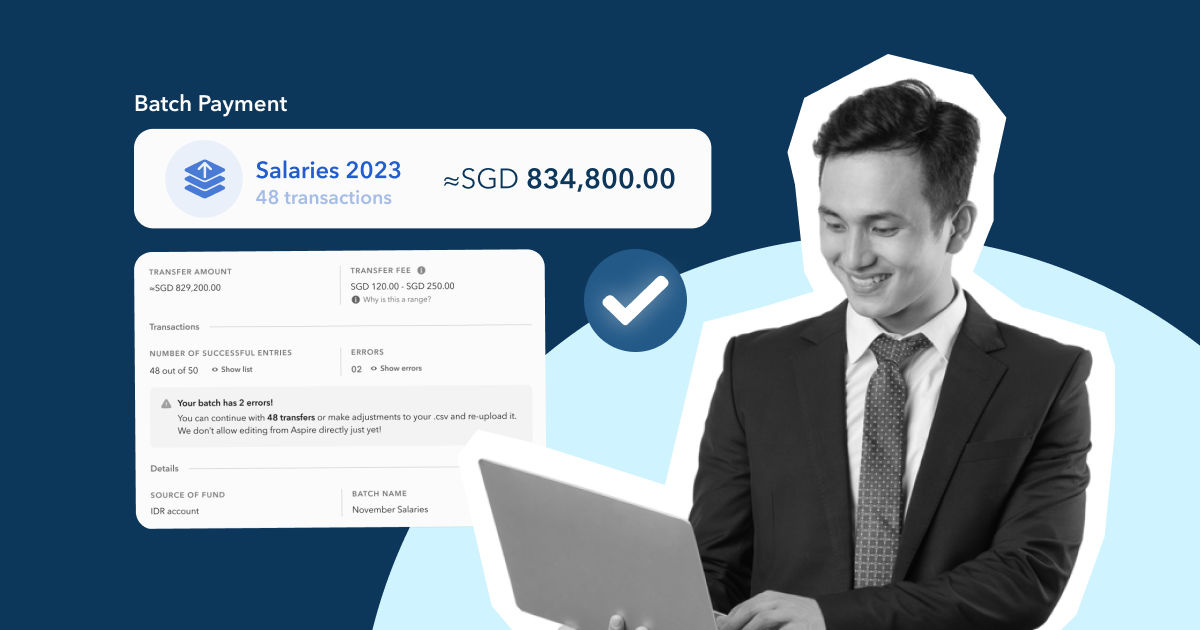
Aspire’s Singapore Payroll feature lets you create payroll batches, review and approve salary payments, track payment status and access payroll reports. Aspire also connects with payroll platforms such as HReasily, Talenox, Payboy and Info-Tech, allowing businesses to bring payroll data into Aspire for salary payments.
For overseas employees, Aspire Payroll supports salary payments in selected currencies and international transfers. You can then connect payroll payments with broader finance processes through expense management, giving your team a more connected way to manage day-to-day finance.
Final thoughts on global payroll outsourcing
Global payroll outsourcing becomes more useful when managing payroll across countries starts taking more time and attention than your team can reasonably give it.
Before choosing a provider, look at your current setup and decide what you actually need to hand over. Keep the approvals, employment decisions, and oversight that matter to your business, while using the provider for the administration you don’t need to manage internally.
The right setup should give you less payroll administration without less control. That’s the balance to look for as your international team grows.
Global payroll outsourcing: FAQs
Q1. What is global payroll outsourcing?
Global payroll outsourcing means using an external provider to manage some or all of your payroll administration across different countries. Depending on your agreement, the provider may handle payroll calculations, statutory requirements, payslips, reporting, and payment support.
Q2. How does international payroll outsourcing work?
International payroll outsourcing usually starts with your business submitting employee and payroll information. The provider then validates the data, applies the relevant country-specific rules, prepares payroll for your approval, and supports payments and statutory requirements included in your service.
Q3. What’s the difference between payroll outsourcing and an EOR?
Payroll outsourcing is generally used when your business already employs workers directly and wants a provider to manage payroll administration. An EOR becomes the legal employer of the worker on your behalf. The choice therefore depends on your employment structure, not simply how much payroll administration you want to outsource.
Q4. How should I compare global payroll outsourcing companies?
Compare providers based on the countries they support, services included, integrations, pricing structure, data controls, payment options, and support. Check whether they manage payroll directly in each country or work with local partners, especially if you’re planning further international expansion.
Q5. What should I look for in international payroll outsourcing services?
Start with the responsibilities you actually want to delegate. Check whether the service covers payroll calculations, statutory filings, payslips, reporting, payment support, and year-end requirements in the countries where you hire. Also confirm what your team remains responsible for.
Q6. Do international payroll outsourcing companies handle Singapore payroll?
Some do, but the scope varies by provider. If you have employees in Singapore, check whether the service supports requirements such as CPF contributions, salary payments, itemised payslips, and applicable IRAS reporting. Your agreement should clearly state which Singapore payroll responsibilities the provider handles.
Q7. Is international payroll outsourcing worth it for a small business?
It depends more on your payroll complexity than your headcount. If you operate in one country with a straightforward payroll, keeping it in-house may be practical. If you’re hiring across several markets and managing different payroll rules, currencies, and reporting requirements, international payroll outsourcing can reduce the administrative workload your team has to manage.





.webp)