


What is payroll outsourcing
Payroll outsourcing is the practice of hiring an external provider to manage some or all of a company's payroll activities. Depending on the service, this can include salary calculations, payslips, statutory filings, payroll reporting, and employee support.
Payroll outsourcing services can cover a specific part of the payroll process or the entire workflow.
Employee payroll outsourcing doesn’t necessarily mean handing over every responsibility to a third party, because businesses can retain oversight and approvals while outsourcing tasks that fit their workforce, systems, and operating model.
How does payroll outsourcing work in Singapore
Payroll outsourcing in Singapore typically follows a defined workflow between the business and its provider:
- The business provides employee and payroll data to the provider
- The provider processes salaries, deductions, allowances, and other payroll inputs
- The provider calculates relevant statutory contributions and obligations, including CPF (Central Provident Fund) and SDL (Skills Development Levy), and supports applicable IRAS (Inland Revenue Authority of Singapore) and MOM (Ministry of Manpower) requirements
- The business reviews and approves the payroll
- Payslips and payroll reports are generated
- Relevant statutory submissions are completed where included in the service
- Payroll data can flow into accounting, HR, or finance systems through integrations
These requirements can also change over time. For example, CPF contribution rates for older workers increased from 1 January 2026, with the total rate rising from 32.5% to 34% for employees aged above 55 to 60 and from 23.5% to 25% for those aged above 60 to 65.
The exact division of responsibility depends on the provider and service model. Before outsourcing, confirm which calculations, statutory submissions, approvals, and integrations are included in the agreed scope.
What services does payroll outsourcing include
Some payroll outsourcing services focus mainly on salary processing, while others combine it with HR administration, statutory compliance, reporting, or multi-country capabilities.
Before comparing providers, check which responsibilities are included in the service scope and which remain with your internal team.
1. Payroll processing and salary calculations
A payroll provider can manage the recurring calculations and updates needed to finalise employee pay, including:
- Monthly salary calculations
- Allowances and deductions
- Bonuses and variable compensation
- Overtime where applicable
- Employee changes
- Payroll adjustments
- Payroll finalisation
2. Statutory compliance and filings
Providers may also support Singapore statutory requirements, including CPF contributions, IRAS reporting, SDL, and other applicable statutory submissions. This can give finance teams access to specialist payroll knowledge without maintaining every requirement internally.
However, the scope varies, making it necessary to confirm whether a provider calculates statutory obligations, prepares filings, submits them on your behalf, or simply provides the data needed for your team to complete them.
For foreign employees leaving Singapore, employers may also need to file Form IR21 for tax clearance and withhold salary due to the employee until IRAS issues the relevant clearance directive. This makes it worth confirming whether tax clearance is included in the provider’s scope.
The Progressive Wage Model (PWM) is another consideration for employers in sectors such as retail, food services, cleaning, and security. Depending on the workforce and sector, employers may need to meet specified wage and training requirements, so check whether your payroll provider can support the relevant calculations and requirements.
3. Payslip generation and payroll records
Payroll outsourcing can include the production and maintenance of key payroll records, such as:
- Employee payslips
- Payroll registers
- Payroll records
- Historical payroll data
- Year-end documentation
- Audit trails
Recordkeeping also has a compliance dimension. Employers covered by the Employment Act must issue itemised payslips with specified salary information and retain payslip records for 2 years, making accessible payroll records important for both compliance and financial control.
For finance teams, accessible and well-maintained records support auditability and financial control.
4. Employee payroll support
Some providers also handle employee-facing payroll queries. This can include:
- Payslip questions
- Payroll discrepancies
- Employee information updates
- Payroll-related requests
This can reduce the number of routine payroll queries reaching finance or HR, but the level of employee support varies by provider and service plan.
5. Payroll reporting and accounting integrations
Payroll data also feeds directly into finance operations. Depending on the provider, services may include payroll reports, accounting exports, HRIS (Human Resource Information System) and ERP (Enterprise Resource Planning) integrations, finance reporting, reconciliation support, and centralised payroll data.
Good integration reduces manual data movement between payroll and finance systems. It can also give finance teams a clearer view of workforce costs and make reconciliation more consistent.
When comparing services, assess whether integrations are included, how data moves between systems, and what reporting your finance team actually needs.
Why outsource payroll in Singapore
In-house payroll becomes harder to manage as headcount and payroll complexity grow. Finance and HR teams may need to handle more salary changes, variable pay, statutory requirements, and employee queries each month.
For founders considering payroll outsourcing in Singapore, these are often the signals that the existing model is becoming difficult to sustain:
- Growing headcount: More employees mean more payroll inputs and changes to manage
- Complex payroll: Bonuses, allowances, deductions, and overtime add more variables to each cycle
- Limited internal expertise: Payroll knowledge may sit with only 1 or 2 employees, creating continuity risks
- Manual processes: Moving payroll data between HR, payroll, and finance systems can create extra work and reconciliation
- Statutory requirements: Singapore payroll needs to account for CPF, IRAS, SDL, and applicable MOM requirements
- Multiple entities: Different payroll processes can make reporting and controls harder to standardise
The final decision comes down to whether the benefits outweigh the cost and reduced day-to-day control.
What are the benefits of payroll outsourcing for Singapore businesses
The right payroll outsourcing setup can turn payroll from a recurring administrative task into a more structured, manageable process. The main benefits include:
- Lower administrative burden: Reduce the time finance and HR teams spend on routine payroll work
- Potentially lower total operating costs: Avoid adding internal payroll capacity as requirements grow, depending on provider pricing and scope
- Better access to compliance expertise: Work with specialists familiar with Singapore payroll requirements
- Reduced payroll processing risk: Use defined processes and controls to reduce the likelihood of avoidable errors
- Greater business continuity: Reduce reliance on individual employees who hold payroll knowledge
- Easier scaling: Support headcount and organisational growth without increasing payroll administration at the same pace
- Better payroll visibility: Access more consistent payroll records, reporting, and data across the organisation
- More finance capacity for strategic priorities: Free internal teams to focus on planning, reporting, treasury, and financial control
Payroll outsourcing vs in-house payroll: Which model is right for your business
Neither model is universally better. In-house payroll gives you greater direct control, while outsourced payroll can reduce internal workload, provide specialist expertise, and make scaling easier.
[Table:1]
The right choice depends on your payroll complexity, internal capacity, control requirements, and growth plans.
For example, a business with a simple payroll setup may prefer to keep it in-house, while a growing or multi-entity business may benefit from outsourcing.
When should a business outsource payroll
There’s no fixed headcount at which outsourcing becomes necessary. The stronger signal is when payroll starts demanding more internal capacity, expertise, or coordination than your current setup can support.
You should consider outsourcing when:
- Headcount is growing quickly, and payroll volume is becoming harder to manage
- Payroll involves more allowances, bonuses, deductions, or employee changes
- Payroll knowledge depends heavily on 1 or 2 internal specialists
- Payroll errors or late adjustments are becoming more frequent
- The company is expanding across multiple entities or countries
- Payroll compliance is becoming harder to manage internally, particularly across CPF, SDL, IRAS, and applicable MOM requirements
- Payroll systems require too much manual work to connect with HR, accounting, or finance systems
Also, outsourcing doesn’t have to be all or nothing. You can retain responsibilities that require internal oversight while handing recurring or specialist payroll tasks to a provider.
How much does payroll outsourcing cost in Singapore
Payroll outsourcing costs in Singapore vary by provider, employee count, payroll complexity, service scope, and pricing model. Providers may charge per employee, per payroll cycle, through a monthly fee, or use customised pricing for more complex or multi-entity requirements.
The financial scale of payroll is significant. Singapore recorded SGD $57,854 million in CPF contributions in 2025, up from SGD $55,851 million in 2024. That makes payroll accuracy, controls, and payment processes relevant to both finanhttps://www.revvgrowth.com/saas-content-marketing/agenciesce and HR administration.
The headline per-employee price doesn’t tell you the full cost. The main cost drivers include:
- Number of employees and entities
- Payroll frequency
- Full-time, part-time, and foreign employees
- Payroll complexity, including variable pay and employee changes
- Statutory compliance and filing requirements
- Employee self-service and HR administration
- Leave management and year-end reporting
- Payroll integrations and custom reporting
- Off-cycle payroll runs
Here's what common payroll outsourcing pricing models look like
[Table:2]
When comparing prices among providers, look beyond the base fee and check whether statutory filings, implementation, off-cycle payroll, integrations, employee support, and year-end services are included, and whether pricing changes by entity or jurisdiction.
Types of payroll outsourcing
Payroll outsourcing can take different forms depending on how much responsibility your business wants to retain:
- Fully outsourced payroll: The provider manages most payroll activities, from processing and reporting to statutory administration
- Partially outsourced payroll: Your team retains selected responsibilities while the provider handles specific payroll functions
- Managed payroll: The provider operates the payroll process using agreed workflows, controls, and service levels while your team retains oversight
- Multi-country payroll outsourcing: The provider supports payroll across multiple jurisdictions, which can suit businesses operating across several legal entities
Challenges and risks of payroll outsourcing in Singapore
Outsourcing can reduce internal payroll work, but it also introduces vendor, data, and governance considerations. The main risks to assess are:
- Reduced control and vendor dependency: Your team has less hands-on involvement in daily processing and becomes more reliant on the provider’s systems, people, and processes
- Data security and privacy: Payroll contains sensitive employee and financial information, so assess the provider’s security controls, access policies, and data handling practices
- Service quality and compliance: Errors or delays can affect employees, financial reporting, and compliance, while outsourcing processing doesn’t necessarily remove your company’s underlying responsibilities
- Additional costs: Setup, off-cycle payroll runs, integrations, reporting, and other services may sit outside the base fee
- Integration and data portability: Poor system integration can create manual reconciliation, while you should also understand how payroll data can be accessed and transferred if you change providers
- Multi-entity complexity: Using different providers across jurisdictions can create fragmented reporting and inconsistent controls
These risks may seem daunting, but are easy to manage with clear SLAs, access controls, approval workflows, escalation procedures, reporting requirements, and contractual responsibilities.
How to choose a payroll outsourcing provider in Singapore
Choosing a payroll provider is about more than finding a service that processes salaries. Look at its Singapore expertise, technology, security, pricing, governance, and ability to support your business as it grows.
Evaluate Singapore payroll and statutory expertise
Check whether the provider understands Singapore payroll requirements, including CPF, IRAS, SDL, and applicable MOM requirements. Ask how the provider keeps its processes updated when regulatory requirements change.
Assess technology and accounting integrations
Confirm whether the provider integrates with your HRIS, accounting software, ERP, and finance systems. Look for automated data exchange, reporting, employee self-service, and API capabilities where relevant.
Review data security and governance
Payroll data includes sensitive employee and financial information. Review access controls, security certifications, data retention policies, business continuity arrangements, and disaster recovery processes before sharing that data with a provider.
Check multi-entity and global payroll capabilities
If you operate across entities or markets, check whether the provider can support multiple jurisdictions, consolidated reporting, standardised controls, and local payroll expertise. A provider that only works well for one entity may create additional complexity as you expand.
Compare pricing and service scope
Don’t choose based on the lowest per-employee price alone. Compare what’s included in the service, including implementation, statutory filings, off-cycle payroll, integrations, year-end services, employee support, and additional reporting.
Assess service levels and governance
Clear governance helps you retain financial control when payroll processing moves outside the business. Review SLAs, approval workflows, error-resolution processes, escalation procedures, audit access, reporting, and provider accountability.
Consider scalability and long-term fit
Your provider should be able to support increasing headcount, additional entities, new markets, and greater payroll complexity without forcing a complete change in your operating model. For a 50–500-person business, look for enough capability to support growth without adding unnecessary operational complexity.
Managing payroll as part of your finance operations
Payroll affects cash flow, budgeting, accounting, financial close, treasury, and internal controls. Treating it as a standalone HR process can leave finance teams managing unnecessary manual work between payroll, payments, and accounting.
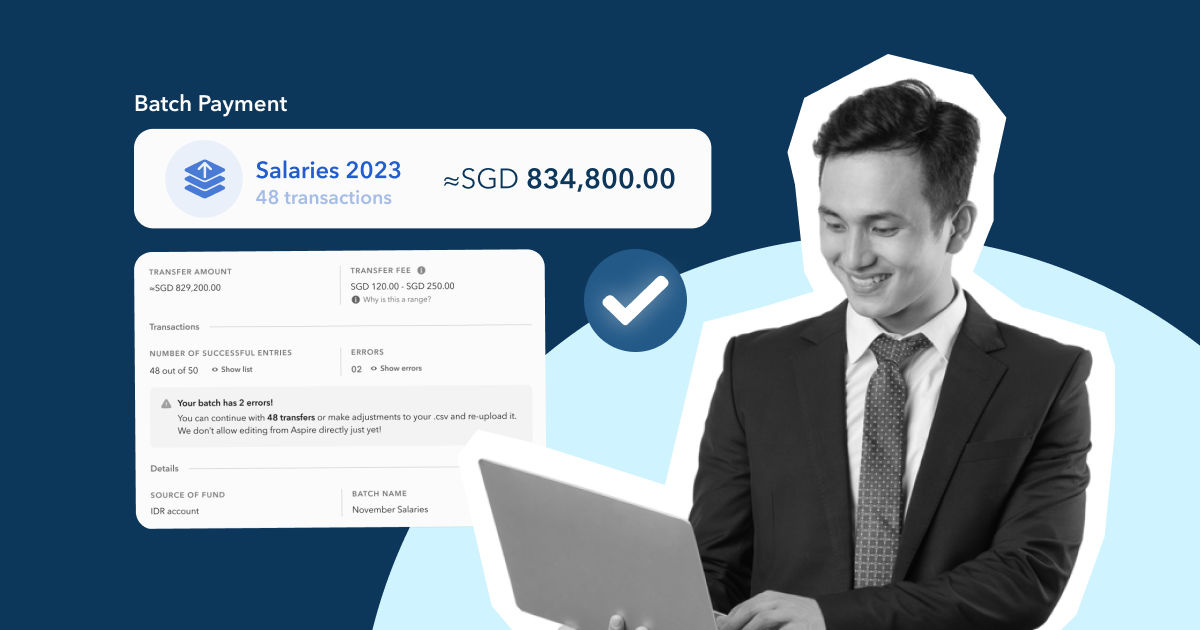
Aspire brings payroll-related payments together with approvals, expense management, global payments, business accounts, and accounting integrations, giving finance leaders a connected view of their operations and a finance function that's easier to manage and grow.
Aspire can support the finance layer around payroll by helping founders:
- Run salary and CPF payments: Make local payroll transfers through FAST and GIRO
- Manage international salaries: Send payments in 30+ currencies for overseas employees with low FX fees
- Reduce repetitive payment work: Reuse employee details, duplicate past transfers, and schedule salary payments in advance
- Control access: Restrict salary payment visibility to selected team members
- Connect payroll with finance: Bring payroll payments into the broader workflow alongside accounts, expenses, budgets, and accounting
This helps finance teams keep greater visibility and control over the cash and financial activity associated with payroll as the business grows.
FAQs
1. What is the difference between payroll outsourcing and managed payroll?
Payroll outsourcing covers the transfer of selected payroll responsibilities to an external provider. Managed payroll is a service model where the provider operates the payroll process under agreed workflows, controls, and service levels, while the business retains oversight.
2. What should I look for in a payroll outsourcing contract?
Check the contract for service scope, SLAs, pricing, data protection, liability, termination terms, data portability, and responsibilities for statutory filings. Make sure it also explains how errors, missed deadlines, payroll disputes, and service interruptions will be handled.
3. What payroll records should a business keep in Singapore?
Businesses should keep key payroll records such as payslips, payroll registers, salary details, deductions, allowances, overtime records, and relevant employee information. Employers covered by the Employment Act must retain itemised payslip records for at least 2 years.
4. Is payroll outsourcing suitable for multi-entity businesses?
Payroll outsourcing can be useful for businesses managing increasing complexity across multiple entities or jurisdictions. A suitable provider can help standardise processes and reporting, but you should assess its multi-entity capabilities, local expertise, controls, and ability to support your specific geographic footprint.
5. Does a payroll outsourcing provider handle CPF contributions?
Many Singapore payroll providers calculate CPF contributions and can handle the related remittance as part of their service. However, the exact scope varies. Confirm whether CPF calculations, submissions, and related administration are included in your provider’s agreement.
6. Can I switch payroll outsourcing providers?
Yes. Businesses can switch providers, but the transition needs careful planning around payroll data, historical records, system setup, and the timing of payroll runs. Before switching, confirm how your existing provider will export your data and how the new provider will migrate it.





.webp)