

What is a purchase order (PO) & what are its types?
Before diving into blanket POs, let's establish the foundation. A purchase order (PO) is a commercial document issued by a buyer to a seller, formally requesting specific goods or services at agreed-upon prices and terms. It serves as a legally binding contract once the supplier accepts it.
For startups and SMEs, properly managed purchase orders prevent maverick spending and create accountability across teams. Understanding the different types helps you choose the right tool for each procurement scenario:
- Standard purchase order: Used for one-time purchases with specific quantities, prices, and delivery dates. Best for unique or infrequent needs.
- Planned purchase order: Created in advance to schedule future purchases, providing visibility into upcoming spending.
- Contract purchase order: A legally binding framework for long-term engagements that defines terms but may not specify exact items upfront.
- Blanket purchase order (BPO): A long-term agreement designed for recurring purchases from the same supplier, covering multiple deliveries over an extended period at predetermined prices.
Each type serves distinct purposes, but for businesses dealing with the same items from the same supplier repeatedly, blanket purchase orders offer unmatched efficiency.
What is a blanket purchase order (BPO)?
A blanket purchase order, also known as a standing purchase order or blanket PO, is a long-term purchasing agreement between a buyer and supplier that authorises multiple deliveries of goods or services over a specified period, typically 6 months to a year, at pre-negotiated prices.
Unlike standard purchase orders that handle single transactions, a blanket purchase order creates a framework for ongoing procurement. This approach allows businesses to place orders as needed throughout the contract period while benefiting from bulk discounts, consistent pricing, and reduced paperwork.
Key features covered in blanket purchase orders
Understanding Blanket PO meaning starts with recognising the defining characteristics that make these agreements valuable:
- Flexible delivery schedules: Request shipments as needed within the contract period, matching actual demand rather than forecasted needs.
- Pre-negotiated pricing: Blanket POs lock your pricing, protecting your business from market fluctuations and enabling accurate budget forecasting.
- Volume-based discounts: Gain access to bulk discounts typically reserved for larger enterprises by committing to purchase quantities over time.
- Simplified ordering process: Once established, subsequent orders require minimal paperwork; simply reference the agreement and specify quantities, dramatically reducing administrative tasks.
- Spend limit controls: Set maximum spending thresholds to maintain budget discipline while retaining flexibility in timing.
- Stronger supplier relationships: The long-term agreement signals commitment to your supplier, often resulting in priority service and guaranteed supply availability.
For professional services firms and mid-size companies, these features translate into significant operational efficiency gains and administrative cost reductions.
Why blanket POs matter for Singapore businesses
Singapore's dynamic business landscape presents unique challenges that make blanket purchase orders particularly valuable for local enterprises.
Singapore businesses face several common pain points that blanket POs directly address:
- Limited resources: Small teams wear multiple hats, and time spent on repetitive administrative tasks reduces capacity for revenue-generating activities. Blanket purchase orders consolidate dozens of individual transactions into a single blanket purchase agreement.
- Cost pressures: Singapore's high operating costs make price predictability crucial. Blanket POs lock pricing to protect against inflation and market volatility.
- Supply chain reliability: Ensuring a consistent supply of critical materials is paramount. Blanket purchase orders provide guaranteed access from the same supplier.
- Compliance requirements: Meticulous record-keeping is essential. Blanket POs simplify audit trails by consolidating transactions.
Singapore companies implementing blanket purchase order systems report significant improvements in procurement efficiency. For instance, a Singapore-based e-commerce startup using blanket orders for packaging materials can negotiate better rates than competitors, directly improving profit margins.
How blanket purchase orders work — Step by step
Understanding the blanket purchase order process helps ensure successful deployment. Let's walk through each stage from initial planning to contract renewal.
1. Identify recurring needs
The foundation starts with analysing your purchasing patterns. Review your past 6–12 months of purchase orders and look for:
- Products or services purchased monthly or quarterly from the same supplier.
- Items with consistent quality requirements.
- Purchases with predictable demand patterns.
- Same items ordered repeatedly across departments.
Common candidates include office supplies, packaging materials, raw materials, maintenance services, and IT support.
2. Select trusted supplier(s)
Blanket purchase orders represent significant commitments, making supplier selection critical. Evaluate suppliers based on:
- Track record of quality and reliability.
- Financial stability and capacity to meet volumes.
- Responsiveness and customer service quality.
- Competitive pricing and willingness to offer bulk discounts.
Bear in mind that vendor management quality directly impacts blanket PO success.
3. Define terms & pricing
Negotiation is where blanket purchase orders deliver their greatest value. Key negotiation points include:
- Pricing structure: Agree on fixed unit prices for the contract duration. Negotiate bulk discounts based on committed volumes (typically 10–25% below one-off pricing).
- Contract duration: Most blanket POs run 6–12 months. Shorter terms provide flexibility for fast-growing startups; longer terms offer greater price stability.
- Volume commitments: Set minimum and maximum order quantities per delivery and total spending limits for the entire period.
- Delivery and quality terms: Establish lead times, delivery locations, acceptance criteria, and defect handling procedures.
- Payment and termination: Agree on payment schedules and include provisions for either party to exit if circumstances change.
For Singapore businesses, spend management platforms like Aspire can help track these negotiated terms and ensure compliance throughout the contract period.
4. Create & approve the blanket PO document
With terms negotiated, formalise the agreement in a comprehensive blanket purchase order document. This should be routed through your organisation's approval workflow based on contract value.
Procurement software solutions can automate these approval workflows, ensuring proper oversight while accelerating the purchasing process.
5. Issue BPO & communicate to supplier
Once approved internally, issue the blanket purchase order to your supplier with:
- Complete blanket purchase agreement document.
- Clear contact points for placing orders.
- Communication protocols for order releases.
- Confirmed supplier acceptance in writing.
Clear communication at this stage prevents confusion during ongoing execution.
6. Fulfilment & invoice matching
With the blanket PO active, your team can place orders by simply referencing the agreement. Each delivery triggers an invoice that must be matched against the blanket purchase order to ensure compliance.
This three-way matching, purchase order, delivery receipt, and invoice, ensures accuracy and prevents overbilling. Automated matching systems reduce invoice processing time by up to 75%.
7. Renew or close out
As the blanket PO approaches expiration, evaluate performance:
- Did we stay within projected spending limits?
- Was supplier performance satisfactory?
- Did market conditions remain stable?
- Has our business demand changed?
Based on this assessment, you can renew, renegotiate, or transition to a different supplier.
Key components of a blanket PO
A well-structured blanket purchase order includes specific elements that protect both parties while facilitating smooth transactions.
According to procurement best practices, every blanket purchase order should contain:
[Table:1]
Singapore companies should also include GST treatment, currency specifications, governing law (Singapore law), and dispute resolution procedures.
Template example of a blanket purchase order
Here's a simplified template structure that solopreneurs, startups, and SMEs can adapt:
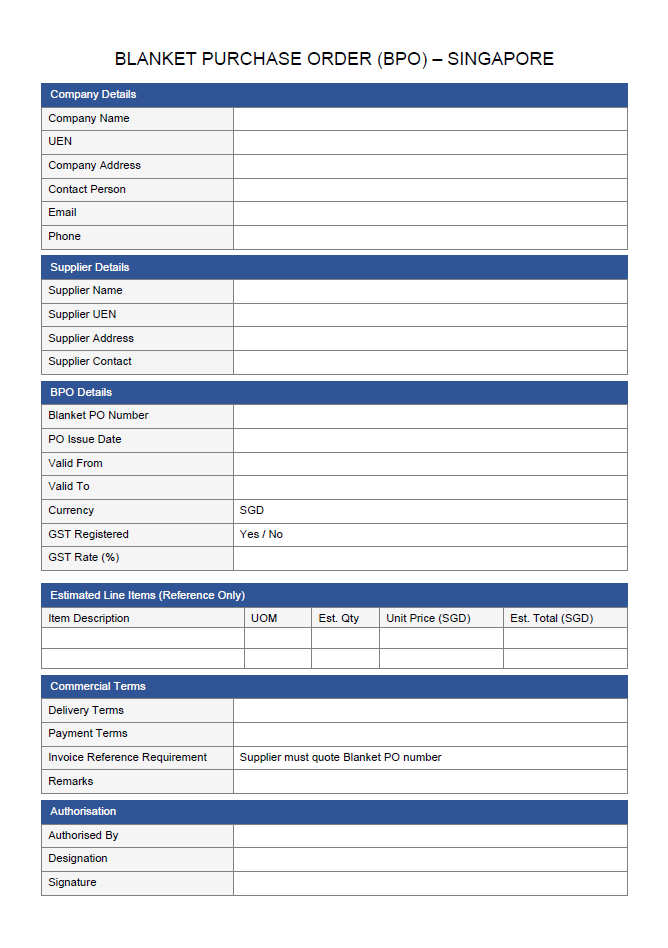
This template demonstrates how blanket purchase orders provide structure while maintaining flexibility.
Blanket POs vs standard purchase orders
Understanding the distinction helps procurement teams choose the right tool for each scenario.
[Table:2]
Blanket purchase orders excel for predictable, recurring needs where operational efficiency matters most. Conversely, standard POs remain ideal for one-time or project-specific needs.
When to use blanket purchase orders
While blanket purchase orders offer compelling advantages, they're not appropriate for every scenario. Let's explore when to deploy this tool and when to avoid it.
Ideal scenarios to use BPOs
Blanket POs deliver the greatest value when:
- Recurring purchases: You regularly buy the same items from the same supplier, office supplies, packaging materials, and maintenance contracts.
- Predictable demand: You can reasonably forecast annual consumption based on historical data.
- Established supplier trust: You've worked with the vendor and have confidence in their reliability.
- Price stability: Market conditions are relatively stable, and suppliers can commit to fixed pricing.
- Volume justifies negotiation: Your purchasing volumes warrant bulk discounts and preferential treatment.
- Administrative burden exists: You're creating multiple purchase orders for similar items, consuming valuable time.
- Supply continuity matters: Consistent access to products is critical for operations.
- Budget predictability needed: You need accurate cost forecasting for financial planning.
Singapore businesses implementing blanket POs for these scenarios report administrative cost reductions of 30–50% while improving procurement efficiency.
When not to use BPOs
Avoid using blanket POs when:
- Demand is uncertain: You can't predict your needs and risk over-committing.
- Supplier is unproven: Never establish blanket orders with vendors you haven't tested.
- Market prices are falling: Locking in today's rates means paying more than market value later.
- Requirements change frequently: When specifications evolve rapidly, rigidity becomes a liability.
- One-time or unique needs: Standard POs provide better flexibility.
- Multiple suppliers preferred: You benefit from supplier competition or want to diversify.
- Supplier capacity concerns: The vendor can't reliably meet your total projected demand.
- Short-term arrangements: For needs under three months, the setup effort often exceeds benefits.
Singapore startups experiencing hypergrowth should be particularly careful, as needs may change dramatically over six months.
Benefits of blanket purchase orders
The strategic advantages extend well beyond simple paperwork reduction. For solopreneurs, startups, and SMEs, blanket POs deliver transformative benefits.
- Dramatic time savings: Businesses reduce purchasing process time by 60-75% for recurring items. A solopreneur can reclaim 30+ hours annually by eliminating repetitive purchase order creation.
- Significant cost savings: Bulk discounts reduce per-unit costs by 10–25%, depending on volume, supplier leverage, and contract terms. Blanket POs lock pricing to protect against inflation, while reduced administrative costs from streamlined workflows add further savings.
- Enhanced supply chain reliability: Suppliers prioritise blanket PO customers with preferential allocation during shortages, faster turnarounds, and priority service.
- Superior budget control: Fixed pricing enables accurate forecasting and cash flow planning.
- Reduced administrative burden: Fewer POs to create, simplified approval workflows, easier invoice matching, and streamlined audit trails allow leaner operations.
- Improved compliance: Pre-approved spending limits and clear terms reduce maverick spending and simplify audits.
- Competitive advantages: Smaller businesses gain access to pricing and terms typically reserved for larger enterprises.
Risks and challenges of blanket POs
Responsible implementation requires acknowledging potential risks and developing mitigation strategies.
Risk 1: Over-commitment - You may commit to purchasing more than needed.
Mitigation: Start conservatively with smaller values and shorter durations (3-6 months). Include adjustment clauses and flexibility margins.
Risk 2: Supplier dependency - Relying heavily on one supplier creates vulnerability.
Mitigation: Maintain backup suppliers, include performance metrics in contracts, and diversify across multiple blanket POs.
Risk 3: Price disadvantages - If market prices drop, you're locked into higher rates.
Mitigation: Include price adjustment clauses, keep durations reasonable (12 months max for volatile markets), and monitor trends.
Risk 4: Inadequate monitoring - Without proper tracking, departments may exceed limits.
Mitigation: Implement automated spend management systems, set alerts at 75% and 90% of limits, and schedule regular reviews.
Risk 5: Insufficient documentation - Ambiguous terms lead to disputes.
Mitigation: Use comprehensive templates, engage legal review for high-value contracts, and document everything in writing.
Singapore businesses should be particularly attentive to currency fluctuations when establishing blanket POs with international suppliers.
Best practices for implementing blanket POs
Successfully deploying blanket purchase orders requires following proven best practices.
Staff training & clear policies
Develop clear written policies documenting when to use blanket POs versus standard POs. Create training materials explaining how to place orders against existing agreements. Define approval authorities and establish monitoring procedures. For startups with lean teams, simple one-page guides can dramatically improve compliance.
Set clear contract limits
Establish maximum spending thresholds based on realistic forecasts. Set both per-order minimums and maximums. Define total contract value caps that trigger renewal discussions. Implement automated alerts at 50%, 75%, and 90% of limits.
Regular review & renewal cycles
Schedule quarterly reviews of all active blanket purchase orders. Track key metrics: actual vs projected spend, delivery performance, quality issues. Assess whether pricing remains competitive. Begin renewal discussions 60-90 days before expiration. These reviews provide data-driven insights for renegotiating better terms.
Robust invoice matching procedures
Implement three-way matching: purchase order, delivery receipt, and invoice. Verify invoice prices match blanket PO rates. Check quantities don't exceed authorised limits. Flag discrepancies immediately. Automate matching where possible to reduce processing time by 75%.
Use procurement/ERP tools
Implement procurement software that supports blanket PO management with real-time tracking, automated alerts, and seamless accounting integration.
Pro tip for founders: When negotiating a blanket purchase order for printed materials, include a mandatory “press proof” approval for the first delivery. This helps ensure brand consistency and print quality are maintained across all orders throughout the 12-month contract period.
Example of how a blanket PO helps budget and cash flow
Let's examine how blanket purchase orders deliver tangible financial benefits for a growing Singapore business.
A hypothetical scenario: GreenTech Solutions, a Singapore-based SME providing eco-friendly cleaning services, consolidated purchases with its most reliable supplier under a blanket purchase agreement:
Before blanket POs:
- Ordered from three different vendors monthly
- Created 150+ individual purchase orders annually
- Prices varied 5-15% depending on availability
- Spent 8 hours monthly on procurement
- Annual cleaning supplies spend: SGD $180,000
After blanket PO implementation:
- 12-month contract with SGD $150,000 authorised spend
- Fixed pricing 12% below the previous average
- Orders fulfilled within 48 hours
- Net 45 payment terms (extended from Net 30)
The financial impact:
[Table:3]
Total quantifiable savings: SGD $33,800 annually (19% of original spend)
Beyond cost savings, GreenTech's blanket PO improved cash flow through predictable monthly costs (~SGD $12,500), extended payment terms providing additional working capital, and eliminated expensive emergency purchases.
Metrics & KPIs every procurement team should track
To ensure your blanket purchase order programme delivers ongoing value, establish clear metrics.
Cost-related metrics:
- Cost savings percentage: Calculate the difference between blanket PO pricing and previous costs (Target: 10-20% savings)
- Spend against budget: Track actual versus authorised spending (Formula: Actual Spend / Authorised Spend × 100)
- Administrative cost reduction: Measure time saved on procurement activities
Operational metrics:
- Order fulfilment rate: Percentage of on-time deliveries (Target: >95%)
- Quality defect rate: Percentage of deliveries with issues (Target: <2%)
- Contract utilisation: Percentage of authorised spend actually utilised (Target: 70-90%)
Strategic metrics:
- Number of POs reduced: Count how many individual POs were eliminated
- Supplier concentration: Percentage of spend with top suppliers (Target: no single supplier >30-40%)
- Contract renewal rate: Percentage renewed versus terminated (Target: >70%)
How Aspire supports efficient blanket PO management
Managing blanket purchase orders effectively requires integrated financial tools that provide visibility, control, and automation.
- Real-time spend tracking: Aspire's expense management platform gives instant visibility into spending against all blanket purchase agreements, showing exactly how much budget remains.
- Automated approval workflows: Set spending thresholds that determine approval requirements; smaller orders proceed automatically, while larger ones route to appropriate managers.
- Multi-level budgeting: Establish category-specific budgets aligned with your blanket purchase orders. Aspire's budgeting resources explain how granular control ensures spending stays within limits.
- Seamless invoice processing: Aspire automates matching supplier invoices to blanket PO terms, verifying prices, quantities, and spending limits while flagging discrepancies, reducing processing time by up to 75%.
- Integration with accounting: Integrates with Xero and QuickBooks, ensuring blanket PO transactions flow correctly into financial records without manual data entry.
- Corporate cards with controls: Issue cards with restrictions aligned with blanket purchase agreement terms, preventing overspending while empowering operational independence.
- Reporting and analytics: Dashboard shows spending trends, supplier performance, budget utilisation, savings realised, and category-level analysis.
Aspire helps centralise spend visibility, streamline approvals, and support invoice reconciliation against agreed purchasing terms, reducing manual effort. Get started with Aspire to transform how you manage blanket purchase orders.
Conclusion and next steps
Blanket purchase orders represent a powerful strategy for businesses seeking to streamline procurement operations, reduce costs, and build stronger supplier relationships. For Singapore solopreneurs, startups, and SMEs, implementing a thoughtful blanket PO programme delivers immediate benefits: significant time savings, 10-25% cost reductions through bulk discounts, improved cash flow, and enhanced operational efficiency.
The key to success lies in identifying the right opportunities, recurring purchases from trusted suppliers, negotiating favourable terms, establishing clear policies and controls, and implementing technology that provides visibility and automation.
Your action plan:
- Audit your current spending: Review 6-12 months of purchase orders to identify repetitive purchases
- Prioritise opportunities: Focus first on high-volume, predictable categories
- Select strategic suppliers: Choose reliable vendors with proven track records
- Negotiate win-win terms: Develop agreements that deliver value through bulk discounts
- Implement clear policies: Document procedures for using blanket POs
- Deploy enabling technology: Use platforms like Aspire to automate tracking
- Monitor and optimise: Track key metrics and review performance quarterly
While blanket purchase orders provide the framework for efficient procurement, having the right financial tools amplifies their impact. Aspire's all-in-one finance platform empowers Singapore businesses to manage blanket POs with unprecedented ease, tracking spending in real-time, automating approvals and invoice matching, setting granular budgets, and generating insights for better decisions.
Get started with Aspire today and discover how the right tools transform blanket purchase order management from an administrative burden into a competitive advantage.
Frequently asked questions
What is an example of a blanket order?
A typical example is an e-commerce business establishing a year-long blanket purchase agreement with a packaging supplier. Rather than creating individual purchase orders each time they need boxes and bubble wrap, they negotiate a blanket PO that:
- Covers a 12-month period
- Locks in fixed pricing at 15% below standard rates
- Authorises up to SGD $50,000 in total spending
- Allows flexible order quantities based on actual needs
- Requires delivery within 3 business days
Throughout the year, the business simply references the blanket PO number when placing orders; no new approvals, no price negotiations, no paperwork. Another common example is a professional services firm using a blanket PO for IT support services, committing to a monthly retainer that covers routine maintenance throughout the contract period.
What is a blanket delivery order?
A blanket delivery order (sometimes called a release order or call-off order) is an individual shipment request made under an existing blanket purchase order. It's the mechanism for actually receiving goods covered by your blanket purchase agreement.
The blanket PO is the overarching agreement with your supplier, establishing pricing, terms, total spending limits, and contract duration.
The blanket delivery order is the specific request when you need products: "Please send 50 units of item X to our warehouse by Friday, per blanket PO #12345."
Think of it like this: The blanket purchase order is your season ticket to events, while each blanket delivery order is when you actually attend a specific game. This structure provides flexibility; you're not obligated to order on a fixed schedule, but can request deliveries as your actual needs dictate, while still benefiting from pre-negotiated terms.
What is the difference between a standing order and a blanket order?
While the terms standing order and blanket order are often used interchangeably, there can be subtle differences:
Blanket purchase order (BPO):
- Covers a range of products from the same supplier with flexible quantities and timing
- You control when and how much to order within contract limits
- Best for variable demand where exact timing fluctuates
- Example: Office supplies where monthly needs vary
Standing purchase order:
- Often implies regular, recurring deliveries on a predetermined schedule
- Quantities and timing may be more fixed (e.g., 100 units delivered first Monday of every month)
- Best for highly predictable, routine needs
- Example: Weekly delivery of fresh produce to a restaurant
However, in practice, many organisations use these terms interchangeably to describe long-term agreements for repetitive purchases. The important thing is ensuring your blanket purchase agreement document clearly specifies whether deliveries are on-demand (true blanket) or scheduled (standing).
Aspire's spend management platform supports both models, allowing Singapore businesses to track spending and manage approvals regardless of whether orders are ad-hoc or scheduled.





.webp)