


C-Corp vs LLC: Which one is the best structure when entering the US?

Galih Gumelar

Summary
Choosing between a C-Corp and an LLC determines how easily you can raise capital, issue equity, hire talent, and scale in the US.
US investors strongly prefer C-Corps because of standardized governance, clean equity structures, QSBS eligibility, and predictable exit mechanics.
LLCs work well for bootstrapped, cash-flow-driven businesses, but create friction for fundraising, stock options, and institutional investment.
Most venture-backed startups incorporate in Delaware because its corporate law, courts, and investor familiarity reduce legal risk and fundraising friction.
Entering the US market is a milestone for many global founders. You’ve validated demand elsewhere, built momentum, and now you’re stepping into the world’s most competitive startup ecosystem.
But before you pitch investors, hire employees, or open a US bank account, there’s a foundational decision that quietly shapes everything that comes next: your business structure.
For most founders, the choice comes down to two options: a C-Corporation (C-Corp) or a Limited Liability Company (LLC). Both are common, both are legal, and both can work. But they’re designed for very different outcomes.
This guide walks you through how C-Corps and LLCs work in the US, how investors think about them, and which structure makes sense depending on what you’re building.
Overview of types of business structures in the US
The US offers several types of legal business entities. According to the Internal Revenue Service (IRS), the most common business structures include:
- Sole proprietorship
- Partnerships
- Corporation (C-Corp)
- LLC
- S-Corporations
However, not all of these structures are practical for startups or global founders. S-Corporations, for example, are restricted to US citizens and permanent residents and can’t have foreign shareholders. Partnerships, while legally available to non-US founders, often create tax complexity and are rarely used by venture-backed startups. Sole proprietorships are also unsuitable if you’re planning to raise capital from venture capitalists or institutional investors.
As a result, global founders almost always choose between a C-Corp and an LLC. Both provide limited liability protection, but they differ significantly in how they handle ownership, taxation, fundraising, and long-term scalability.
What is a C-Corp
A C-Corporation (C-Corp) is a standalone legal entity that exists separately from its founders and shareholders. It can own assets, enter into contracts, hire employees, pay taxes, and issue equity in its own name. In the US startup ecosystem, the C-Corp isn’t just common; it’s the default structure for venture-backed companies.
Most US venture capital firms expect startups to be structured as C-Corps before they invest, particularly if the company plans to scale quickly, raise multiple funding rounds, or pursue an acquisition or IPO in the future.
Because the company is legally separate from its owners, a C-Corp continues to exist even if founders leave, equity changes hands, or new investors come on board. This permanence is one of the reasons it works well for high-growth businesses.
Key characteristics of a C-Corp
A C-Corp has a clearly defined and widely understood structure:
- It’s taxed as a separate entity from its owners
- Ownership is represented by shares
- It can issue multiple classes of stock, including preferred shares
- Governance follows a standard hierarchy: shareholders, a board of directors, and corporate officers
- Equity can be easily transferred, issued, or repurchased
This structure is deeply embedded in US corporate law and startup practice, which makes it predictable for lawyers, investors, and acquirers alike.
Why investors prefer C-Corps
From an investor’s point of view, C-Corps offer several advantages:
- Clean, standardized equity ownership through shares
- The ability to issue preferred stock with investor protections
- Predictable governance and voting rights
- Clear exit mechanics for acquisitions or public listings
- No pass-through tax exposure to individual investors
This familiarity matters. When investors don’t have to re-engineer a deal structure or explain exceptions to their limited partners, deals move faster and with less friction. For founders, that often translates into smoother fundraising and fewer last-minute structural demands.
Another reason investors strongly prefer C-Corporations is access to Qualified Small Business Stock (QSBS) under the One Big Beautiful Bill Act.
If certain conditions are met, QSBS allows eligible shareholders to exclude up to USD $15 million in capital gains from US federal tax when they sell their shares. To qualify, shares generally must be:
- Issued by a US C-Corporation
- Acquired at original issuance
- Held for at least 3 years
- Issued by a company below specific asset thresholds at the time of issuance
This potential tax exclusion is a major driver behind venture capital firms insisting on C-Corp structures from day one. LLCs and other pass-through entities don’t qualify for QSBS treatment.
What is an LLC?
A Limited Liability Company (LLC) is a flexible business structure that blends elements of corporations and partnerships. It provides limited liability protection to its owners while offering simpler operations and, by default, pass-through taxation.
LLCs are extremely popular in the US, particularly among small businesses, consultants, real estate ventures, and bootstrapped startups that don’t plan to raise institutional capital.
Instead of shareholders, LLCs have members, and ownership is expressed through membership interests rather than shares. Management can be handled directly by the members or delegated to appointed managers, depending on how the LLC is set up.
Key characteristics of an LLC
An LLC is designed to be operationally flexible:
- Limited liability protection for members
- Pass-through taxation by default, meaning profits and losses flow directly to owners
- Flexible ownership and management structures
- Fewer formal governance requirements than a corporation
- Fewer ongoing corporate formalities, such as board meetings
Because of this flexibility, LLCs can be customized extensively through an operating agreement, which defines how profits, voting rights, and management responsibilities are handled.
Why founders choose LLCs early
Many global founders start with an LLC because it feels more accessible at the beginning. Common reasons include:
- It’s faster and cheaper to set up
- There’s less upfront legal and administrative complexity
- Profits and losses pass directly to owners, which can simplify early tax reporting
- It works well for solo founders or small, cash-flow-positive teams
However, once a business plans to raise venture capital, issue stock options, or scale aggressively in the US, the same flexibility that makes LLCs attractive early on may become a limitation, especially for global founders dealing with US investors.
C Corp vs LLC: Which one is the best?
Choosing the right business structure isn’t about what feels easiest today. It’s about where you want the company to go next, and how you plan to fund and operate it along the way.
The table below highlights the key differences to help you decide which structure fits your plans.
| Factor | C-Corp | LLC |
|---|---|---|
| Investor-friendly? | Preferred by venture capitalists and angel investors. Most US startups that raise funding are C-Corps. | Investors typically avoid LLCs due to pass-through taxes and complex ownership classes. |
| Taxation | The corporation pays US corporate tax. Shareholders only pay tax on dividends (if any). No personal US tax return needed for foreign owners unless they draw salary/dividends.Franchise tax depending on the state or jurisdiction chosen. | Profits pass through to the owner's personal taxes. Foreign owners must file US tax returns and might owe tax on undistributed LLC profits. |
| Legal Structure | Needs a board of directors, officers, bylaws, stock issuance, etc. | Less formal requirements and more flexibility. Can be managed by members or managers and governed by an operating agreement. |
| Ease of ownership | Easy transfer of shares. Stock can be issued in classes (common/preferred) and transferred and sold. | Ownership is in membership units. Transferring interests or adding new investors may require revising the operating agreement. |
| Better for | Default for startups aiming to scale or raise capital. Also necessary if you plan an IPO or stock option pool. | More suitable for businesses that have no plans to seek venture capital. |
If you plan to raise money from US investors, offer equity to employees, or build a high-growth company, a C-Corp may be the right choice from the start. It reduces friction, avoids future restructuring, and aligns with how the US venture ecosystem operates.
An LLC can work well early on if you’re testing the market, operating as a small team, or prioritizing simplicity over scale. However, many global founders who start with an LLC eventually may need to convert to a C-Corp before fundraising, often under time pressure and at higher legal cost.
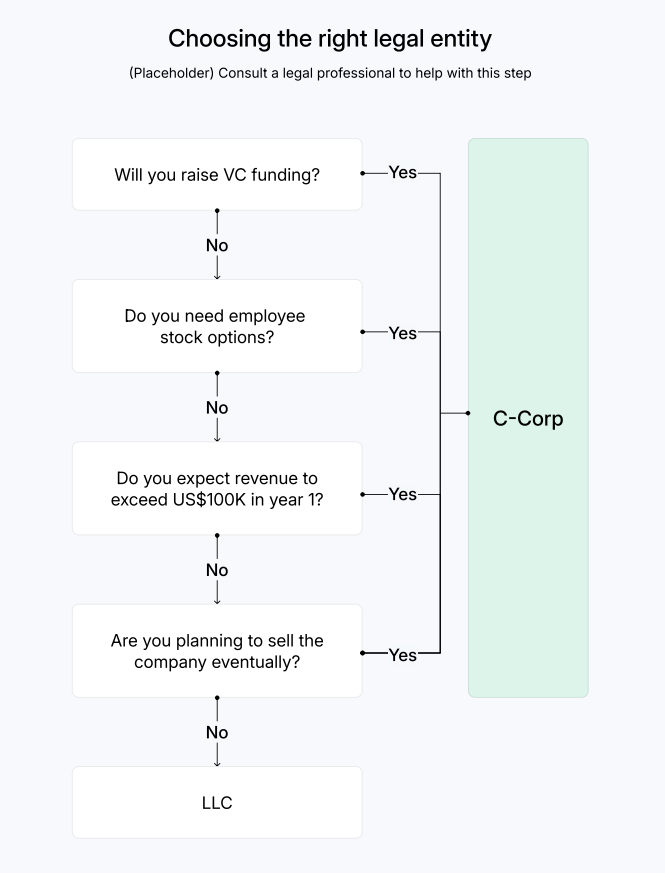
To make this decision clearer, you can also use the flowchart below to assess which structure best fits your US expansion goals.
Where should you incorporate C-Corp?
Choosing a business structure is one step, but deciding where to incorporate is just as important because it affects your legal exposure, investor readiness, ongoing compliance, and long-term scalability.
In the US, you don’t have to incorporate in the state where you live, operate, or even hire employees. Many startups incorporate in one state and register to do business in others as they grow. For global founders, the goal is usually to choose a state that minimizes friction, is widely understood by investors, and won’t create unnecessary complexity later.
Below are the most common states founders consider when incorporating a C-Corp.
Delaware
Delaware is the default choice for venture-backed startups in the US. More than half of all publicly traded US companies and the vast majority of US startups backed by venture capital are incorporated here.
Delaware offers:
- A well-established corporate law system focused on business disputes
- The Delaware Court of Chancery, which specializes in corporate cases
- Predictable legal outcomes that investors and lawyers trust
- Strong privacy protections for founders and shareholders
- No state corporate income tax on revenue earned outside Delaware
Because Delaware law is so standardized, most VC firms use legal templates designed specifically for Delaware C-Corps. This familiarity reduces legal risk, speeds up fundraising, and avoids negotiations over basic structural issues.
California
California is often considered by founders who plan to operate primarily in Silicon Valley or other parts of the state. While it’s a major startup hub, incorporating directly in California can introduce additional complexity.
Key considerations include:
- Higher franchise taxes and regulatory requirements
- Less flexibility around certain corporate governance matters
- Investors still typically prefer Delaware C-Corps, even for California-based companies
As a result, many startups operating in California incorporate in Delaware and register as a foreign entity in California instead.
Wyoming
Wyoming is often marketed as a low-cost, founder-friendly state with minimal reporting requirements. While it can work for small businesses or holding companies, it’s rarely used for venture-backed startups.
From an investor’s perspective:
- Wyoming C-Corps are less familiar
- Legal precedent is thinner than Delaware’s
- Additional due diligence may be required
This unfamiliarity can slow down fundraising or create unnecessary legal discussions.
So, where should you incorporate?
If you’re building a company with any intention of raising US venture capital, issuing stock options, or pursuing a future exit, Delaware may be the best choice.
Incorporating in Delaware doesn’t mean you have to operate there. It simply gives your company a legal foundation that US investors already understand and trust. For global founders, that familiarity removes friction, shortens fundraising timelines, and prevents painful restructuring later.
Considerations when registering in Delaware
Incorporating a C-Corp in Delaware is a relatively straightforward process, but getting the foundations right matters. Many fundraising and compliance issues later on can be traced back to a rushed or incomplete setup at this stage.
Below are the key steps and considerations to keep in mind when registering your Delaware C-Corporation.
1. Prepare your capitalization table early
Before you file anything, you should have a clear pro forma capitalization table (cap table). This document defines ownership and is one of the first things investors will review.
Your cap table should determine:
- The total number of authorized shares
- Who the shareholders are
- How many shares are issued to each shareholder
- The percentage of ownership for each shareholder
- Optional but often included:
- Stock classes (for example, common vs preferred)
- Value per share
At the earliest stage, most startups only authorize and issue common stock to founders, and that’s normal. Preferred shares are typically introduced later during priced funding rounds. However, if you already have multiple share classes or early investors, your cap table should reflect that clearly. Getting this right upfront helps avoid confusion, dilution disputes, and investor hesitation later.
2. Check name availability with the Delaware registry
Next, confirm that your desired company name is available in Delaware. The state maintains an online business name search through the Delaware Division of Corporations.
Your name must be distinguishable from existing registered entities. Even small differences, such as punctuation or suffixes, matter. It’s also a good idea to check domain availability at the same time, especially if you plan to launch publicly soon.
You can optionally reserve your entity name for 120 days for a fee of USD $75 (as of January 2026), though this isn’t required to incorporate.
3. Confirm directors and basic governance details
Delaware requires every corporation to have at least one director, but directors are typically appointed after incorporation through bylaws or board consent. In this case, what you need to do is confirm the full legal names and mailing addresses of directors for your internal records and initial corporate documents.
4. Secure a business address
While you don’t need a physical office in Delaware, you do need a business address for banking, compliance, and correspondence. Many founders use:
- A virtual office
- A US mailing address service
- Their registered agent’s address for limited purposes (note that many banks require a separate operating address)
This helps ensure you can receive official communications without delays.
5. Appoint a registered agent
Every Delaware corporation must appoint a registered agent with a physical address in the state. This agent receives official legal documents on behalf of your company, such as service of process and compliance notices.
Most global founders use a professional registered agent service. It’s inexpensive and removes the need for a physical presence in Delaware.
6. File your Certificate of Incorporation
To officially form your company, you’ll file a Certificate of Incorporation with the Delaware Division of Corporations. This document typically includes:
- Your company name
- Registered agent details
- Incorporator name and address
- Authorized share count
- Par value per share
- Basic purpose clause
Once filed and approved, your C-Corp legally exists.
7. Complete post-incorporation steps
After registration, there are a few essential follow-ups you shouldn’t skip:
- Adopt bylaws
- Issue founder shares according to the cap table
- Execute stock purchase agreements
- Set up founder vesting schedules
- Apply for an Employer Identification Number (EIN)
These steps formalize ownership and governance and are often required before opening bank accounts or raising funds.
A quick note on taxes: Understanding 83(b) election
The 83(b) election is a one-page filing with the IRS that affects how your stock grants are taxed. It must be filed within 30 days of the date you receive your shares.
If your startup shares vest over time, filing an 83(b) election tells the IRS that you want to be taxed on the shares upfront, based on their current (typically low) value, rather than being taxed as they vest later at a potentially higher value.
This can mean much lower taxes for founders. You lock in a low value now and avoid higher tax bills down the road. For most startup C-Corp founders with vesting stock, filing the 83(b) is essential.
Failing to file can result in significantly higher tax bills later, especially if the company’s valuation increases quickly. While not every founder situation requires an 83(b) election, it’s one of the most common early-stage tax considerations and should be reviewed with a US tax advisor as part of your incorporation process.
How long does Delaware incorporation take in total?
While the legal incorporation itself can be completed in days, most founders should plan for two to four weeks to fully complete incorporation, post-incorporation formalities, and banking readiness.
Rushing this process may save a few days upfront, but it often creates weeks of cleanup later—especially once investors, banks, or regulators start asking questions.
Conclusion
When comparing a C-Corp and an LLC, the deciding factor isn’t which structure is “better” in theory; It’s which one aligns with how you plan to grow.
If your goal is to build a venture-scale company in the US—one that can raise capital, issue equity, hire talent with stock options, and eventually exit—a C-Corporation may be the more practical choice. Once that decision is made, the next logical question isn’t whether to incorporate as a C-Corp, but where.
While you can form a C-Corporation in many US states, most venture-backed startups end up in the same place: Delaware. Not because it’s trendy, but because its corporate laws are predictable, investor-friendly, and widely understood. Choosing Delaware reduces legal friction, shortens diligence cycles, and avoids the need to explain unfamiliar state rules to investors later on.
In other words, choosing a C-Corp sets the structure for growth. Choosing Delaware sets the foundation for fundraising and long-term scalability.
Want a detailed, step-by-step playbook for starting in the US?
Choosing a business structure in the US is only one part of the journey. For global founders, the real challenge is aligning company structure, banking, compliance, and fundraising readiness so nothing breaks when investor interest finally shows up.
If you’re looking for a more practical, end-to-end guide, we’ve put together the ultimate guide to entering the US. It’s designed specifically for global founders who want fewer surprises and more clarity as they enter the US market.
Inside the guide, you’ll find:
- Which visa should you use when entering the US
- What investors are looking for when you raise funds in the US
- What metrics to use to show you’re gaining momentum in the US
- Practical insights from founders who’ve already made the move
Taken together, the guide is designed to help you move into the US with clearer expectations, fewer structural surprises, and a setup that supports fundraising rather than slowing it down.
Sources
- Internal Revenue Service - https://www.irs.gov/businesses/small-businesses-self-employed/business-structures
- US Small Business Administration - https://www.sba.gov/business-guide/launch-your-business/choose-business-structure
- Investopedia - https://www.investopedia.com/terms/c/c-corporation.asp
- Internal Revenue Service - https://www.irs.gov/businesses/small-businesses-self-employed/limited-liability-company-llc
- Harvard Business Service - https://www.delawareinc.com/blog/why-venture-capitalists-prefer-delaware-c-corps/
- Delaware.gov - https://corp.delaware.gov/stats
- Forbes - https://www.forbes.com/councils/forbesnycouncil/2019/03/04/the-benefits-and-pitfalls-of-incorporating-in-delaware-nevada-and-wyoming/
- CrossVentura - https://www.crossventura.com/blogs/best-us-state-for-startups-2025
This blog is for general information only and does not constitute financial, legal, tax, or professional advice. Aspire’s services are subject to the terms outlined in our ’Terms of Service’ and ’Pricing’ pages. We make no guarantees as to the accuracy, completeness, or timeliness of the content, and past results do not indicate future performance. Always consult a qualified professional before acting on any information provided.
Galih Gumelar
Writer
Galih is a seasoned writer specialising in macroeconomics, business, finance and politics. With a writing history at CNN Indonesia, The Jakarta Post, and various other reputed organisations, Galih leverages his broad range of experiences to create insightful resources for those wanting to start a business.
Aspire Launchpad
Supercharge your finance operations with Aspire
Find out how Aspire can help you speed up your end-to-end finance processes from payments to expense management.

Latest articles

Best multi-currency business accounts in the US for 2026
Compare the best multi-currency business accounts in the US for 2026. Explore fees, FX costs, currencies, holding, receiving options, and key features.

How to start an LLC in Ohio: Step-by-step guide
Starting an LLC in Ohio costs $99 and clears in two business days if expedited. The filing steps, real year-one costs, and the municipal tax to plan for.
Divvy credit card: Features, fees, eligibility
Explore Divvy credit card eligibility, fees and reward tiers, plus how its credit limits are set dynamically, and how you can boost yours.