

.webp)

Why the hiring decision matters
Your first hiring decisions in the US shape far more than your org chart. They directly affect how fast you can enter the market, how much you’ll spend each month, and how complex your operations become. Hiring locally can speed up customer access and credibility, while relocating your team can preserve culture and execution speed, but each choice comes with very different trade-offs.
There’s also a significant compliance layer. Hiring in the US triggers obligations around payroll setup, employment taxes, benefits, and labor laws. Relocating team members adds another dimension, including visa eligibility, immigration timelines, and ongoing reporting requirements. These choices can ripple into other areas, such as which payroll providers you can use, how banks assess your risk profile, and whether your company looks “US-ready” to partners and investors.
Because of these effects, hiring isn’t just an HR decision; it’s a strategic one. By the end of this guide, you should be able to decide whether hiring local talent or relocating your team makes more sense for your US expansion. We’ll break down each option below.
Option 1: Hiring local talent in the US
For some global founders, hiring in the US may seem like the most direct way to build credibility and momentum in a new market. Bringing on local talent can help you move faster with customers and partners, but it also introduces higher costs and operational complexity. Here’s how to think about the trade-offs.
Key advantages
1. Cultural fluency
US hires understand local communication styles, workplace norms, and customer expectations. That cultural context reduces friction in sales, hiring, and day-to-day operations, especially if your founding team is based outside the US.
2. Faster access to customers and networks
Local employees often come with existing relationships across customers, vendors, and industry peers. These networks can accelerate deal flow, partnerships, and hiring in ways that are hard to replicate from abroad.
3. Stronger client trust
For many US customers, especially enterprise buyers, having US-based employees signals commitment and legitimacy. A local point of contact can make procurement, contracting, and ongoing relationships smoother.
4. No visa or relocation timelines
Local hiring removes immigration from the critical path. You don’t need to wait for visa approvals, manage relocation logistics, or deal with uncertainty around entry timelines. That speed can matter when you’re racing to validate demand or support early customers.
5. Lower immigration risk
From a compliance standpoint, hiring US-based employees is simpler than relocating foreign team members. You avoid visa denials, renewal risks, and changing immigration policies, which can disrupt planning if your growth depends on specific individuals being in the US.
Key challenges
1. Requires US payroll and compliance
Hiring locally means setting up US payroll, handling employment taxes, and complying with federal and state labor laws. This adds ongoing administrative work and often requires external support from payroll providers or advisors.
2. Higher salaries in competitive markets
Compensation in the US, particularly for engineering and leadership roles, is significantly higher than in many other regions. Benefits like health insurance and equity further increase total employment costs.
3. Faster employee turnover
The US job market is competitive and fluid. Employees may change roles more frequently, especially at early-stage startups, which can lead to higher churn and recurring rehiring costs if expectations aren’t aligned early on.
Option 2: Relocating your team
On the other hand, some global founders decide not to hire new people when expanding into the US. Instead, they relocate the people who already know the business best.
It’s not that they reject hiring US talent—often the cost is higher—but rather that their existing team helps preserve execution quality and company culture. However, this approach also introduces its own set of challenges.
Key advantages
1. Deeper product and company context
Your existing team already understands the product, roadmap, and internal decision-making. There’s no onboarding curve, which helps maintain momentum during early US expansion.
2. Culture continuity
By relocating the team that shaped your company’s culture, you reduce the risk of dilution or misalignment. This is especially valuable when your values, ways of working, and speed of execution are core differentiators.
3. Built-in loyalty and long-term retention
Team members who relocate with the company are often more invested in its long-term success. That loyalty can translate into lower turnover and stronger commitment compared to early-stage local hires in competitive US markets.
4. Stronger control over operations and decision-making
Founders often feel more confident when core decision-makers and key operators move together. With your leadership and execution team aligned in one place, it’s easier to maintain consistency across strategy, product development, and customer engagement.
5. Easier alignment with HQ processes
Your internal workflows, reporting structures, and communication habits don’t need to be rebuilt. This can be especially valuable if your company already has well-defined processes that would be difficult to replicate quickly with a newly hired US team.
Key challenges
1. Visa uncertainty and long approval timelines
US immigration is complex and unpredictable. Visa approvals aren’t guaranteed, processing times can stretch for months, and policy changes can introduce last-minute delays. These uncertainties can make planning US expansion timelines difficult.
2. Distance from US customers and networks
Even when physically in the US, relocated teams may lack immediate access to local customer networks, industry relationships, and market intuition. This can slow customer acquisition and partnerships early on.
3. Possible cultural gaps in communication
Working styles, sales conversations, and stakeholder expectations in the US can differ from those in other markets. Without strong local exposure, teams may face subtle communication gaps that affect customer trust or deal velocity.
4. Relocation and personal costs
Relocating employees involves more than visas. Housing, healthcare, family considerations, and cost-of-living adjustments all add up. These factors can increase compensation expectations and place personal strain on team members.
When hiring local talent vs relocating your team makes more sense
There’s no single “right” hiring strategy when expanding into the US. The better choice depends on what stage your company is in, what you’re optimizing for, and how critical speed, cost, and control are to your next phase of growth.
Hiring local US talent may make more sense when your priority is market access. If you need people who understand US customers, sales cycles, regulations, or industry norms from day one, local hires can shorten the learning curve. This approach is especially effective for go-to-market roles like sales, marketing, partnerships, and customer success, where proximity, trust, and cultural fluency directly impact revenue.
Relocating your existing team, on the other hand, may work better when execution quality and internal alignment matter more than local context. If your product is complex, your processes aren’t fully documented, or your company culture is still forming, moving people who already know how the business runs can reduce operational risk. Founders often choose this route when they want consistency during early US expansion, even if it means slower local market penetration.
In practice, many global founders don’t treat this as a binary decision. They’ll relocate a small core team to anchor execution and culture, while selectively hiring local talent for customer-facing roles. The right mix depends on whether your biggest risk is misunderstanding the US market or losing control of how your business operates as you scale.
Key considerations before hiring local talent
If you’ve decided to prioritize hiring local talent, there are a few important considerations to work through before making your first US hire. While hiring locally can accelerate market access and credibility, it also introduces operational and compliance complexity that many global founders underestimate early on.
Regardless of which hiring model you choose, the real complexity lies in understanding the legal, financial, and operational implications of employing people in the US, which is why it’s critical to look closely at the key considerations before hiring local talent.
Contractor vs employee classification
One of the first decisions you’ll face is whether to hire US talent as an independent contractor or a full-time employee. While contractors can work well for short-term or clearly defined projects, they generally can’t replace core, ongoing roles without increasing the risk of misclassification.
That risk has become more pronounced in 2025, as the US Department of Labor reaffirmed its enforcement focus on the “economic reality” test. In practical terms, if your company controls how, when, and where someone works, the law may view them as an employee, not as a contractor.
Using contractor status primarily to reduce taxes or administrative burden can lead to serious consequences. Misclassifications may trigger back taxes, penalties, and interest, and it often surfaces during Series A or B due diligence, where investors closely examine employment and compliance practices.
US payroll and compliance readiness
Hiring US employees means setting up compliant payroll, handling federal and state tax withholdings, and managing benefits such as health insurance, unemployment insurance, and workers’ compensation. These requirements vary by state, and mistakes can be costly.
The good news is that hiring in the US doesn’t mean you need to build a full HR function from day one. Most global founders rely on one of three hiring models, depending on their stage and local setup, to support payroll and compliance readiness since day one:
- Employer of Record (EOR): HR platforms can hire employees on your behalf, handling payroll, benefits, and compliance. This is the most common “day one” option for companies that don’t yet have a US entity.
- Professional Employer Organization (PEO): Once you have a US entity in place, a PEO can co-employ your team and manage payroll, benefits, and HR administration, while you retain day-to-day control over employees.
- Direct payroll: This approach is usually adopted later, once headcount and operational complexity justify building internal HR and finance capabilities.
Compensation expectations and cost structure
US salaries, especially in competitive markets like San Francisco and New York, are often significantly higher than in many other regions. But more importantly, salary is only one part of the total cost of hiring in the US.
Unlike many markets where base pay makes up most of an employee’s cost, US compensation is viewed holistically. Founders should plan for additional components such as employer payroll taxes, health insurance contributions, retirement (401(k)) matching, and required insurance coverage.
In practice, total compensation is often understood as:
Total compensation = annual take-home pay + equity (expected, not a bonus) + health insurance quality and premiums + 401(k) matching and other benefits
This equation is increasingly shaped by pay transparency laws and cost-of-living expectations. A competitive package in San Francisco or New York may look very different from one in Atlanta or Denver. Therefore, the key isn’t just whether you can afford a salary today, but whether your compensation structure is sustainable as you scale hiring across different US markets.
[Table:1]
Talent competition and retention risk
US talent markets move quickly, and employees are generally more willing to change jobs. If expectations around growth, compensation, or impact aren’t met, turnover can happen fast. Without clear career paths, strong management, and a compelling mission, retaining local talent can be more challenging than hiring it.
It’s also important to note that employment in the US is generally “at-will.” In most states, this means either the employer or the employee can end the employment relationship at any time, for any legal reason, without prior notice.
For founders from Europe or Latin America, where termination processes are more structured and protective, this can feel abrupt. In practice, many companies still use notice periods and severance for trust and retention, but the legal baseline is very different.
Management and communication readiness
Hiring local talent only works if you can support and manage that team effectively. This means setting clear goals, documenting processes, and maintaining strong communication across time zones. If leadership and decision-making remain offshore, you’ll need to be deliberate about how local hires are empowered and supported.
Key considerations before relocating your team
If you decide to relocate your team because it’s the most suitable option for now, there are several important factors you’ll need to consider upfront. Unlike hiring locally, relocation shifts complexity toward immigration, timelines, and long-term compliance, so early planning matters.
Choosing visa options
US work visas are complex, slow-moving, and often uncertain. While several visa categories are commonly used by startups, none are guaranteed, and each comes with trade-offs.
At a high level, founders usually explore options such as:
- L-1 visas, for transferring employees or key executives from a foreign parent company to a US entity
- H-1B visas, which are subject to annual caps and lottery selection
- O-1 visas, designed for individuals with extraordinary ability
- International Entrepreneur Rule (IER), if your startup is less than 5 years old and has received a total investment of at least USD $311,071 from qualified US investors
However, when it comes to visas, there’s no single “best” option. In practice, one route is far more commonly used for team relocation.
For most global founders, the L-1 visa may be the most practical starting point for relocating existing employees. It’s designed specifically for transferring staff from a foreign company to a related US entity. However, L-1 eligibility depends on prior employment history and qualifying corporate relationships, so early legal review is essential.
Meanwhile, O-1 visas can work for highly specialized or senior individuals, but they require strong evidence and don’t scale well for moving multiple team members.
You can refer to the diagram below to get a high-level view of how these visa options compare in terms of ease of eligibility and duration.
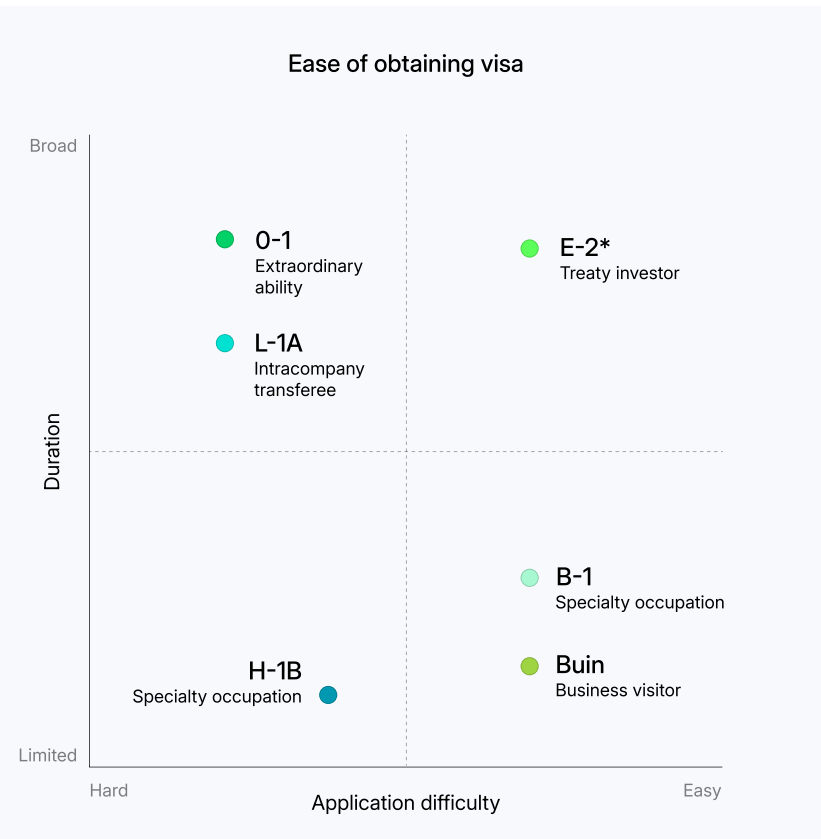
The key takeaway: Your visa strategy should follow your operating reality. If your goal is to move existing employees who already work for you, L-1-style transfers are often the most aligned option.
However, immigration timelines, eligibility, and risk vary significantly, so visa planning should happen early and alongside your broader US expansion strategy, not after you’ve committed to relocation. Note: You may want to consult a legal expert to help guide you on immigration and visa matters.
Cost of living and compensation adjustments
Relocation usually requires salary adjustments to reflect the US cost of living, especially in major hubs. Even if you’re not matching top-tier market rates, employees will expect compensation that allows them to live comfortably in the US. This can materially change your burn rate compared to hiring or retaining talent outside the US.
Employment law and compliance exposure
Once your team is working in the US, you’re subject to US employment laws at the federal, state, and sometimes city level. This includes rules around minimum wage, overtime, termination, anti-discrimination, and workplace policies. These obligations apply even if the employee was previously hired abroad, and misclassification or non-compliance can create legal risk quickly.
Conclusion
There’s no single right answer when it comes to hiring in the US. Whether you hire local talent or relocate your existing team depends on what your business needs right now, not just where you want to be long term.
Hiring local talent can give you faster access to customers, networks, and market insight, but it comes with higher costs, stricter compliance, and more competitive hiring dynamics. Relocating your team helps preserve execution quality and company culture, but it introduces visa complexity, higher operational costs, and scaling limitations.
In practice, many global founders take a hybrid approach. They relocate a small core team to establish presence and continuity, then hire locally as US operations mature. The key is to align your hiring strategy with your stage, budget, and growth priorities, so your expansion supports momentum rather than slowing it down.
Want a detailed, step-by-step playbook for starting in the US?
If you’re looking for a more practical, end-to-end resource, we’ve put together the ultimate startup guide to entering the US. It’s designed for global founders who want clarity on how hiring, compliance, and company setup fit together, so your expansion doesn’t create hidden risks down the line.
Inside the guide, you’ll find:
- A step-by-step checklist for setting up the right US business structure before you hire
- How different visa options impact your ability to relocate team members
- What US investors look for when evaluating your team, traction, and operating readiness
- Practical insights from founders who’ve already built and scaled teams in the US
If this article helped you think through who to hire and where, the guide will help you execute with confidence as you build, hire, and scale in the US.