



Who’s entering the US today
International founders entering the US today typically come with proven product-market fit and early revenue. They are pursuing one of two paths:
Path 1: Market expansion
They have potential US enterprise customers who require a US entity for commercial contracts and insurance coverage. As Lindsey explains, "Most companies that come to us are targeting big tech or other large enterprise customers. Those customers typically require specific insurance coverage as part of the contract. Insurance companies here in the U.S. will insure you, but you usually need to have a Delaware corporation in place first.”
Path 2: Fundraising
They have a US VC term sheet requiring them to restructure as a Delaware C-Corp parent (what lawyers might refer to as a "Delaware flip") as a condition of investment.
Incorporating in the US
The right time to incorporate is when US incorporation unlocks something critical for your business. Here are the signals that might indicate it's time:
- You need to hire US employees or open US bank accounts: Both typically require US incorporation for payroll, tax compliance, and banking relationships.
- Your fundraising timeline is less than six months: If you have serious conversations with US VCs underway, you need a US entity. Most will require Delaware C-Corp.
- You have active US customers requiring insurance: Large enterprise clients routinely require vendors to carry US insurance, which typically requires a US entity.
- You're positioning for a future flip and want to simplify the structure: If you'll eventually raise from US VCs, establishing a Delaware C-Corp subsidiary now simplifies the future restructuring.
Before incorporating in the U.S., founders can still operate through their home entity to test with pilot customers, meet investors, run market research, and attend U.S. conferences or events.
If you're still exploring, testing demand, validating pricing, or building initial relationships, you may not need US incorporation yet.
Why Delaware C-Corp remains the default
When foreign founders incorporate in the US, the overwhelming default is a Delaware C-Corp. This is driven by how the US venture capital ecosystem operates.
American VCs use standardized financing documents created by the National Venture Capital Association (NVCA). These forms are structured around Delaware corporate law.
So, if you incorporate in a state other than Delaware, your lawyers might need to customize every financing document to conform with that state's corporate code. This adds legal cost and complexity at exactly the moment when you want your fundraising to move quickly. Most VCs will simply ask you to reincorporate in Delaware rather than deal with the administrative friction.
Additionally, Delaware Court of Chancery has developed extensive case law around corporate governance, shareholder rights, and M&A transactions. This legal precedent creates predictability as investors, lawyers, and acquirers know how Delaware corporate law will be interpreted. While Delaware is the most common choice and not the only option, alternatives typically require customized financing documents and can create friction during fundraising.
Cross-border structuring
When international founders enter the US, the path they choose determines costs, complexity, and what becomes possible down the road.
Path 1: Wholly-owned US subsidiary
This is the straightforward option for founders focused on US market expansion without immediate fundraising plans.
- Your existing company abroad remains the parent.
- You create a Delaware C-Corp as a 100% owned subsidiary.
- An intercompany services agreement governs the relationship between entities, specifying how services, revenue, and expenses flow between them.
Suitable if:
- You're expanding to pursue customers and market traction without immediate US fundraising. Your IP and core value stays in your home country and the subsidiary exists to sign contracts, hire employees, and operate in the US market.
If you later raise from a US VC who requires a Delaware parent structure, you can execute what's called a "flip", but you don't incur that cost and complexity until you need to.
Path 2: “Delaware flip”
This is the complex, expensive option that gets triggered when a US VC makes their investment contingent on having a Delaware C-Corp as the top-level entity.
- Your existing shareholders exchange shares in the foreign parent for shares in a newly created Delaware C-Corp.
- The Delaware C-Corp becomes parent and owns 100% of your original foreign entity. Lawyers call this a "reverse triangular merger."
A Delaware flip typically costs USD 45,000 to USD 150,000 or more, depending on complexity.
"Most of that will actually go to the CPA firm that's doing the IP valuation for the IP transfer,” Lindsey says. “And transfer pricing analysis for the intercompany services agreement."
Don't flip speculatively hoping it makes you more attractive to VCs. The cost is too high, and some VCs may not require it. Wait until you have a committed investor who specifies the requirement, then execute the flip as part of the financing round.
All you need to know before a Delaware flip
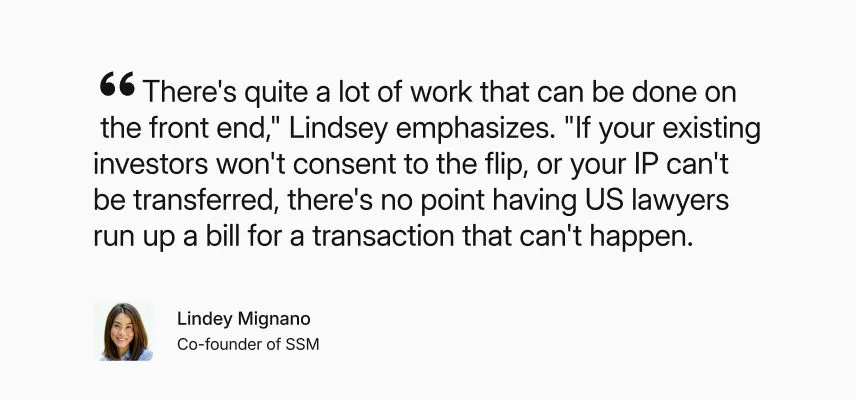
If you're planning a Delaware flip, talk to your abroad lawyer and international CPA before engaging US counsel. This seems counterintuitive, but too many issues can block a flip that your abroad advisors might identify.
Here's the recommended sequence for founders planning to flip:
- Talk with your lawyer in your home country about existing agreements, shareholder restrictions, local law implications
- Engage an international CPA firm for IP valuation and transfer pricing cost estimates
- Get a clear picture of total costs (abroad legal + US legal + CPA)
- Identify any deal-blockers (investor restrictions, IP transfer issues, consent requirements)
- Only then engage US counsel for flip documentation
Hiring and employment law
US employment law creates compliance complexity that foreign founders consistently underestimate. When you hire a remote US employee, the law of the state where they live and work governs the relationship, not where your headquarters is.

Employment law varies dramatically across the 50 states. The specific state law determines:
- Minimum wage requirements (both state and sometimes local)
- Independent contractor vs. employee classification (with very different rules across states)
- Wage and hour regulations (overtime, meal breaks, final paycheck timing)
- Officer and director personal liability (in some states, company officers can be held personally liable for violations)

What you should do
When you're hiring remote employees in the US, research the specific state's requirements for:
- Wage and hour compliance
- Classification rules (employee vs. contractor)
- Personal liability exposure for founders and officers
- Administrative compliance burden
In most states, classifying someone as an independent contractor is extremely difficult. Assume they need employee classification with full payroll tax and compliance obligations.
Multi-state compliance
The US doesn't have unified national business registration. Each state has different requirements, deadlines, and fees. On top of that, many cities and counties impose their own licensing and taxes.
"Let's say you're a Delaware C-Corp subsidiary, but your office is in the Embarcadero Center of San Francisco," Lindsey explains. "You have to register that company to do business with the California Secretary of State because your office is there. And in the city and county of San Francisco, you also have to register for a business license. So it's a state, a city, and a county."
The layers of compliance:
- State Secretary of State registration: Required in any state where you have physical presence (office, warehouse) or employees conducting work
- State franchise tax: Most states impose annual franchise taxes or fees. Delaware charges $300 annually for the parent entity; California charges $800 minimum even if you make $0 in revenue
- City and county business licenses: Depending on location, you may need licenses at the city level, county level, or both
- Revenue-based fees: Some jurisdictions tie business license fees to your local revenue, which means tracking and allocating revenue by location
The burden compounds as you grow. Five states with employees means five Secretary of State registrations, five franchise tax filings, and multiple city/county licenses.
What founders typically miss
Many founders skip registration in states with minimal presence. "Some foreign clients will be like, 'I'm just not gonna register,'" Lindsey notes. "In some states, there are no penalties, but in other states, there can be penalties for late registration."
Another common pitfall is relying on firms back home for accounting and bookkeeping that may not fully understand state-level registration requirements.

There's a distinction between tax nexus (which determines whether you owe state taxes based on economic activity) and corporate registration requirements (which can be triggered simply by having employees or an office in the state, regardless of revenue).
Fundraising

Capital is concentrating into fewer companies. When startups do get funded, the valuations look extraordinary. But the odds of being one of them have gotten higher. Investors are more sophisticated and selective than ever, even in hot categories like AI.
What international founders should do
Lindsey's advice is to follow the data and understand the market you're entering. For foreign founders, this means:
- Legal structure must be pristine — No messy cap tables, unclear IP ownership, or non-standard entity structures
- Understand what's standard — Delaware C-Corp, NVCA financing documents, standard vesting are table stakes
- The flip cost is the cost of competing — It's expensive, but it's what the market expects
- Time your entry strategically — Build traction and prove you can win US customers before raising
Your next steps before building in the US
US expansion is complex, but the pattern among successful founders is consistent: they plan ahead, ask the right questions, and build foundations that support their long-term vision.
A few principles to carry forward:
- Legal structure is competitive positioning. When US VCs evaluate your company, they're comparing you to local startups with clean Delaware C-Corps and standard financing documents. Your structure either puts you on equal footing or creates friction.
- Managing state compliance is an administrative challenge. You're navigating 50 state systems with different rules and penalties. Plan for the burden, understand where compliance is non-negotiable, and make conscious choices about risk.
- Employment law creates personal liability. Particularly in California, officers can be held personally liable for wage violations. Know what you're taking on before hiring in strict employment law states.
- The market has changed. Fewer deals, higher valuations, intense competition, and investor selectivity define 2025. Don't assume 2021 playbooks work today. Follow the data and be realistic about investor expectations.
- Start with your abroad lawyer if planning to flip. Issues that can block flips such as shareholder restrictions, IP transfer limitations, consent requirements, are things only your home-country advisors can identify. Get clarity on feasibility and costs before engaging US counsel.
Invest the time to get your foundations right, engage experienced counsel who understand cross-border complexity, and build with your long-term vision in mind.
Once you're ready to move from legal setup to operational execution, partners like Aspire help international founders manage US banking, cross-border payments, multi-entity treasury, and the financial infrastructure that turns legal entities into operating businesses.
About this series
This article is part of Aspire's Webinar Series focused on helping non-US founders plan and execute successful US market entry. The series brings together legal experts, financial advisors, tax specialists, and operational leaders to provide practical, founder-first guidance on the decisions that matter most during international expansion.

The information provided is for educational purposes and does not constitute legal advice for your specific situation. Consult qualified legal counsel for advice tailored to your circumstances.


.webp)