


Revolut vs Airwallex: At a glance
[Table:1]
Note: Yields are variable and depend on your subscription plan. Interest rates, eligibility, and availability may change over time and vary by market.
What is Revolut Business
Revolut Business is a digital business financial platform, combining business accounts, international payments, multi-currency balances, corporate cards, expenditure management, and payment acceptance all in one. You can exchange more than 30 currencies, make international transactions, issue virtual and physical cards, integrate accounting software, and automate workflows with its Business API.
Pros
- Includes integrated expense management, bill payments, payment acceptance, and accounting connections to help eliminate the need for many separate solutions.
- It offers Business APIs to assist companies in automating payments, reconciliation, currency conversion, and other finance activities.
- In-app customer assistance is provided 24/7, with better support options included in the higher subscription levels.
Cons
- Several advanced features, including higher transfer allowances, expanded expense controls, and additional automation, are tied to higher-priced plans, which can increase costs as businesses scale.
- International transfer fees and FX conversion benefits vary by subscription plan. If your business handles frequent cross-border payments, focus on the total cost of ownership rather than the monthly subscription fee alone.
- Feature availability depends on the country; therefore, if your business operates in more than one country, make sure to check that your required services are supported in each market.
What is Airwallex
Airwallex is a global financial platform that was founded in Australia to enable businesses to handle cross-border finance from one place. It combines Global Accounts, cross-border payments, multi-currency wallets, company cards, online payment acceptance, and embedded finance tools to enable enterprises that operate across markets.
Pros
- Global Accounts provides you with local bank details in more than 20 currencies, allowing you to collect payments in local markets without opening separate offshore bank accounts.
- Offers international transfers to more than 120 countries via local payment rails, helping to minimise the dependency on standard SWIFT transfers when local rails are available.
- Business accounts, multi-currency cards, expense management, bill payments, payment acceptance, and accounting connectors, all in one place.
- It offers APIs for payments, foreign exchange, accounts, cards, and embedded finance. This is ideal for enterprises wanting to automate financial activities or build custom connections.
- Includes sophisticated spend controls, approval flows, automatic receipt extraction, and reimbursement administration for qualified plans.
Cons
- Features like expense management, bill pay, and complex approval workflows are only available on higher-tier plans in finance management.
- Businesses that mostly operate domestically and infrequently make international payments may not require all the cross-border features offered on the platform. Therefore, it is crucial to determine if the added functionality is something that you need in your operations.
- Availability of some services may vary depending on where your business is registered, and not all products are available in all areas.
Pricing comparison: What will your business actually pay
Pricing plays a key role in deciding between Airwallex vs Revolut. The monthly subscription plans contribute the most to the overall pricing. Foreign exchange, international transfers, payment processing, and plan limits often have a bigger impact on your total cost than the subscription itself.
[Table:2]
Monthly plans
Revolut Business has a lower entry price, while Airwallex's higher-tier plans include broader finance capabilities such as expense management and workflow automation. Compare plans based on your expected transaction volume rather than the subscription fee alone.
Foreign exchange costs
Foreign exchange can become one of the highest operating costs for businesses that regularly move money internationally. Airwallex uses a transparent markup above the interbank rate, while Revolut Business includes interbank pricing within plan allowances before additional fees apply.
Transfer fees
Both platforms support international transfers but use different pricing models. Airwallex relies on local payment rails where available, with SWIFT transfers supported when needed. Revolut Business includes transfer allowances within its plans, with fees applying once those limits are exceeded.
Payment acceptance fees
If you accept customer payments online, compare more than the headline processing rate. Consider card type, settlement currency, alternative payment methods, refunds, and chargeback fees to understand your actual payment costs.
Airwallex vs Revolut feature comparison: How it impacts day-to-day finance operations
Both platforms offer similar core capabilities, but they take different approaches to managing international payments, spending, and finance operations. When comparing Airwallex vs Revolut, the right choice depends less on the number of features and more on how those features support your day-to-day business operations.
[Table:3]
International payments: Airwallex vs Revolut
For businesses paying overseas suppliers, contractors, or employees, the payment network is just as important as the transfer cost. In comparing Airwallex vs Revolut, both offer international payments but differ in the way that payments are handled, priced, and managed.
[Table:4]
Airwallex
Airwallex routes payments through local payment rails where available, helping businesses reduce transfer costs and improve settlement speed compared with traditional cross-border transfers. If local rails aren't available, payments are processed through the SWIFT network, allowing businesses to send funds to more than 200 countries and regions.
Revolut Business
Revolut Business supports international transfers through its multi-currency business account. Paid plans include transfer allowances, with additional fees applying after plan limits are exceeded or for certain transfer types. Transfer speed and availability vary based on the destination, currency, and payment method.
Corporate cards and business spending: Airwallex vs Revolut
Both solutions provide physical and virtual corporate cards with spend controls, letting companies manage staff purchases, subscriptions, and supplier payments. The distinction is in the way each platform enables expenditure management and finance workflows.
[Table:5]
Airwallex
Airwallex offers separate Company Cards and Employee Cards, allowing businesses to manage shared company spending and individual employee expenses differently. Finance teams can issue cards instantly, apply spend limits and merchant controls, and connect card spending with approvals, reimbursements, and accounting workflows.
Revolut Business
Revolut Business provides physical and virtual cards with granular spending controls. Businesses can configure limits by merchant, category, currency, country, and spending period, while receipt capture and expense policies help simplify expense management for distributed teams.
Specialised capabilities
Besides daily finance activities, both systems provide capabilities for specialised business types. The value of these capabilities relies on how your organisation accepts payments, manages teams, and supports international expansion.
[Table:6]
Airwallex
Airwallex is built for enterprises that manage international payments. It also has multi-currency accounts and global transfers, plus e-commerce connectors with Shopify, WooCommerce, and Magento, subscription payments, and online payment acceptance. These capabilities can allow organisations to streamline the collection of payments and settlements across multiple marketplaces.
Revolut Business
Revolut Business provides more than international payments with solutions to manage teams and corporate expenditure. Businesses can create roles, issue company cards, and control spending all from one platform. It also has in-person payment acceptance, including Tap to Pay on iPhone, in supported markets, making it a good fit for enterprises that sell online and in person.
Questions to ask before making your decision
Before you make up your mind on Airwallex vs Revolut, think about how your business accepts payments, spends money, and supports international expansion.
Where do your customers pay you from?
If you’re selling overseas, seek out local account details, multi-currency balances, and local payment options to ease collections and save FX costs.
Where are your suppliers located?
If you’re making frequent foreign payments, transfer costs, payment networks, and settlement periods matter more than the monthly plan price.
Which currencies do you work with?
Select a platform that enables you to collect, hold, and pay in the currencies your business uses most often to avoid wasteful conversions.
How often do you make international payments?
Regular cross-border payments might turn FX markups and transfer costs into a higher cost than your subscription.
How do you manage employee spending?
If your team uses company cards, evaluate the spend controls, approvals, and expense management tools.
Does it integrate with your accounting software?
Native interfaces with programs such as Xero or QuickBooks help cut down on manual reconciliation and save time.
Will it support your growth?
Think of the platform’s ability to support more markets, additional payments, more users, and the requirement for automation.
What's the total cost of ownership?
Look past the monthly charge. Compare FX mark-ups, transfer fees, payment processing expenses, card fees, and any premium feature prices.
Aspire: An alternative for modern finance operations
Running a business involves more than just making international payments. As your business grows, so does the finance work that comes with it. Company cards need to be managed, expenses need to be approved, suppliers need to be paid, invoices need to be created, and transactions need to be reconciled. When these routines span various systems, they can hold your team down and reduce visibility into business costs.
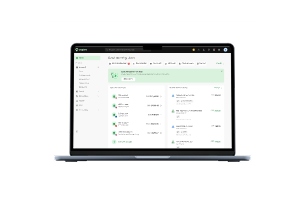
Aspire puts these finance operations into a single platform. It features corporate cards, cost management, invoice management, approval workflows, and accounting connections with Xero and QuickBooks, as well as multi-currency company accounts and overseas payments. Aspire helps businesses streamline their day-to-day finance processes, support long-term growth by minimising manual reconciliation, and give finance teams greater control over corporate spending.
Conclusion
Choosing between Airwallex vs Revolut depends on how your business now makes and receives payments and how that might alter as you scale. Airwallex is built for businesses that often send money abroad and work across many currencies. Revolut Business brings together business accounts, payments, corporate cards, and expense management in one place.
Instead of looking at monthly costs or feature lists in isolation, consider how each platform supports your payment flows, financial operations, and long-term growth. Aspire is another option to consider if your company wants a more connected way to manage accounts, spending, payments, and finance workflows for modern finance operations.
FAQs
Is Airwallex or Revolut better for Australian businesses?
It depends on your business needs. Airwallex is designed for businesses managing frequent international payments and multi-currency operations, while Revolut Business suits businesses looking for a digital business account with integrated payments, corporate cards, and expense management.
Which platform offers lower FX conversion costs?
The answer depends on your transaction volume and currencies. Airwallex applies a transparent markup above the interbank rate, while Revolut Business offers interbank exchange rates within plan allowances before additional fees apply. Compare your expected FX volumes to estimate the total cost.
Which platform is better for international payments?
Both platforms support international payments, but they take different approaches. Airwallex uses local payment rails where available alongside SWIFT transfers, while Revolut Business includes international transfers within plan allowances, with additional fees applying after plan limits are reached.
Do Airwallex and Revolut offer business accounts in Australia?
Yes. Both Airwallex and Revolut Business offer business accounts for Australian businesses. However, eligibility, available features, and supported services may vary depending on your business type and subscription plan.
Can I switch from Airwallex to Revolut Business or vice versa?
Yes. Businesses can switch platforms if their financial requirements change. Before migrating, compare payment capabilities, multi-currency support, integrations, corporate cards, historical transaction data, and any migration or account closure requirements.
Are Airwallex and Revolut the only options for Australian businesses?
No. Australian businesses can also consider platforms such as Aspire and traditional business banking providers, depending on their finance requirements. If you need a platform that combines business accounts, international payments, corporate cards, expense management, invoice payments, and accounting automation, Aspire is another option worth considering.



















.jpeg)

































.jpeg)





.jpeg)


.jpeg)