

What is a business merchant account
Whether you’re a retailer, an online store, a SaaS company, a freelancer, or a restaurant owner, you may need a way to accept card payments from customers. This can be done through a dedicated business merchant account. A business merchant account temporarily holds funds from customers’ card payments before the money is transferred to your business account. Unlike a regular business bank account, this one is specifically designed to process debit and credit card payments.
A business merchant account is essential, especially for online and e-commerce companies. However, businesses don’t always need to open a dedicated merchant account themselves. Many small businesses accept card payments through a payment service provider (PSP) or payment facilitator that provides this infrastructure on their behalf.
How a business merchant account actually works
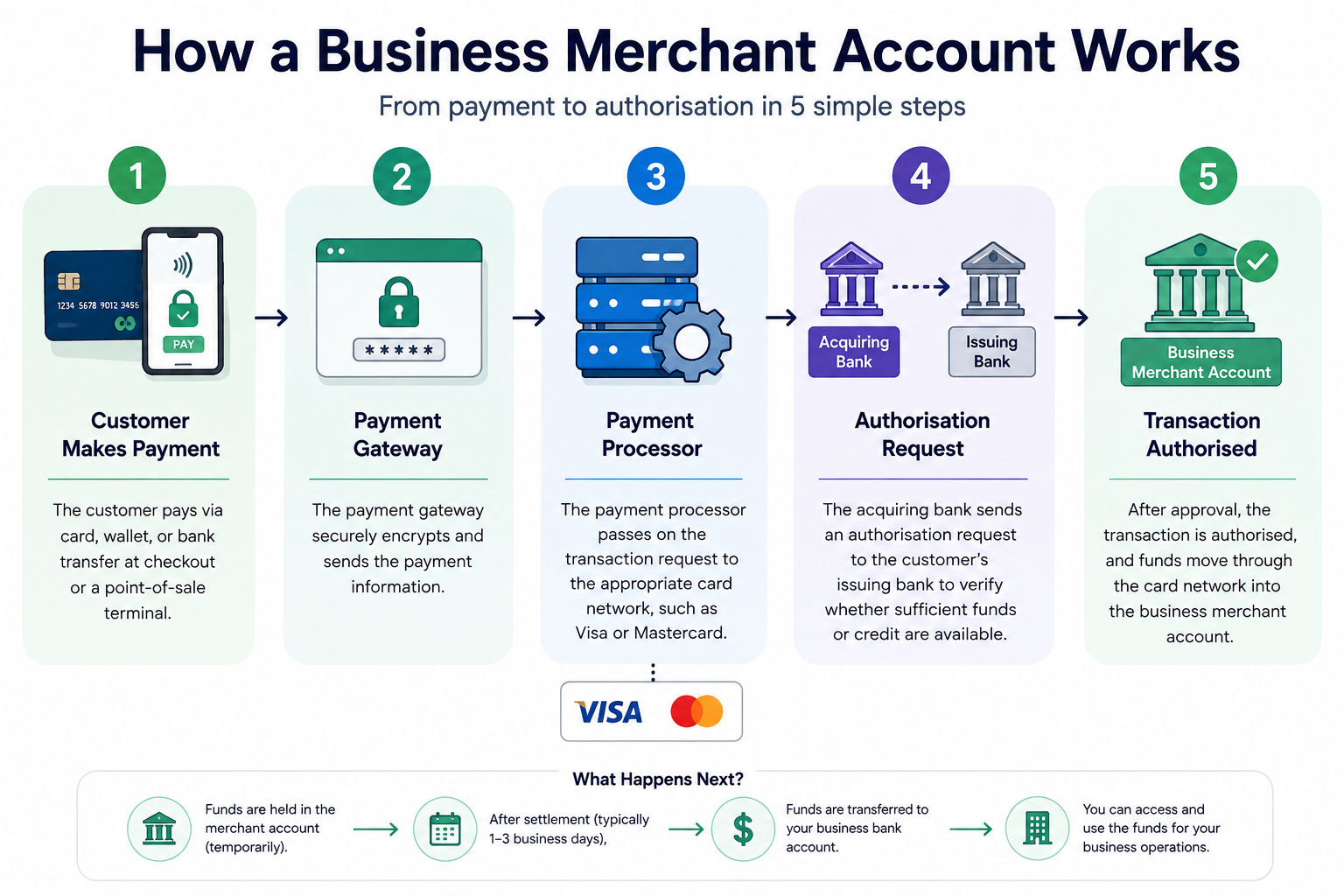
Even though a card payment takes just a few seconds, the settlement may take longer depending on your payment provider. It passes through several parties before the final settlement. Here’s how the whole process works:
1. Customer makes a payment: The customer pays by credit or debit card, digital wallet, or through an online checkout.
2. Payment details are captured: A payment gateway or point-of-sale terminal securely captures the payment details and sends them for processing.
3. Transaction is authorised: The payment processor routes the transaction through the relevant card network to the customer's issuing bank and the merchant's acquiring bank. The banks and card networks check the transaction and authorise or decline it.
4. Funds are held: Once approved, the funds are held in the business merchant account or the payment provider's settlement account, depending on the payment setup.
5. Funds are settled: After accounting for applicable fees, refunds, reserves, and chargebacks, the provider settles the funds and transfers the available amount to the business bank account according to its settlement schedule.
Business merchant account vs business bank account
Although the two accounts work together, they serve different purposes. Where a business merchant account temporarily holds customer card payments, a business bank account stores and manages its funds for daily operations. The table below lays out the key differences between the two accounts.
[Table:1]
Note: You generally need a business bank account before a provider even opens a merchant account for you, since payouts need somewhere to land. Also, settlement for a business merchant account depends on the provider, card type, industry, risk, and payout schedule.
Payment gateway vs merchant account vs payment processor
A payment gateway, payment processor, and business merchant account each play a different role in accepting card payments. The gateway securely captures and transmits payment details, the processor routes the transaction between the relevant financial institutions and card networks, and the merchant account receives and temporarily holds the funds before settlement.
[Table:2]
Dedicated merchant account vs payment facilitator
A business merchant account and a payment facilitator (PayFac) both enable businesses to accept card payments. However, their setup is different. With a dedicated merchant account, the business has its own account relationship with an acquiring bank or provider. A payment facilitator enables businesses to onboard under the facilitator's master merchant arrangement, which can make setup faster and simpler.
[Table:3]
How to get a merchant account for online business
You will need to follow the steps below when opening a business merchant account.
- Decide on your setup: Whether you want a dedicated account through an acquiring bank or a bundled account via a payment service provider that includes the merchant account, gateway, and processing in one
- Compare providers: Do a comparison of the transaction rates, payout speed, fraud tools, and whether the provider supports your business model
- Gather documentation: Next, you’ll need to provide documents such as your Australian Business Number (ABN), business registration details, business bank account information, proof of identity for directors or business owners, and details about your business model and expected transaction volume.
- Submit application: The provider does an underwriting process to assess risk, projected sales volume, and industry type
- Integrate and go live: Lastly, you connect your merchant account to your point-of-sale system, e-commerce platform, or invoicing tools, and start accepting payments
How much does a business merchant account cost
When setting up a business merchant account, you may be charged several fees, depending on your provider.
- Setup fee: A one-time charge to open the account ranges from AUD $0 to AUD $200.
- Monthly or annual fee: It varies from AUD $20 to AUD $50 per month, or AUD $100–AUD $500 per year, depending on the provider.
- Transaction/processing fee: It typically costs 1.5%–3.5% of each sale, plus a small flat fee. Online gateway pricing often averages around 2.9% + AUD $0.30 per transaction.
- Batch fee: A small per-batch charge is around AUD $0.10–AUD $0.30 for bundling a day's transactions for processing.
- Chargeback fee: This usually costs AUD $15–AUD $50 per disputed transaction, on top of the lost sale itself.
- Early termination fee: This is between AUD $250 to AUD $500 if you close the account before your contract term ends.
Note: The exact numbers depend on your industry, transaction volume, and risk category. If you wish to reduce your overall cost, then we suggest consolidating your business merchant account, payment processor, and processing under one provider instead of leveraging several vendors.
Chargebacks: The cost most businesses underestimate
This happens when a customer disputes a card transaction, and their bank reverses it. It is one of the most expensive parts of running a business merchant account.
- For Australian businesses, the cost of accepting card payments can vary significantly depending on the business size, payment method, and provider. According to the Reserve Bank of Australia (RBA), small businesses processing less than AUD $1 million in annual card transactions typically face card payment processing costs of around 0.85%–2% for debit and EFTPOS transactions and 1%–2% for credit card transactions.
- For businesses considering surcharging customers to recover card payment costs, Australian rules also apply. The ACCC states that businesses can currently charge a card surcharge, but it generally cannot exceed the business's cost of accepting that payment type. These rules are set to change from 1 October 2026, when surcharging on designated Visa, Mastercard and eftpos payments is scheduled to end.
Chargebacks usually happen because of fraudulent transactions, duplicate charges, products not received, customer dissatisfaction, and billing errors. To avoid chargebacks, it’s essential for businesses to have fraud tooling, clear billing descriptors, and responsive customer support.
How to choose the best business merchant account for small business
When choosing providers to open a business merchant account, ensure to look at:
- Total cost, not headline rate: Add up processing fees, monthly minimums, gateway costs, and chargeback fees to see the actual cost per transaction.
- Settlement speed: Faster payouts directly improve your cash flow. Few providers take up to five business days to settle the amount, while some offer next-day or instant payouts.
- Fraud and compliance tools: Ensure that the provider offers PCI DSS compliance, 3D Secure, and built-in dispute management as a standard, and not a paid add-on.
- Multi-currency and cross-border support: If your business has international customers paying in different currencies, then you need a business merchant account provider that provides competitive foreign exchange rates.
- Integration and operational fit: See if your business merchant account plugs seamlessly with your e-commerce platform, POS system, invoicing, and accounting stack.
- Support for your industry: Some sectors, such as travel, subscriptions, and high-ticket goods, are classified as higher-risk and face scrutiny. So, ensure that your provider supports your business model instead of treating you as an edge case.
- Surcharging compliance: If you pass card acceptance costs on to customers through surcharges, make sure your surcharge complies with Australian rules. The ACCC states that businesses must not exceed excessive card surcharges, while the RBA's standards determine which costs can be included when calculating the permitted surcharge.
Where Aspire goes beyond a standard business merchant account
A business merchant account is just a part of managing business finances. Along with it, organisations also need to handle payments, expenses, cash flow, and international operations. This is where Aspire fits in. It complements your existing payment setup. Instead of replacing your merchant acquiring facility, Aspire provides financial tools you need to manage your business funds after settlement. With multi-currency business accounts, international transfers, corporate cards, and expense management tools, Aspire helps businesses manage the financial operations that sit alongside payment acceptance.
In other words, your business merchant account helps you get paid, while Aspire can help you manage and move those funds once they're available to your business.
FAQs
1. What is the best merchant account for small businesses?
The best merchant account for small business depends on your business model, transaction volume, and payment needs. Instead of focusing only on processing fees, compare providers based on settlement speed, pricing visibility, supported payment methods, fraud protection, ease of integration, and the ability to scale as your business grows. If you sell internationally, it's also worth considering features like multi-currency support and competitive foreign exchange rates.
2. What's the difference between a payment aggregator and a merchant account?
A payment aggregator lets multiple businesses accept payments through a shared merchant account, making setup faster and simpler. A business merchant account is dedicated to a single business, offering greater control, scalability, and customisation as your payment volumes grow.
3. Do Australian businesses need a merchant account to accept credit card payments?
Not necessarily. Australian businesses can accept credit card payments through a payment service provider (PSP) or payment facilitator that manages the merchant account infrastructure on their behalf. A dedicated business merchant account may be worth considering for businesses with higher transaction volumes, more complex payment needs, or greater control requirements.
4. How long does it take to get a merchant account approved?
Approval times vary by provider and your business profile. Some payment service providers can approve applications within minutes, while a dedicated business merchant account may take anywhere from one to five business days, depending on the underwriting and verification process.
5. What's a high-risk merchant account?
It's a merchant account designed for industries like travel, subscriptions, gaming that face higher chargeback rates or regulatory complexity. These accounts typically carry higher fees to offset the additional risk.
6. What is the difference between a payment gateway and a merchant account?
A payment gateway securely captures and transmits a customer's payment details for authorisation, while a business merchant account is used to receive and temporarily hold card payment funds before settlement. In simple terms, the gateway handles the payment information, while the merchant account handles the funds.
7. What fees can Australian merchants surcharge?
Australian merchants can surcharge customers for eligible card payments, but the surcharge generally cannot exceed the merchant’s cost of accepting that payment type. The ACCC and RBA provide guidance on excessive surcharges and which costs can be included.
8. How long do merchant account payouts take in Australia?
Merchant account payouts in Australia typically take 1–3 business days, but the exact timing depends on the payment provider, transaction type, and risk checks. Some providers may offer faster or same-day payouts, while weekends, public holidays, holds, and additional verification can cause delays.
9. Can a merchant account accept digital wallet payments?
Yes, a business merchant account can support digital wallet payments such as Apple Pay and Google Pay when the payment provider and processing setup support them. The wallet transaction is processed through the relevant payment network and settled alongside other eligible payments.


















.jpeg)




























.jpeg)



.jpeg)

.jpeg)