


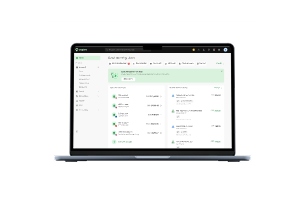
Zeller vs Square at a glance
[Table:1]
What is Zeller
Zeller is built for businesses that want to simplify their payments and manage their expenses. Instead of using separate providers for EFTPOS, business banking, and merchant services, Zeller brings them all together to one platform. It allows you to settle your card payments directly in your Zeller Transaction Account. This gives you faster access to your revenue without relying on a third-party bank account.
Who should choose Zeller
Zeller is the best choice for you if you:
- Process a high volume of in-person card payments and want to keep the transaction costs low
- Already use accounting for POS software you’re happy with and simply need a payment provider that integrates with it
- Want same-day settlement into business transaction account instead of waiting for funds to reach another bank
What is Square
If you are looking for a platform that offers more than an EFTPOS terminal, Square is the right choice for you. Square is designed to become your business operating system, which combines your payment processing with POS software, inventory management, online selling, staff management, appointments, invoices, and customer insights. All in one ecosystem. Instead of wasting your time integrating multiple business tools, Square lets you run many day-to-day business operations from a single platform.
Who should choose Square
Square might be the best fit for you if:
- Want one platform for payments, POS, inventory, ecommerce, and customer management
- Open a new retail, hospitality, or service business with no existing business software
- Sell both online and in-store and want all your sales data in one place
- Value convenience over having a lower transaction fee
How do Zeller and Square compare on fees and pricing
As you choose between Zeller vs Square, transaction fees have a larger impact on your overall costs than the price of the EFTPOS terminal.
Zeller Vs Square pricing at a glance
[Table:2]
What are the extra costs with Zeller
With Zeller, many core products are free to use, including Transaction Account, Business Debit Card, and account setup. Beyond payment processing, nothing carries a monthly fee. The main additional costs you might have to bear arise if you choose premium services, such as Corporate Cards for employees, or use payment methods with different processing rates. This includes online payments or invoices. One suggestion here would be to check the pricing for the payment channels your business relies on before comparing Zeller vs Square.
What are the extra costs with Square
Extra costs are primarily software-driven rather than banking-related. The core payment account is free, but your monthly costs can increase if you add premium POS software for restaurants, retail, appointments, payroll, or team management. This offers more functionality as you expand your business beyond borders. The total cost depends on the features you need and not just the transaction fees.
Which provider offers better EFTPOS hardware in Square vs Zeller
Your Electronic Funds Transfer at Point of Sale Terminal, or EFTPOS terminal, is the device businesses use to accept in-person card and digital payments. It helps you securely transfer funds from a customer’s bank account or card issuer to your business during a sale. Most terminals offer more than just payment acceptance. They connect with POS software, inventory, and reporting, and run on PCI DSS-compliant hardware so card data is handled securely by default.
How does Zeller approach EFTPOS
Zeller treats the terminal as one piece of a broader banking platform. Terminals start at AUD $99, run on either WiFi or a SIM card, are useful for market stalls, tradies, and anywhere WiFi isn't guaranteed, and connect directly to a free Zeller Transaction Account, so a sale on the counter is available to spend from the same day. Split payments, tipping, and customisable receipts come standard, without needing a higher-tier plan.
Zeller fits businesses that want:
- Portable hardware with Wi-Fi and 4G connectivity
- Integrated business banking and payment acceptance
- A lower flat transaction rate over deeper built-in software functionality
- Integrations with existing third-party POS and accounting systems
How Square approaches EFTPOS
Square treats EFTPOS as an entry point to the larger commerce platform. Hardware starts at AUD $65, and connects natively to Square’s own POS, inventory, customer profiles, staff management, and online store. All of this is accessible with one login. It's the perfect fit for businesses that want the terminal and software to be in the same place and not something you keep syncing.
Square is the best fit for businesses that want:
- One platform for managing in-store and online sales
- Built-in inventory, customer, and staff management
- Lower-cost entry-level hardware
- A scalable setup for multiple locations and sales channels
POS system in Zeller vs Square and what you get beyond the terminal
An EFTPOS terminal is one part, but the software behind running your business often shapes your day-to-day progress more than the hardware does. This is where Zeller and Square really diverge. While Square works as your complete commerce platform, Zeller works more as your payments layer built to plug into the tools you already use.
Square gives you a complete POS ecosystem
Square has built software for specific industries. It offers tools to run a retail shop, cafe, salon, or professional service business. You will find a purpose-built POS with:
- Inventory management
- Customer profiles and loyalty programs
- Staff scheduling and permissions
- Sales reporting
- Online ordering
- Appointment bookings
- E-commerce integrations
- Built-in invoicing
You can work with everything inside a single ecosystem. This cuts down the time you would waste on stitching different software together, especially in your initial few years.
Zeller gives you flexibility
Zeller takes a different approach and integrates more than 600 third-party POS systems instead of replacing the POS software. This becomes important once you have invested in specialist software for:
- Hospitality
- Retail
- Healthcare
- Professional services
- Franchise operations
Zeller offers the flexibility, as you can fit right into your existing system that you already run instead of asking you to rebuild around it.
Which POS system is right for you between Square vs Zeller
The choice depends on your requirements. If you want one platform to run your entire business, Square is the stronger choice. If you have your own finance and tech stack, Zeller gives you room as it adapts to your existing tools without locking you into a single ecosystem.
Zeller vs Square: which platform offers same-day settlement
Getting paid and having access to that money aren’t the same thing at all. Settlement speed directly impacts your cash flow, especially when you are paying suppliers, ordering stock, or running payroll.
Zeller’s settlement process
Zeller settles into your Zeller Transaction Account the same day, 7 days a week. Sales made during the day are available to spend sooner, with no waiting on traditional banking cut-off times. Transfer funds to an external bank account instead, and settlement takes until the next business day. When you regularly reinvest your revenue, quicker access can help you manage cash flow easily.
Square’s settlement process
Square settles on the next business day as standard. Need funds sooner? Instant Transfers gets them to you for an extra fee. That option helps when cash flow gets tight occasionally. Faster access comes at an extra cost, so it's worth weighing against how often you'd actually use it.
If you are okay with predictable access to your daily revenue with no extra fees, Zeller is the best option for you, but if you are fine with next-business-day payouts and only need instant access now and then, then Square’s payout options cover you.
Does the card surcharge ban from October 2026 change your Zeller vs Square decision
For years, you could offset payment processing costs by adding a card surcharge at checkout. This is officially changing on 1 October 2026.
The Reserve Bank of Australia has confirmed that you won’t be able to apply any surcharges to EFTPOS, Visa, or Mastercard transactions. After 1 October 2026, payment processing costs become part of your operating expenses, and you won’t be able to transfer it to your customers.
What does this mean for founders
The transaction fee doesn't disappear. You still pay it. The difference is you recover that cost through your pricing, not a separate line item at checkout. That makes your payment provider's fee structure matter more than it used to. On AUD $25,000 in monthly card turnover, the gap between a 1.4% and a 1.6% rate is around AUD $50 a month, and you're now absorbing all of it yourself.
So Zeller vs Square, which should you choose
After comparing all the factors above such as hardware, software, settlement, and support, there’s no universal winner. Each platform serves a different purpose and type of business:
You can choose Zeller if:
- Your business processes high volumes of in-person card payments
- You want lower long-term transaction costs
- You value same-day settlement into an integrated business account
- You already use specialist POS software
- You need mobile connectivity and related features for markets, pop-ups, or field work
- You prefer an Australian-built payments platform
Choose Square if:
- You want one platform for payments, POS, ecommerce, and operations
- You're opening a retail or hospitality business from scratch
- You need advanced inventory, customer, or staff management
- You sell across physical and online channels
- You want a wider choice of hardware
- You're happy paying slightly higher processing fees for a more complete software ecosystem
Zeller and Square solve the same problem in different ways. Zeller keeps the terminal simple and pulls your business account in close, so you get a lower ongoing rate and same-day settlement without stitching providers together. Square pulls the software in close instead, giving you inventory, staff, and online sales in one login, at a slightly higher rate.
Neither is the wrong choice. The right one depends on what you're actually running: a lean, high-volume payments setup, or a full commerce platform that grows with you.
Whichever you pick, the terminal only covers one part of the job. What happens to that money next, how you separate it from personal funds, issue cards to your team, and reconcile it against invoices and bills, is a decision worth making on its own terms.
FAQs
Does Zeller vs Square let me pass on transaction fees to customers?
While both platforms currently offer a version of this, this might end after 1 October 2026 RBA’s surcharge ban. Zeller’s zero-cost EFTPOS setting lets you pass on your full or partial transaction fee at checkout, including tap-to-pay. Square offers a similar surcharge function, currently in beta. The RBA ban stops merchants on either platform from adding a surcharge to Visa, Mastercard, or EFTPOS transactions. So this option won’t be available for too long.
Is Zeller more reliable than Square?
Zeller markets itself around uptime, positioning its payments reliability against Square's history of reported outages. Independent, verified uptime data for either platform isn't publicly published, so treat brand claims on this point with some caution and check current outage history directly with each provider before you commit.
Does Zeller integrate with Xero?
Yes. Zeller connects directly with Xero for accounting, alongside its 600+ POS integrations. Square also integrates with major accounting platforms, including Xero, through its own app marketplace.
Would either Zeller vs Square lock me into a contract?
No. Neither requires a lock-in contract or charges a monthly fee for the terminal; you buy the hardware outright and pay per transaction.
Which is better for a market stall or mobile business with unreliable WiFi?
Zeller Terminal can run on a SIM card as well as WiFi, while Square's in-person terminals rely on WiFi connectivity. If you're taking payments somewhere connectivity isn't guaranteed, that's a real point in Zeller's favour.

















.jpeg)


















.jpeg)




.jpeg)


.jpeg)