


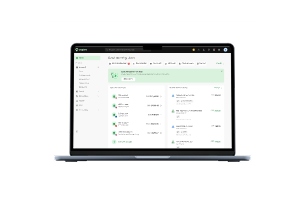
What is Stripe
Stripe is a major fintech platform that facilitates the movement of funds across e-wallets, checkout pages, in-person terminals, and more. Businesses can choose between Standard and Custom Plans. The latter offers personalisation tools to eliminate the complications that arise in APIs while merging it with your existing payment structure as you scale.
Although it is a leading choice in the market, it could lead to avoidable difficulties, including high fees, manual reconciliations, and pricing transparency issues.
Why does your team need Stripe alternatives
Parallel to growing companies, Stripe can have limitations at the level of operations and sales conversions. Consider a Stripe alternative if you aim to:
Avoid a piecemeal stack
Stripe is merely a payment gateway; not a comprehensive solution applicable at every stage. This redirects your team’s focus to compiling supporting tools and integrating subscriptions, invoicing, SaaS metrics, and taxes. Every transaction is forced under a magnifying lens in terms of product, country, and customer. Stripe can handle payments well, but businesses may still need separate tools for FX, business accounts, corporate cards, expense management, payables, and accounting reconciliation.
Reduce payment and maintenance overhead
The volume of failed payments could result in a high churn figure. This reinstates the requirement for heavy maintenance. While Stripe offers customisable plans, it complicates operational maintenance and pricing. Constant vigilance to spot these gaps is important, which can be avoided with Stripe alternatives.
Simplify tax configuration
Tax is calculated based on the customer's location, not the supplier's. Stripe Alternatives in Australia synchronise transaction data with multi-currency platforms or accounts. Automate GST categorisation and FX tracking to eliminate manual effort spent by Australian Business Number (ABN) holders. Fintech dashboards also simplify multi-currency conversion fees and configure them in the invoices.
If founders spot a high frequency of these, it may be time to upgrade to an alternative to Stripe for online payments with advanced PCI compliance and easier online integration.
Stripe pros vs cons
[Table:1]
Best 5 Stripe Alternatives Australia
[Table:2]
What fintech platforms do differently from Merchant of Record (MoR) and payment gateways is that they offer one-in-all solutions equipped to pilot multi-currency transactions. Migrating from Stripe to a finance platform that carries your business from easy payment set-up to seamless integration to the scaling phase reflects in your revenue in the long-run.
Not every Stripe alternative replaces Stripe checkout directly. Some replace one part of the payments workflow, while others support the finance operations around payments.
- GoCardless
Because GoCardless operates on bank-to-bank payments, it solves two of the major problems Stripe causes. One, it ensures that the due amount is debited from the account despite the card having expired. This relieves late payment fees. Secondly, it offers bank-level security to transactions and results in minimal payment failures. Even 70% of those are automated to recover.
Best for: SaaS subscription models.
Costs: Standard Australia domestic transactions are capped at 1.25% + AUD $0.40p, capped at AUD $5, plus 0.3% for payments above AUD $3,000. International transactions are charged 2.25% + AUD $0.40p. It is a cheaper Stripe alternative in Australia.
Pros: Eliminates payment failures, has low transaction costs, and offers recurring billing.
Cons: Long processing period, slow cash flow.
Point of comparison: Unlike Stripe, GoCardless is compatible with partner integrations and offers a well-documented API. This alternative to Stripe helps founders to localise GoCardless into their pre-existing system.
- Aspire
Aspire targets multinational currency, expense management, and tools integration in its all-in-one financial products. Instead of Stripe’s standard T+7 payout schedule, Aspire speeds it up to T+3. This Stripe alternative goes beyond exclusive digital payments to offer founders corporate cards, treasury tools, and competitive API integration. To start with, it is fairly simple, and your business can fit into its infrastructure to eliminate complexity rather than create it.
Best for: Founders and CXOs, managers, startups, SMBs.
Costs: Set up an Aspire account for free. Its fixed FX rate is 0.5% above the mid-market rates. Also, it demands zero deposit at registration.
Pros: Easy integration with Xero and QuickBooks, move funds across 30+ currencies, bulk payments, 1% cashback on FX spends.
Cons: Being an infrastructure platform, Aspire can be compatible with a separate payment gateway.
Point of comparison: Where Stripe is only a payment processor, Aspire is a comprehensive solution to globalise transactions.
- Square
SMBs choose Square for its frictionless hardware ecosystem, niche products, and POS software perks. Stripe deposits are slower to reflect than Square deposits, which are processed the following business day or the same day for a small fee. If your business has yet to compile a team of engineers, Square can be operated and integrated into your system without the pressing demand for code.
Best for: SMBs, retail units, hospitality, and in-person services.
Costs: 1.6% for card-present transactions for sellers who signed up on or after 30 May 2024, and 2.2% for manually entered payments, card-on-file recurring payments through Square invoices, virtual terminal, and online products.
Pros: No PCI compliance fee, robust cash flow, niche plans.
Cons: Limited online payment checkout alternatives, restricted developer flexibility.
Point of comparison: Customer-retention tools like gift cards, loyalty programs, and marketing innovations are offered by Square but are absent in Stripe.
- Airwallex
Leverage like-for-like settlements across 14+ currencies with Airwallex. This allows founders to cut down FX costs when conversion of funds can be avoided. Payment plugins and links, and online checkout forms ensure interruption-free reception of funds. With Airwallex, you can offer BPNL (Buy Now, Pay Later) options like Klarna and Afterpay to the global market, overcoming the Stripe limitation of domestic bandwidth.
Best for: Global e-commerce brands, scaling tech startups, multinational SMBs
Costs: 1.65% + AUD $0.30 on domestic card payments, 3.40% + AUD $0.30 for international cards, 0.5-1% FX fee above interbank rates for major currencies, and 1% for all other currencies
Pros: Free transfers within the Airwallex network, quick setup, software integration, and low currency conversion margin.
Cons: ATM withdrawals are only available to Beta customers, competitor payment method fee.
Point of comparison: Stripe requires a local bank account, whereas an Airwallex multi-currency account eliminates that pre-requisite entirely.
- Wise Business
Wise Business has a simple yet selling objective: it wants to make cross-border transactions less expensive and more favourable for business owners. Save on transfer fees with mid-exchange rates and transparent fee structure. With its wide network of local banks in over 10 countries, global currency transfers become a feasible move at baseline investments.
Best for: International freelancers, part-time professionals
Costs: Free registeration, AUD $65 setup fee, sending money starts from 0.63% with fee varying by currency, ATM withdrawals capped at AUD $400 a month, 2.69% of the amount if it exceeds the limit
Pros: Lower fees on international transactions, Payouts within 1-2 business days, midmarket exchange rate
Cons: Wise is not built for merchant card acceptance or full spend-management workflows.
Point of comparison: Stripe works best for card payments; this alternative to Stripe streamlines online international transfers with its database of major global banks.
Choosing the right Stripe alternative in Australia
Whether you’re a retail business needing a POS hardware, a SaaS company needing direct or subscription billing, an ecommerce brand needing international payment acceptance, or a growing team ready to equip finance tools, the Stripe alternative best suited for you will vary.
Aspire may be a fit when the issue is not the payment itself, but the finance workflow around payments; managing funds across currencies, paying suppliers, issuing cards, tracking expenses, and reconciling transactions. At minimal payout period, multinational currency, low conversion rates, and catering to a wide range of SaaS companies and SMBs stands Aspire. An Aspire Multi-Currency account can also be integrated with Stripe to elevate your payment performance while sustaining the infrastructure benefits Stripe provides.
Frequently Asked Questions
- How does Stripe compare to Australian platforms?
Stripe alternatives help you cross borders when it comes to the movement of funds across countries and currencies whereas Stripe is more focused on the technicalities of payment processors, whereas Stripe alternatives Australia minimize the fees, facilitate easy API, and offer loyalty schemes.
- Will I lose my customer data while migrating to a Stripe alternative?
As per Stripe’s compliance policy, the receiving destination must be a verified PCI DSS Level 1-compliant payment processor. Keep your Visa registry listing or Attestation of Compliance (AOC) ready as identity proof. Connect with their customer support for non-PCI-regulated data.
- Which alternative to Stripe has the lowest merchant fee?
Wise Business levies the lowest fee in the range of 0.3-1.5% on domestic and international transactions, second only to Aspire which lets you set up for free.
- How does Aspire integration with Stripe help businesses?
This founder-first decision helps your business by inviting faster payments, a global field of digital wallets, and bringing cashflow to a single dashboard.
- How can I avoid conversion fees with an alternative to Stripe for online payments?
Airwallex has a network of over 14 currencies, wherein you can avoid FX fees completely. Even outside the network the fee is capped at only 0.5-1% above bank rates.


















.jpeg)



































.jpeg)





.jpeg)


.jpeg)