


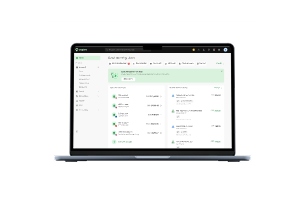
Who is Xero built for
Businesses running their own invoicing and reconciliation, without an in-house bookkeeper, tend to get on well with Xero. Here's where it fits best:
- Solo invoicing and reconciliation: the dashboard doesn't need much accounting background to navigate, and small errors surface early instead of piling up before tax time.
- Businesses using other tools: with over 1,000 app integrations, things like Stripe or a dedicated inventory tool usually just connect, rather than forcing a switch.
- Teams about to hire: payroll is built in, and setting up Single Touch Payroll takes a few steps rather than a separate module.
- Service businesses and consultants: quotes convert to invoices in one click, and clients can pay directly from the link.
Where it starts to feel like a squeeze: the entry-level plan caps invoices and bills each month, so anyone sending more than a handful of invoices a week will hit that ceiling and need to upgrade.
Who is MYOB built for
MYOB tends to suit businesses that already have some accounting knowledge on the team, or work with an accountant who's used to it. Here's where it fits best:
- Complex payroll needs: MYOB AccountRight is built for larger teams, multiple locations, or more complicated pay runs, and its payroll reporting is hard to beat.
- Product-based businesses: inventory tracking covers orders, suppliers, and stocktakes without needing a third-party add-on, which matters for retail or anything with real stock to manage.
- Businesses with an accountant already using it: a lot of Australian accountants learned on MYOB first, so collaboration tends to be smoother.
Where it starts to feel like a squeeze: the interface hasn't caught up to Xero's in terms of feel, so sole traders without bookkeeping experience often need more time to get comfortable. Third-party integrations are thinner too, a few hundred compared to Xero's four-figure app store.
Xero vs MYOB: at a glance
Xero generally costs more at the entry level but scales cleanly through app integrations, while MYOB's Lite plan is cheaper to start and includes more built into the base price. If integrations and multi-device access matter most, Xero pulls ahead; if you need strong inventory and payroll out of the box without add-ons, MYOB holds its own.
[Table:1]
Xero vs MYOB Pricing in Australia
[Table:2]
Prices above are standard rates before promotional discounts, since intro pricing reverts to full cost after 3-12 months.
Which pricing tier makes sense for you:
- Solo, no employees, simple invoicing: MYOB Solo is the cheapest entry point at $11/month, and now includes unlimited quotes and invoices, though it's still mobile-only with no payroll or desktop access.
- Solo, want quotes and desktop access: Xero Ignite covers this at AUD $37/month, but caps you at 20 invoices and 5 bills monthly.
- Small business with 1-2 employees: MYOB Business Lite offers unlimited invoicing at a lower cost than Xero Grow, if built-in inventory matters more than app integrations.
- Small business prioritising integrations: Xero Grow removes invoice caps and connects to over 1,000 apps, worth the higher cost if you're already using tools like Stripe or a CRM.
- Growing team needing detailed payroll: MYOB Business Pro or AccountRight Plus handle more complex pay runs and multiple locations better than Xero at a similar price point.
- Multi-entity or scaling fast: Xero's Ultimate tiers price by payroll headcount in clear steps (10/20/50/100), which makes budgeting for growth more predictable than MYOB's custom Premier pricing.
Xero vs MYOB: Payroll and single touch payroll
Both platforms handle Single Touch Payroll reporting to the ATO, so compliance isn't the deciding factor here. The real difference shows up in how many employees you're paying and how complex those pay runs get.
Xero payroll
- Payroll for 1 person included on the Ignite plan, useful if you're paying yourself through a company structure.
- Grow plan extends to 2 people, Comprehensive to 5, and Ultimate tiers scale by headcount (10, 20, 50, up to 100).
- Superannuation is automated on all payroll-enabled plans.
- STP reporting happens directly within the same dashboard used for invoicing and reconciliation, so there's no separate module to learn.
- Good fit if you want payroll tightly integrated with the rest of your accounting and your team is small to mid-sized.
MYOB payroll
- Business Lite and above include payroll, charged at roughly AUD $3/month per employee on top of the base plan.
- Business Pro has no hard cap on employee numbers, unlike Xero's tiered structure, so cost scales more linearly as you add staff once you're past Business Lite's 2-employee limit.
- AccountRight Plus and Premier support more advanced pay run scenarios, including multiple locations or award interpretation for complex industries.
- Solo (MYOB's sole trader app) has no payroll functionality at all.
- Best option if you're planning to grow headcount significantly and want payroll pricing that doesn't jump in large tier increases.
Inventory management for Xero and MYOB
MYOB generally handles inventory more thoroughly out of the box, while Xero leans on third-party apps to fill the gaps. If you're running a product-based business with real stock to track, that difference matters more than it looks on a feature list.
Xero inventory
- Basic tracking on all plans: covers simple stock counts and item pricing from the entry tier up.
- Full inventory from Grow up: purchase orders and stock level alerts unlock once you move past the Ignite plan.
- Relies on third-party apps: anything beyond the basics, like multi-warehouse tracking or batch and serial numbers, needs an add-on.
- Best for smaller product ranges: suits service businesses or sellers with a limited number of SKUs.
- Scales through integrations: connects well with dedicated inventory platforms once stock needs outgrow the built-in tools.
MYOB inventory
- Available from Business Lite up: more depth than Xero's equivalent tier straight out of the box.
- Native order and supplier tracking: covers stocktakes without needing a third-party add-on.
- Stocktake is Plus-only: full stocktake functionality is reserved for AccountRight Plus, not included on Business Lite or Pro.
- Built for higher stock volumes: better suited to businesses managing multiple product lines.
- Job costing on AccountRight: adds further inventory depth tied to specific jobs for more complex operations.
- Best when stock is central: a strong fit if inventory management is core to the business, not a secondary feature.
Xero vs MYOB: Integrations and third-party apps
Xero's app ecosystem is roughly three times the size of MYOB's, which matters most if your business already runs on a specific stack of tools. MYOB covers the essentials but expects you to lean more on its built-in features instead of bolting on extras.
[Table:3]
If your business already relies on tools like Stripe, a CRM, or a specific e-commerce platform, Xero is more likely to connect without extra work. If you'd rather keep everything inside one system and avoid managing multiple app subscriptions, MYOB's built-in features cover more of that ground natively.
Xero vs MYOB: GST, BAS, and ATO compliance
Both platforms support GST tracking and direct BAS lodgement with the ATO, so neither leaves you short on compliance basics. The differences come down to how automated the process feels and which plan tier you're on.
- BAS lodgement: Xero lodges directly with the ATO on every plan, while MYOB only offers direct lodgement from Business Lite up, with Solo users tracking GST but lodging separately through myGov.
- GST visibility: Xero shows running GST totals as you go, so you can check your estimated liability mid-quarter rather than waiting until it's time to lodge.
- AI-assisted BAS prep: MYOB is rolling out AI BAS, currently in beta, aimed at reducing manual effort in pulling BAS figures together.
- Accountant familiarity: Xero is the platform most Australian accounting professionals use day-to-day, which can make collaboration at tax time smoother.
- Record-keeping guidance: both platforms align with ATO requirements for GST and Single Touch Payroll record-keeping. BAS lodgement is covered too, except on MYOB Solo, which tracks GST but doesn't lodge BAS directly.
For sole traders or businesses on entry-level plans, Xero's direct lodgement across every tier is the more straightforward option; for larger teams already on MYOB's higher tiers, the compliance gap between the two narrows significantly.
Xero vs MYOB vs QuickBooks
QuickBooks shows up in a lot of Australian searches, but it's worth being upfront: it's built primarily for the US market, and payroll here runs through a separate integration (Employment Hero) rather than being built into the platform the way it is with Xero and MYOB. Here's how the three compare.
[Table:4]
- Where QuickBooks falls short for growing businesses: Simple Start locks you to a single user, so the moment you want to give a bookkeeper or business partner access, you're paying AUD $60/month for Essentials just to get to 3 users. Inventory tracking doesn't appear at all until the AUD $84/month Plus tier, well above where Xero and MYOB offer it.
- Where QuickBooks makes sense: a solo operator who only needs to send invoices, track expenses, and lodge BAS, with no plans to add staff or manage stock, gets that covered at AUD $33/month, cheaper than Xero's equivalent Ignite plan.
For most Australian businesses weighing all three, the decision still comes down to Xero or MYOB once payroll or a second user enters the picture. QuickBooks works better as a stopgap for a true one-person operation than a long-term system to grow into.
Xero and MYOB: Which one should you choose?
The right choice depends less on which platform is "better" and more on where your business sits right now, and where it's headed over the next year or two.
If you're a solo operator just starting out
- MYOB Solo is worth a look if you want the lowest cost and don't mind working entirely from your phone, especially since it comes with built-in banking through Solo Money. But if you expect to send quotes, want desktop access, or think you'll bring on an accountant soon, Xero's Ignite plan costs more but won't box you in the same way.
- Most sole traders outgrow Solo's limitations faster than they expect, particularly once they start winning bigger clients who ask for formal quotes. For a business that's likely to grow past invoicing and basic expense tracking within the year, Xero is the safer long-term pick.
If you're about to hire your first employee
- This is where Xero tends to edge ahead, since payroll and Single Touch Payroll are built into every plan from the start, including the entry tier. MYOB requires moving up to Business Lite or higher before payroll becomes available, and it's charged per employee on top of the base price.
- If your main concern is getting compliant payroll running with minimal setup, Xero's integrated approach saves time. But if you're expecting to scale headcount quickly and want payroll pricing that grows in a straight line rather than jumping between tiers, MYOB's structure can end up more predictable.
If you're running a product-based business
- MYOB has the stronger case here for most product businesses, since order management and supplier tracking are built in from Business Lite up, without needing a third-party app. Stocktakes specifically are reserved for AccountRight Plus, so businesses needing that feature will land on a higher tier. Xero covers basic inventory on its early plans, but full functionality only unlocks from Grow upward, and even then it leans on integrations to cover more complex stock needs.
- A retail business, a wholesaler, or anyone managing multiple SKUs day to day will likely find MYOB requires less patchwork to get inventory right. If stock management is central to how you operate, not a side task, MYOB deserves serious consideration over Xero.
If your business already runs on other software
- If your business already runs on Stripe, Shopify, or a CRM platform, there's a decent chance Xero already connects to it. It's built around integrations, over 1,000 of them, so you're rarely stuck building a workaround. MYOB's app library is smaller, closer to a few hundred, and it shows in how the platform's designed.
- A lot of what Xero hands off to third-party apps, MYOB just builds in. That's not automatically worse. Some businesses would rather have fewer moving parts and one system doing more of the work, instead of juggling logins and subscriptions across five different tools.
If your accountant already has a preference
- Sometimes the decision isn't really yours to make alone. Many Australian accountants and bookkeepers specialise in one platform, and working in the system they know best usually means faster support and smoother tax-time collaboration.
- Xero currently has the larger base of accounting professionals using it day to day, so if you don't already have a strong opinion, that can tip things in Xero's favour. Still, it's worth asking your accountant directly before deciding, since their comfort with the software will affect how much you end up paying for ongoing bookkeeping help either way.
What if neither Xero nor MYOB is the right fit
Xero and MYOB handle the accounting side well, but neither is built to manage how money actually moves in and out of a growing business, especially once you're paying suppliers overseas or issuing cards to a team. Aspire's Business Account gives Australian founders free local payments alongside multi-currency accounts, so holding and paying in different currencies doesn't mean juggling separate banking relationships. It's designed to sit alongside your accounting software rather than replace it, syncing cleanly with the systems you're already comparing in this guide.
Spend visibility is another area where growing teams start to feel the gap. Aspire's Corporate Cards let you issue cards on demand while earning 1% uncapped cashback on FX spend, turning international costs that would otherwise just be an expense line into savings you can put back into the business. When combined with Accounts Receivable tools that automatically create, send, and reconcile invoices, the admin side of getting paid takes up less of your week.
None of this replaces Xero or MYOB, and it isn't meant to. Aspire's accounting automation connects directly with both platforms, so whichever one you choose from this comparison, your books stay in sync without manual re-entry. If your business is scaling past domestic invoicing into multi-currency payments and team spend, that's the point worth exploring what Aspire adds alongside your existing setup.
FAQs
1. Why do accountants prefer Xero?
Xero is the platform most Australian accountants and bookkeepers use day-to-day (it holds roughly 60% of the Australian cloud accounting market), largely because of its clean interface and real-time bank reconciliation. Accountants can access a client's file directly through the accountant portal without needing files sent back and forth, which speeds up everything from monthly reviews to tax time. That familiarity also means faster troubleshooting, since most accounting professionals already know their way around it.
2. What is the best accounting software in Australia?
There's no single best option; it depends on how your business operates. Xero tends to suit businesses that want a modern interface and heavy use of third-party integrations. MYOB fits businesses that need stronger built-in payroll and inventory tools without relying on add-ons. QuickBooks can work for a true solo operator with very simple needs. The right pick comes down to your team size, industry, and how much you plan to grow in the next year.
3. What are the disadvantages of Xero?
Xero's entry-level Ignite plan caps invoicing at 20 per month and bills at 5, so businesses sending more than that will need to upgrade to Grow fairly quickly. Inventory management is also fairly basic unless you're on a higher plan or connect a third-party app. Support runs through Xero Central rather than a phone line on every standard plan, though the newer Ultra tier (aimed at larger, scaling businesses) adds priority access to Xero specialists.
4. What are the disadvantages of using MYOB?
MYOB's interface carries more of a learning curve than Xero, particularly for users without prior bookkeeping experience. Its third-party app marketplace is smaller too, sitting at a few hundred integrations compared to Xero's four-figure count, so businesses relying on specific external tools may find fewer native connections. Solo, MYOB's sole trader app, also lacks quoting and payroll entirely.
5. Is MYOB Essentials the same as Xero?
No. MYOB Essentials was MYOB's earlier cloud-based small business product, since phased out and folded into MYOB Business as of January 2026. Xero is a separate platform entirely, built by a different company, though both aim at the same small business accounting market with GST tracking, invoicing, and payroll features.


















.jpeg)


























.jpeg)




.jpeg)


.jpeg)